optimization
Beyond Market Intelligence keeps optimization in one place: 106 stories so far. The section currently leads with “Discover how intentional friction with AI sharpens your thinking”, “Meta's Custom AI Chip Targets Smarter, Faster Recommendation Models”, and “Android apps face memory limits as AI demand reshapes hardware”. We've all felt the pull toward endless AI-assisted shortcuts, but relying on them blindly can dull your edge. Meta's move to build MTIA 300, its first in-house accelerator for ranking and recommendation models, signals a deliberate step beyond compute and into networking. Acme AI is the next-generation, AI-powered spreadsheet platform built to replace Excel and redefine how analysts, data scientists, and enterprise teams work… The list below is every optimization story on Beyond Market Intelligence, newest first.
Discover how intentional friction with AI sharpens your thinking
We've all felt the pull toward endless AI-assisted shortcuts, but relying on them blindly can dull your edge. In *How I Fight AI Brain Rot*, the author pushes back with a practical tactic: friction maxxing, using Codex, Grok, and Claude not as crutches but as deliberate tools for sharper thinking. It's a refreshing, action-oriented approach that values effort over ease. If you're ready to rethink how you engage with these models, a straightforward path is available.

Meta's Custom AI Chip Targets Smarter, Faster Recommendation Models
Meta's move to build MTIA 300, its first in-house accelerator for ranking and recommendation models, signals a deliberate step beyond compute and into networking. It's a smart evolution for a company that understands how much latency shapes user experience. By owning more of the stack, Meta isn't just chasing efficiency; it's reducing dependence on off-the-shelf parts. That kind of control tends to pay off.

Android apps face memory limits as AI demand reshapes hardware
Google is drawing a line in the sand for Android memory use, and it's a direct response to the hardware squeeze AI data centers have created. Lower-cost phones are feeling the pinch first, which makes this a practical move, not a flashy one. We see this as a necessary constraint that could actually push developers toward smarter, leaner apps. It's a trade-off worth watching.
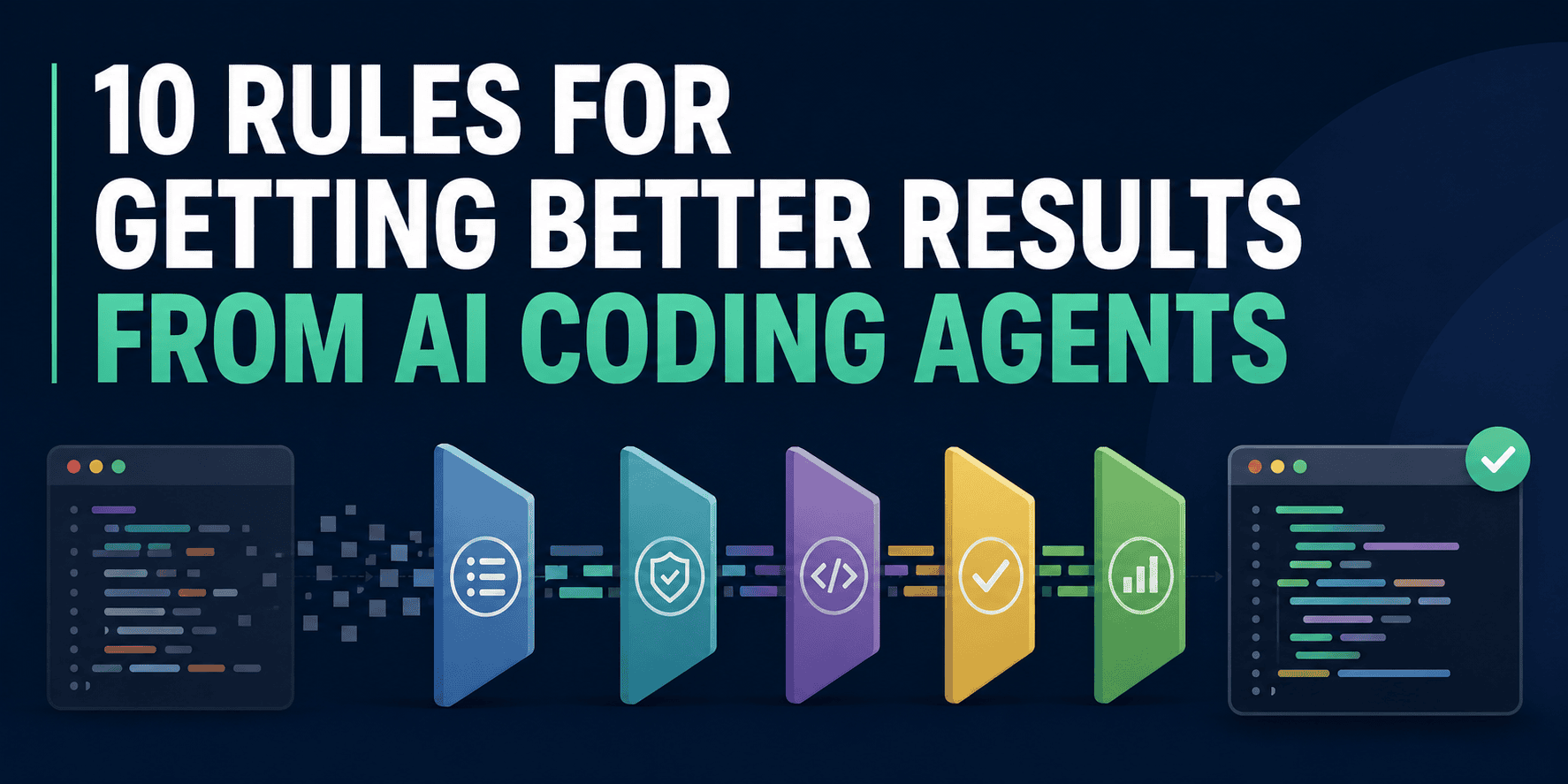
Master AI coding agents with simple rules that transform your workflow
AI coding agents are everywhere right now, but most teams are leaving results on the table. We've watched the hype cycle, and the truth is simple: the tool matters less than how you direct it. These ten rules cut through the noise, focusing on practical habits that turn a generic assistant into a reliable contributor. If you're ready to move past trial and error, start here.

The Equation That Reveals Bagging's Limits and Why Randomness Matters
Bagging has a ceiling, and no amount of trees will break it. The equation explains why random forests need that extra layer of chaos to keep improving. It's a sharp reminder that more isn't always better when the mechanism stalls. The experiment makes the point concrete, turning theory into something you can see. If distributed systems intrigue you, *Unlock LLM Training* pairs well with this mindset, though it stands firmly on its own.

Jalapeño delivers faster inference with greater energy efficiency
OpenAI's Jalapeño chip isn't just fast; it's fast where it counts. Tested on SemiAnalysis' InferenceX benchmark, it delivered more tokens per user and higher throughput per kilowatt than any currently available model. That's the kind of efficiency that turns experimental AI into practical tooling. We're eager to see how this reshapes deployment decisions, especially for teams tired of trading speed for cost. For a closer look at how AI performance impacts real-world judgment, our piece on questioning an AI clone offers a useful counterpoint.

When Milliseconds Matter: Teaching LLMs to Forget on Purpose
Most LLM runtimes treat memory as an endless resource, but this one treats it as a deadline. It refuses admission rather than miss a 33ms robot control cycle, evicting KV cache by meaning instead of age, all in hand-written CUDA. That's a sharp rebuke to the bloat most of us accept. It's a focused, practical stand for precision, and it makes you wonder what else we're letting slip.

From Infeasibility to Insight with Farkas' Lemma
Infeasibility in optimization isn't a dead end; it's a signal. Benders decomposition often stumbles when subproblems return infeasible, but Farkas' lemma turns that dead end into a roadmap. This second part shows how feasibility cuts let the algorithm learn from failure, applied concretely to the capacitated facility location problem. It's a sharp, practical read that reframes errors as data. For more on how structured thinking drives problem-solving, our related piece, "Exploring Paragraph Structure: How LLMs Navigate Token Space," offers a complementary lens.
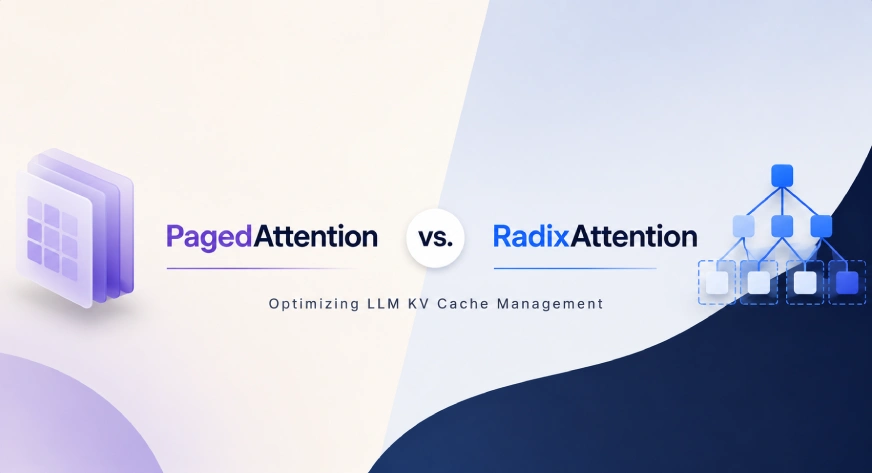
Unlocking LLM Performance Through Smarter Memory Management
KV cache memory can quietly decide whether an LLM deployment thrives or stalls. PagedAttention tackles fragmentation with smarter allocation, while RadixAttention targets prefix reuse. Both cut the GPU strain that limits concurrency and throughput. What stands out is how practical these optimizations feel. Production latency improves without demanding new hardware. For readers exploring how context shapes model behavior, our piece on agentic context learning pairs well with this discussion. It is a useful next step for understanding what makes modern LLMs efficient beyond raw architecture.

Fine-Tune Large Language Models for Real-World Results
Fine-tuning an LLM often feels like stepping into a black box, but this guide opens it up. It walks you through the entire process, from preparing data to deployment, with a clear focus on practical, real-world application. We appreciate how it cuts through the complexity, giving you a path to follow rather than abstract theory. If you are curious about the broader challenges of training these models, our related piece on distributed algorithms is a useful next step.
Empower your classroom with smarter, automated student activity grouping.
A teacher's request to automate student group assignments for a theme-week is exactly the kind of practical challenge that deserves a smart, accessible solution. You've already done the hard part by cleaning the data; the next step is letting Excel's logic handle the heavy lifting. With priorities and activity constraints in play, a simple formula won't cut it, but a structured approach using built-in tools can. If you're curious how similar optimization problems scale, our piece on the Forrester function offers a useful parallel.

Docker Rebuilds Its Desktop Foundation for a Faster Container Workflow
Docker's new virtualization layer is a smart move for developers who feel the drag of third-party components they can't tune. By rebuilding the VMM in-house for Docker Desktop 4.86, Docker takes direct control over container workloads, promising a performance boost that feels less like a patch and more like a deliberate step forward. It's available now in public beta on Mac and Windows, so you can test its edge without waiting for a formal release.

Agentic traffic demands a smarter approach to autoscaling.
Autoscaling used to follow a predictable arc: manual rules, then reactive thresholds, then predictive models. Each generation assumed traffic patterns that resemble human behavior. Autonomous agents broke that assumption. They spawn bursts of activity that don't map to any prior curve, so two decades of capacity planning logic stops holding up. We need a new mental model, one that treats agentic bursts as first-class citizens rather than anomalies. It's a sharp, practical read.

Smarter retrieval reduces inputs by 4-5x while improving chat accuracy
Automatic budget selection in chat retrieval is a puzzle many of us know well, and this user's experience at 25% accuracy is telling. They are seeing results that rival benchmarks, yet the system still grabs too much context far too often. It is smart to question whether CELF is the right tool for the job. Exploring a keyword-based trie feels like a practical step toward sharper, more intentional retrieval. This is the kind of iterative problem-solving that makes AI feel genuinely useful.

Let AI choose the right tool so you can focus on results.
Choosing an AI shouldn't feel like a research project. If you're stuck weighing options, stop overthinking and start with one clear action: define the single task you want to simplify, then test that first. The right tool reveals itself through use, not speculation. We've explored similar themes before, like in "Talking to My AI Clone Taught Me to Question the Tech," which shows why hands-on experience beats abstract debate. So pick a starting point, try it, and let the results guide your next move.
Theory guided machine learning: A practice worth rediscovering.
The gap between machine learning theory and practice has never been wider, and the confusion is understandable. Many of the field's most famous guidelines, like avoiding overfitting or trusting only certain optimizers, started as narrow mathematical results but became rigid folklore. We now know breaking these rules often works better, yet no one formally retracts the old lessons. This leaves practitioners questioning whether any theoretical guidance still holds, or if empirical trial-and-error is the only honest approach.
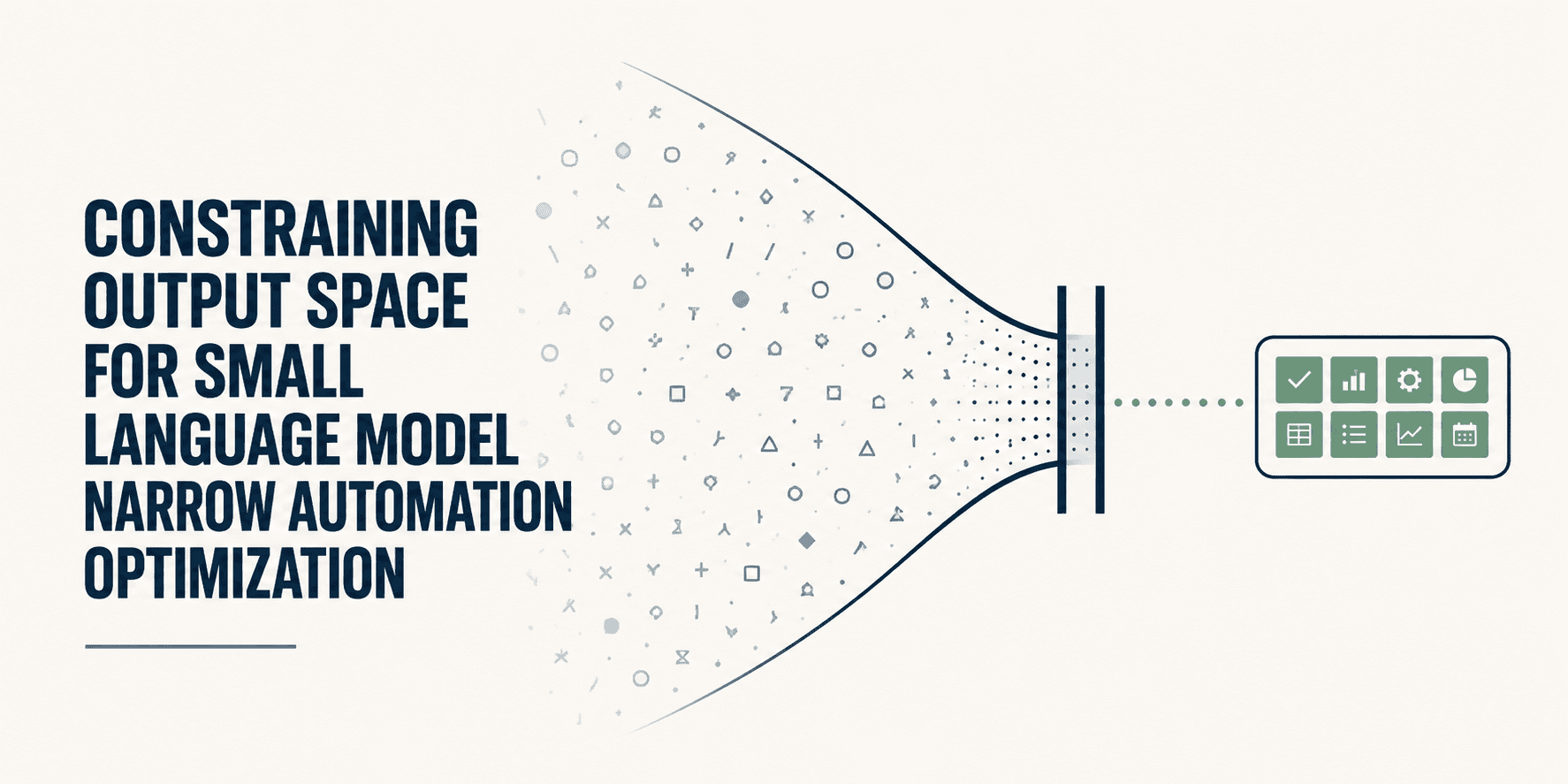
Tame Small Language Models by Constraining Their Output Space
Parsing generated text is a losing game. Every format variation you forget to handle becomes another silent failure. This first entry in our narrow automation optimization series tackles the real solution: constraining the output space from the start. It's a practical technique that saves time and spares you the headache of brittle regex. For a broader take on connecting systems, our piece on bridging retrieval and action offers a useful companion. This approach is simpler than it sounds, and it works.

Route easy queries around the model to cut latency and cost
Every question in an enterprise RAG pipeline doesn't deserve a full model call. The pipeline from Article 9 proves that simple keyword matches can skip the LLM entirely, saving about two seconds per query. That's not a small win; it's a direct cut to latency and cost without sacrificing accuracy. Buying faster hardware isn't the only answer. Routing easy questions around the model is smarter. For more on questioning AI's assumptions, check out "Verify Your AI's Understanding: A Simple Check for Tax Season."

Why Adam Misses What Gradient Descent Naturally Preserves
The loss landscape of factored models hides a subtle trap, and this work exposes it with refreshing clarity. Adam's per-coordinate scaling breaks rotation invariance, a property GD naturally respects, and that single flaw explains why it loses low-rank bias. The one-parameter transition to a shared scalar is a clever mechanism, proving anisotropy, not adaptivity, is the culprit. Muon's crossover near 4% tail energy is particularly striking, showing both claimed behaviors along one axis.

Mapping City Airspace with Data to Plan Smarter Vertiport Networks
Lagos is crowded, complicated, and constantly moving, which makes it the perfect stress test for vertiport placement. This case study uses geospatial machine learning to balance population density, transport access, and airspace constraints, turning a daunting urban puzzle into a reproducible workflow. It is practical, not theoretical, and that is why it works. If you are curious about how machine learning handles spatial decision-making, this walkthrough offers a clear, actionable starting point.

From One Gradient to Every Gradient: How Backpropagation Connects the Dots
Backpropagation often feels like a leap from theory to math, but this guide closes that gap with clarity. The guide walks you from a single gradient to the full chain, showing how errors flow backward through each layer. It is practical, grounded, and surprisingly intuitive for such a technical topic. If you are ready to move past intuition and see the mechanics clearly, this is the right next step.

Explore why early A/B test significance often misleads your decisions
A single day of statistical significance in an A/B test is not a win. It's a mirage. The post "Stop Calling the First Significant Day a Win" challenges that premature celebration, and it's a critique worth taking seriously. We often chase early signals, but data needs time to stabilize. The rush to declare victory is understandable, yet it undermines the entire process. For those looking to refine their analytical instincts, this pairs well with our piece on catching AI slop before it skews your model.

Diversify Your Budget Without Losing the Insights That Power It
A well-structured budget should never force you to choose between clarity and control. This piece tackles that exact tension, showing how you can diversify a budget while keeping the shadow prices that explain every decision. It's a practical approach for anyone tired of opaque spreadsheets that hide their own logic. We appreciate work that makes financial modeling more transparent, and this guide delivers exactly that. For readers exploring how data tools evolve, *Expanding Your Tech Fluency* offers a useful complement.

Designing Smarter Inference for High-Volume Workloads at Lower Cost
Meryem Arik's guide cuts straight to a question most teams avoid: how do you make AI inference genuinely cheap when the workload is massive but patience is on your side? Her answer isn't a single trick but a series of deliberate trade-offs across hardware, runtimes, and queue design. For engineering leaders tired of ballooning costs, her approach reframes non-real-time processing as a strategic advantage. It's practical, clear, and refreshingly grounded.