Article: InfoQ Culture and Methods Trends Report - 2026
Our take
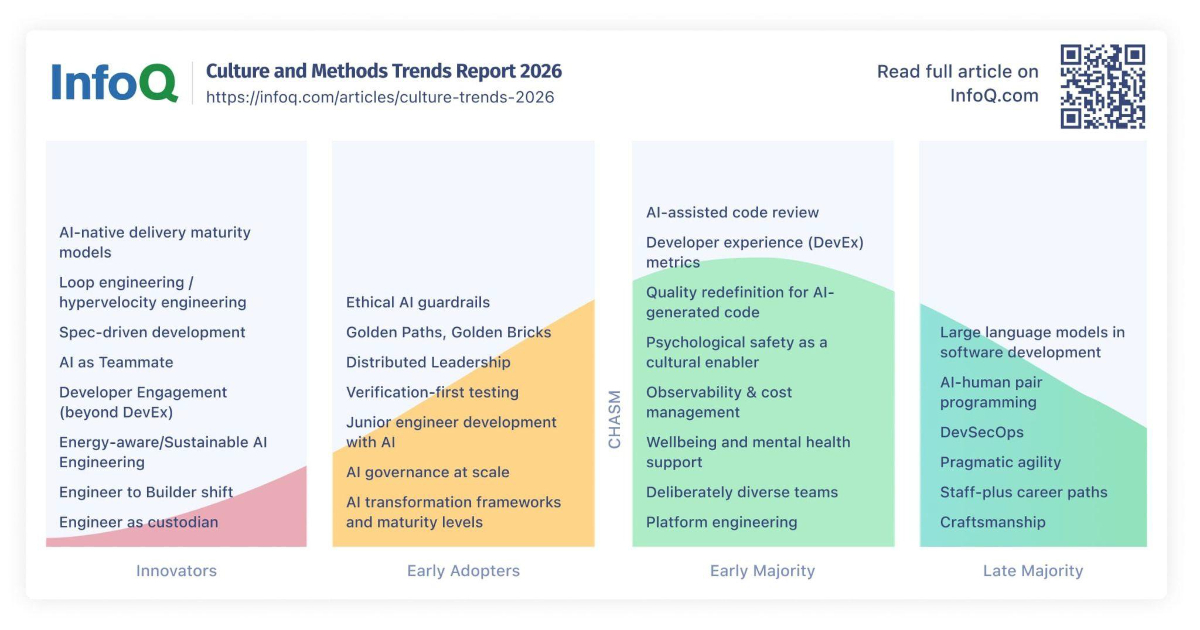
The InfoQ Culture and Methods Trends Report – 2026 offers a compelling glimpse into the evolving landscape of software development practices and organizational culture, and it’s a report worth careful consideration. It’s clear that the core tenets of agility, DevOps, and lean methodologies, while still relevant, are undergoing significant refinement and adaptation in response to the accelerating pace of AI integration and the increasing complexity of modern systems. The report highlights a shift away from rigid frameworks and towards more fluid, context-driven approaches, reflecting a growing recognition that “one size fits all” solutions are no longer viable. This is particularly evident in the increasing emphasis on emergent design and self-organizing teams, which are better equipped to navigate the uncertainty inherent in AI-driven development. For those seeking a deeper understanding of the tools enabling this shift, “The Minimal AI Engineer Toolkit for 2026” The Minimal AI Engineer Toolkit for 2026 provides a valuable overview of the essential technologies shaping the field, while understanding how to access data is also critical, as outlined in “7 Best Web Crawling Tools and APIs in 2026” 7 Best Web Crawling Tools and APIs in 2026.
The report’s emphasis on "human-centric" culture is particularly noteworthy. While technical advancements are undoubtedly driving change, the report rightly underscores the importance of fostering environments where individuals feel empowered, supported, and able to contribute their unique skills and perspectives. This isn't simply about employee satisfaction; it’s about recognizing that human creativity and adaptability remain essential ingredients for innovation, especially as AI takes on more routine tasks. The traditional hierarchical structures that have historically defined software development are gradually giving way to flatter, more collaborative models, where knowledge sharing and cross-functional teamwork are prioritized. The move towards decentralized decision-making, facilitated by AI-powered insights and communication tools, is also enabling teams to respond more quickly to changing market demands and customer feedback. It's a shift that requires a fundamental rethinking of leadership roles, moving away from command-and-control towards coaching and facilitation.
Beyond the immediate implications for software development teams, the trends outlined in the InfoQ report have broader significance for organizations across all industries. The principles of agility and continuous improvement, originally championed within the tech sector, are increasingly being adopted by businesses in fields as diverse as healthcare, finance, and manufacturing. The ability to rapidly adapt to change, experiment with new ideas, and learn from failures is becoming a critical competitive advantage in an increasingly volatile and unpredictable world. The report’s observation that organizations are moving beyond simply “doing DevOps” and are actively cultivating a “DevOps culture” is a key insight. It’s not enough to implement the right tools and processes; organizations must also foster a mindset of collaboration, shared responsibility, and continuous learning. This requires a commitment to breaking down silos, empowering employees, and creating a culture of psychological safety where individuals feel comfortable taking risks and challenging the status quo.
Looking ahead, it will be fascinating to observe how organizations navigate the ethical considerations surrounding the increasing use of AI in software development. Ensuring fairness, transparency, and accountability in AI-driven systems will be paramount, and it will require a concerted effort from developers, policymakers, and the broader community. The long-term impact of AI on the nature of work itself also remains an open question. While AI is likely to automate many routine tasks, it also has the potential to create new opportunities for human creativity and innovation. The key will be to proactively invest in education and training programs that equip individuals with the skills they need to thrive in an AI-powered future, and to build organizational cultures that embrace lifelong learning and adaptation. What new forms of collaboration will emerge between humans and AI, and how will organizations cultivate the skills needed to effectively manage these hybrid teams?
This report summarizes how the InfoQ Culture and Methods editorial team sees the ongoing and emergent trends in the culture and methods space in 2026.
By Shane Hastie, Ben Linders, Vanessa Formicola, Shawna Martell, Rafiq Gemmail, Craig Smith, Phillip Mortimer, Yinka OmoleRead on the original site
Open the publisher's page for the full experience