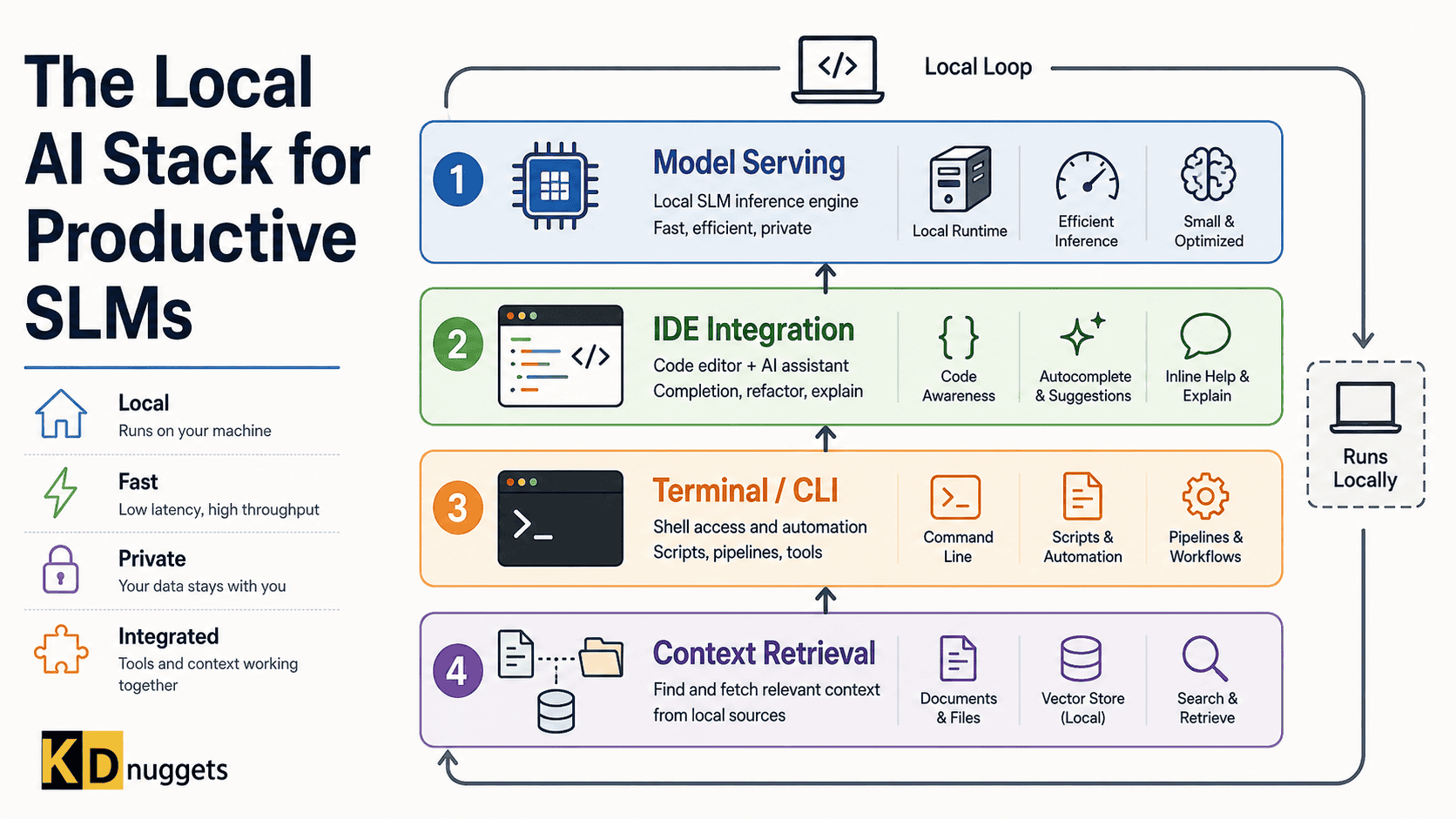
The most interesting thing about the local AI movement isn't the models themselves. It's the infrastructure quietly forming around them. For too long, the conversation has been about raw capability, about who can serve the largest parameter count or the most complex reasoning task. Building a productive local stack finally asks the question that actually matters: how do you turn a model into a tool you can rely on, day after day, without burning your entire afternoon on plumbing? That shift from experimentation to utility is where the real progress happens.
We've seen the same pattern play out in adjacent spaces. The recent work on Scale AWS Server Deployments Effortlessly with Stateless Model Context Protocol makes it clear that even the protocol layer is being simplified to remove operational friction. And when you look at how Bridging Retrieval and Action: A New Approach to AI Tasks connects RAG to actual agent behavior, you start to see a coherent philosophy emerging: the value is not in any single component, but in how deliberately you compose them. The local stack framework fits squarely into that trajectory. It's not about owning the most powerful hardware; it's about making deliberate choices at each layer so that the whole system hums.
Our take is straightforward. If you are still treating your local AI setup as a single monolithic download, you are already behind. The practical consequence of this framework is that you must think in terms of interfaces, not products. Model serving, context retrieval, orchestration: each layer has its own failure modes and its own optimization levers. This framework gives you permission to stop chasing benchmarks and start measuring what matters: latency on your own documents, accuracy on your own queries, and the time it takes to swap one component without rewriting everything else. That is the difference between a hobby and a workflow.
What we would tell a reader who asked us about this is simple: start with your retrieval layer, because that is where most local setups quietly die. A model that cannot find the right context will produce fluent nonsense, and no amount of serving optimization will fix that. The related work on stateless protocols and explicit retrieval-to-action connections reinforces this point from different angles. They all point toward the same conclusion: the stack is the product. The specific detail we will be watching is how quickly tooling consolidates around these layers, because right now, the biggest risk is choice paralysis. The winners will be the ones who commit to a stack, any stack, and then iterate. Pick your tools, wire them together, and let the results tell you what to change next.