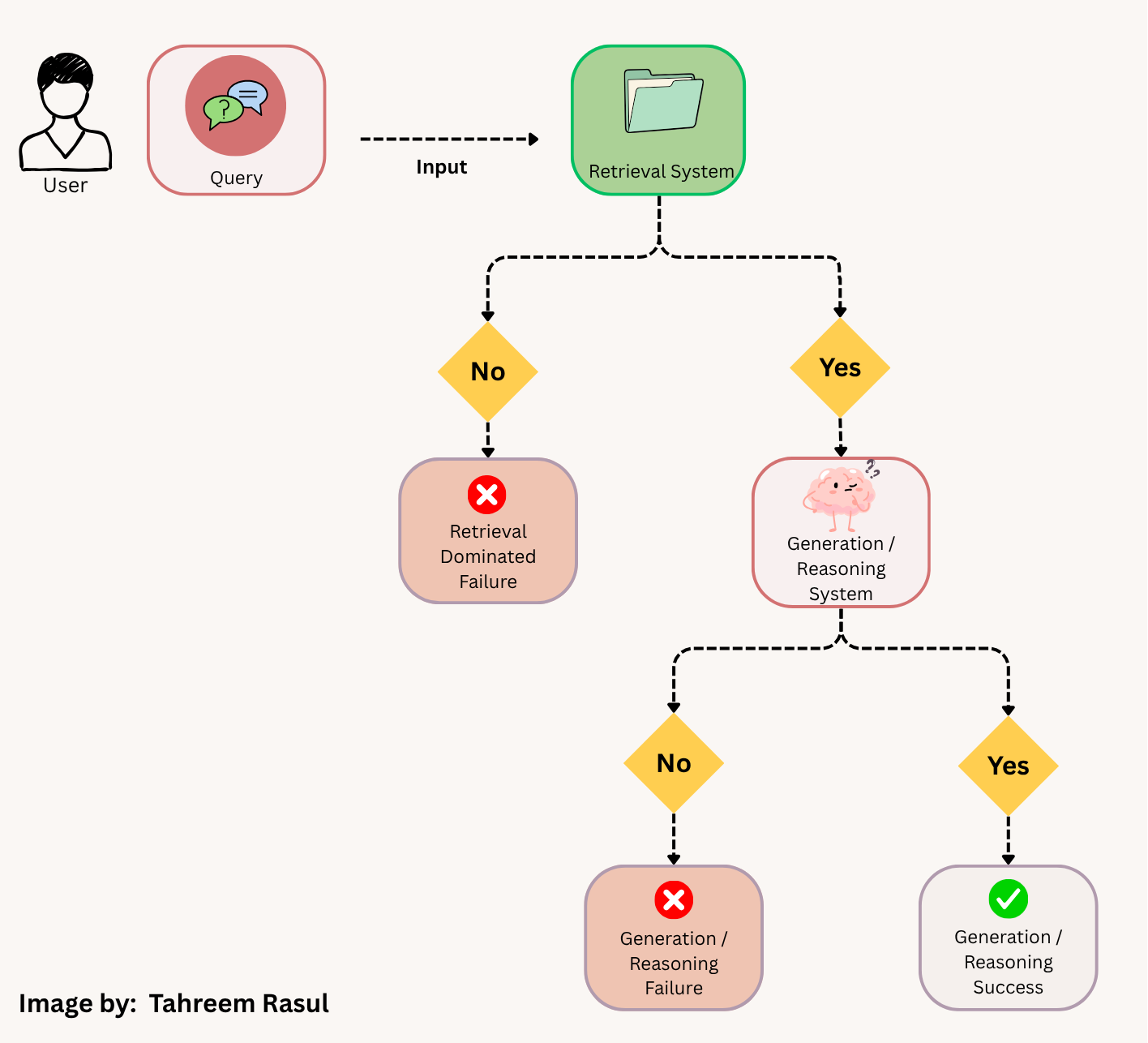
Most teams don't start a RAG project intending to build something convoluted. They start with a simple retrieval question, a vector database, and hope. Then the first bad answer appears, so they add a reranker. Then a question stumps the retriever entirely, so they bolt on an agent loop. Before long, the pipeline looks like a Rube Goldberg machine with dependencies held together by prompt strings. Complexity should be earned through observed failure modes rather than adopted preemptively, that is the rare piece of practical wisdom that deserves to be printed and stuck to a monitor. It's not a call for laziness. It's a call for honesty about what your system actually fails at, rather than what you imagine it might fail at someday.
We've seen this pattern play out across the broader AI conversation. Too often, the temptation is to reach for the most elaborate architecture the moment a demo underperforms, without first isolating whether the problem is lexical, semantic, or purely a matter of context window. The framework of moving from lexical search to hybrid retrieval, then to reranking, and only then to agentic information seeking mirrors a mature engineering principle: fix the simplest layer that solves the observed problem. This is the same instinct behind Expanding Your Tech Fluency: Key Insights Beyond Artificial Intelligence, which argues that fluency means knowing when not to reach for the newest tool. It's also directly aligned with Bridging Retrieval and Action: A New Approach to AI Tasks, where the author explicitly separates retrieval from action and only connects them when tasks demand it. The through-line is restraint.
Giving permission to start small without feeling inadequate is what makes this particularly useful. If your users are asking questions that a simple hybrid search handles correctly 90% of the time, then you've earned a simple system. The complexity budget should be spent on the 10% that genuinely breaks, not on hypothetical edge cases that might never occur. That's not a conservative mindset; it's a disciplined one. And it's far more human-centered than the alternative, because every added component is another place for latency, cost, and silent failure to creep in. The reader who walks away from this piece should feel empowered to say "no" to a reranker until a specific query proves it necessary. That's a concrete, quotable takeaway: **Do not add a component until a real failure mode demonstrates it earns its place in the pipeline.**
The honest question left on the table is whether your evaluation set actually reflects those failure modes. Most teams test on a handful of curated prompts and call it a benchmark. Complexity should be a response to observed failure, which means you need an observation mechanism that's reliable. If you don't have a way to systematically log bad retrievals and trace them to a specific bottleneck, then you're guessing. And guessing is how you end up with an agentic loop that hallucinates its way through a customer support ticket. So before you add that next layer, build the feedback loop first. That's the real prerequisite, and it's the detail worth watching in your own projects.