Cloudflare Migrates JavaScript CDN Serving 9B Requests a Day to Its Developer Platform
Our take
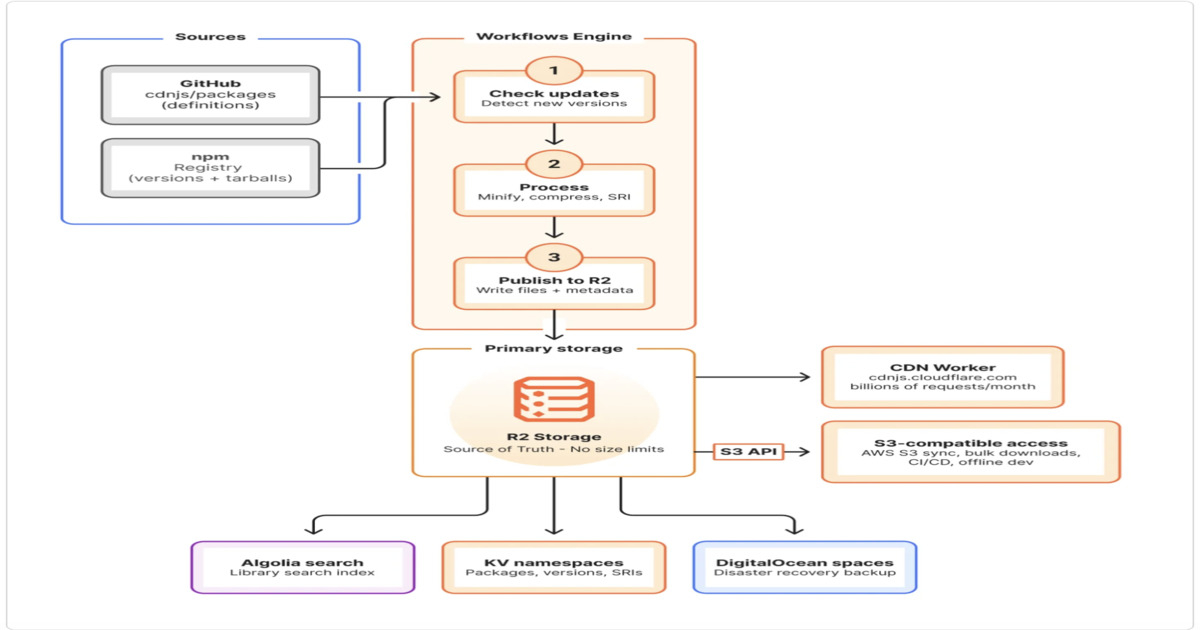
Cloudflare's recent migration of cdnjs, its open-source JavaScript and CSS library CDN, to its Developer Platform is a quietly significant development, demonstrating a powerful shift toward composable, serverless architectures for content delivery. Handling a staggering 9 billion requests daily, the move consolidates publishing and delivery infrastructure leveraging a suite of Cloudflare’s own technologies – Workers, R2, KV, Workflows, Queues, Durable Objects, and Containers – to streamline operations and improve performance. This isn’t just about efficiency; it’s a validation of the broader trend toward building complex applications from modular, independently scalable components, a concept explored in depth in "Presentation: The Right 300 Tokens Beat 100k Noisy Ones: The Architecture of Context Engineering," which highlights the importance of focused, well-managed context in AI-driven systems—a principle directly applicable to optimizing CDN performance and resource utilization. The inherent flexibility of this new architecture allows Cloudflare to rapidly adapt to evolving demands and incorporate new features, a stark contrast to the rigid, monolithic architectures that often underpin legacy CDN solutions.
The implications of this migration extend beyond Cloudflare itself. It underscores the growing viability of edge computing and serverless functions for handling high-volume, low-latency content delivery. Previously, CDNs often relied on complex, geographically distributed server networks, requiring significant infrastructure management and scaling efforts. Cloudflare's approach, utilizing its Developer Platform, offers a more agile and cost-effective alternative, particularly as AI agents and increasingly complex workflows become commonplace. Consider the challenges discussed in "LangChain vs LangGraph: 4 Key Differences and When to Use Each"; effectively routing and managing data for these agents requires robust and scalable infrastructure, and a platform like Cloudflare’s provides a compelling foundation. The use of R2, Cloudflare’s decentralized storage network, further enhances resilience and reduces reliance on centralized storage solutions, a critical factor for maintaining uptime and performance at scale. The choice of tools within the platform demonstrates an understanding that the future of application development isn’t about monolithic deployments but about orchestrating a collection of specialized services.
What’s truly impressive is Cloudflare’s commitment to preserving the existing ecosystem around cdnjs. Migrating such a widely used service requires meticulous attention to detail, ensuring that existing package contents, URLs, and SRI hashes remain intact. This commitment minimizes disruption for developers and fosters continued adoption of cdnjs, highlighting Cloudflare’s user-centric approach. The emergence of tools like DeepSeek Harness, as described in "DeepSeek Harness launches as open source rival to Claude Code, alongside V4-Pro on API with higher prices," further emphasizes this trend toward composable infrastructure, enabling developers to rapidly deploy and manage AI-powered applications and workflows – a trend that Cloudflare’s cdnjs migration actively supports. This focus on backwards compatibility and seamless integration is often overlooked in the rush to adopt new technologies, but it's crucial for ensuring widespread adoption and long-term success.
Ultimately, Cloudflare's cdnjs migration serves as a compelling case study for the future of content delivery and edge computing. It demonstrates the power of serverless architectures, decentralized storage, and composable infrastructure to deliver high-performance, scalable, and resilient services. The question now becomes: how will other CDN providers respond to this shift, and will we see a broader adoption of similar approaches across the industry? The move suggests a future where content delivery is less about managing vast server farms and more about orchestrating a network of specialized, AI-powered services operating at the edge.
Cloudflare has migrated cdnjs, its open source CDN for JavaScript and CSS libraries, to its Developer Platform. The new architecture uses Workers, R2, KV, Workflows, Queues, Durable Objects and Containers, consolidating publishing and delivery infrastructure while preserving package contents, URLs and SRI hashes at a scale of 9 billion requests per day.
By Leela KumiliRead on the original site
Open the publisher's page for the full experience