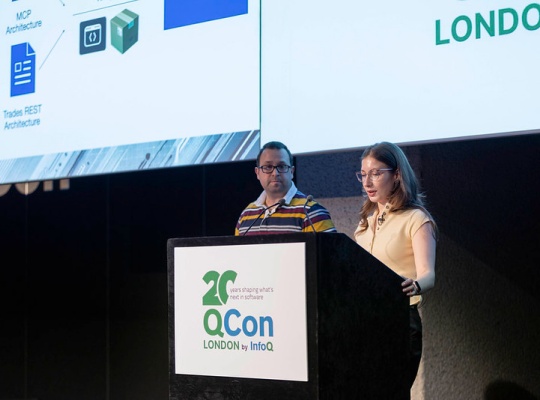
The increasing complexity of AI workflows demands a shift away from traditional, often brittle, infrastructure management. Morgan Stanley’s adoption of Architecture as Code (AaC) with CALM, as detailed by Gough and Niculcea, exemplifies this necessary evolution. Their approach, integrating Model Context Protocol (MCP) and Agent-to-Agent (A2A) communications alongside automated governance and zero-downtime upgrades, isn’t just about streamlining API deployment; it’s about building a foundation for sustainable AI scaling within an enterprise. It resonates with the broader discussion around responsible AI adoption, mirroring concerns raised by Greece's PM who stated that AI's Future Demands More Than Yesterday's Solutions - legacy systems simply cannot keep pace with the demands of increasingly sophisticated AI models. The move towards AaC represents a proactive step in addressing these challenges, moving beyond reactive fixes to a more deliberate and scalable approach.
The brilliance of Morgan Stanley’s implementation lies in its holistic approach. Focusing solely on API modernization would be a limited victory; the integration of MCP and A2A highlights a deeper understanding of the evolving agentic landscape. Allowing agents to communicate and share context seamlessly is critical for building complex, interconnected AI systems. Further bolstering this is the enforcement of automated governance through deployment gates, a crucial element often overlooked in the rush to deploy. This proactive governance demonstrates a commitment to risk mitigation and ensures that AI models operate within defined boundaries, a concern increasingly relevant given the rapid development of AI capabilities, as demonstrated by Meta's acknowledgment of OpenClaw’s inspiration for their Muse AI Assistant, detailed in Meta's Muse AI Assistant Draws Inspiration from OpenClaw. The zero-downtime upgrades are a testament to the maturity of their platform and a recognition that continuous operation is paramount for many enterprise applications.
The shift to AaC isn't merely a technological upgrade; it's a cultural one. It requires a fundamental change in how infrastructure is conceived and managed, moving away from manual configuration and towards a codified, version-controlled approach. This shift empowers development teams, allowing them to iterate faster and with greater confidence, while simultaneously improving overall system reliability and security. The benefits extend beyond the immediate deployment process; AaC enables better collaboration, improved traceability, and a more resilient infrastructure capable of adapting to future changes. Qualcomm's focus on local processing capabilities, outlined in Unlock AI Power: Qualcomm’s New Chips Bring Local Processing, underscores the growing importance of distributed AI architectures, and AaC provides a crucial framework for managing the complexity inherent in such environments.
Ultimately, Morgan Stanley's experience with AaC and CALM provides a valuable blueprint for other organizations seeking to unlock the full potential of their AI investments. The adoption of this approach signals a move toward a more mature and sustainable AI ecosystem, one where scalability, governance, and reliability are prioritized alongside innovation. As AI continues to permeate every aspect of business, the question isn’t *if* organizations will adopt AaC, but *when* and how effectively they can integrate it into their existing workflows. The challenge now lies in democratizing these principles, making them accessible and adaptable for organizations of all sizes, and ensuring that the benefits of AaC are not limited to the largest enterprises.