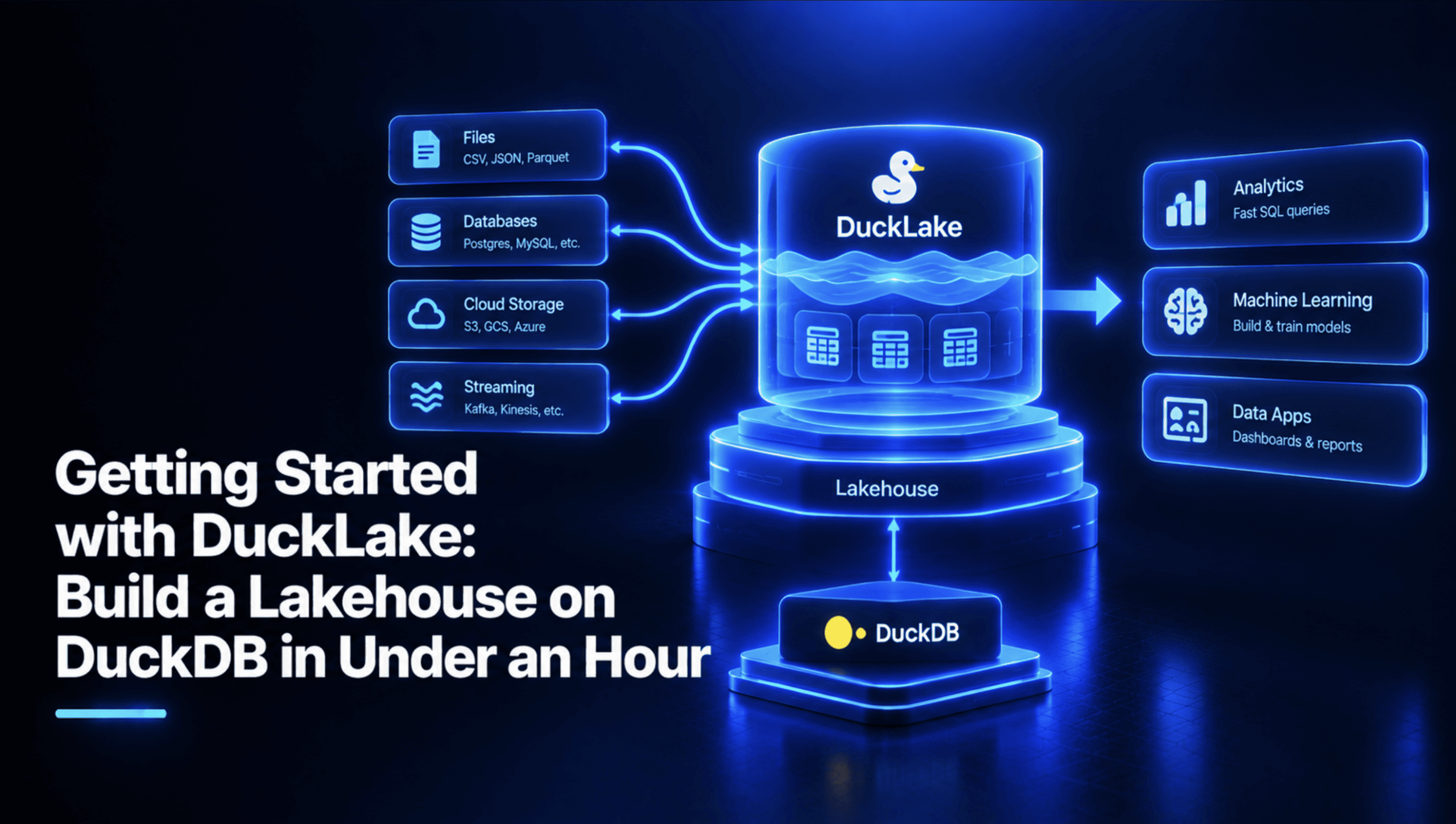
DuckLake is a genuinely important step forward, and it deserves more attention than it's likely to get amid louder AI news. By shipping a stable 1.0 specification with guaranteed backward compatibility, the DuckDB team has quietly solved one of the most persistent headaches in modern data architecture: the tension between simplicity and durability. DuckLake keeps table metadata in a SQL database and stores the actual data in Parquet files, which means you can build a functional lakehouse in under an hour using tools you probably already know. That is not a marketing claim; it is a direct consequence of the design. For anyone who has wrestled with the operational complexity of formats like Apache Iceberg or Delta Lake, this feels like a deliberate correction of course.
The timing is telling. As Google's AQuA tool shows us how to diagnose AI agent failures in production, the industry is waking up to the reality that shiny agentic workflows are only as reliable as the data infrastructure underneath them. DuckLake does not promise to fix agent failures, but it does promise that the data layer will not be the source of those failures. Meanwhile, the uncertainty around Nvidia's open source commitments following Jensen Huang's exit raises a broader question about Nvidia’s open source AI future that applies here too: who guarantees that an open format stays open? DuckLake's explicit backward compatibility guarantee is the right answer, but it only matters if the community actually adopts the format. And for that to happen, the format has to be genuinely easy to use, not just easy to describe.
The practical consequence for readers is straightforward. If you are building a data pipeline today, you have a choice between a heavyweight lakehouse format that demands dedicated engineering time and a lightweight file-per-query approach that collapses under concurrent writes. DuckLake occupies the middle ground that most teams actually need: a single SQLite database holds the catalog, Parquet files hold the data, and DuckDB does the heavy lifting. That architecture is not revolutionary, and the team is not claiming it is. What it is, is honest. It acknowledges that most organizations do not need a distributed metastore or a compaction service. They need metadata that does not corrupt and data that does not drift.
The detail to watch is how DuckLake handles concurrent writes in practice. The specification says metadata lives in a SQL database, which suggests transactional guarantees are inherited from that database, but the spec also promises backward compatibility from day one. That is a bold commitment for a 1.0 release. If DuckLake delivers on that promise, it will become the default choice for teams that want a lakehouse without hiring a lakehouse team. If it does not, the community will know quickly, because the format is open and the code is visible. Either way, the question is no longer whether you can build a lakehouse in an hour. It is whether you should have been doing so all along.