- Agentic AI arrives, and the path forward demands our focus.
The age of agentic AI is upon us — whether we like it or not. What started with an innocent question-answer banter with ChatGPT back in 2022 has become an existential debate on job security and the rise of the machines.
More recently, fears of reaching artificial general intelligence (AGI) have become more real with the advent of powerful autonomous agents like Claude Cowork and OpenClaw. Having played with these tools for some time, here is a comparison.
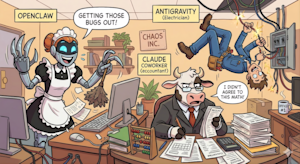
First, we have OpenClaw (formerly known as Moltbot and Clawdbot). Surpassing 150,000 GitHub stars in days, OpenClaw is already being deployed on local machines with deep system access. This is like a robot “maid” (Irona for Richie Rich fans, for instance) that you give the keys to your house. It’s supposed to clean it, and you give it the necessary autonomy to take actions and manage your belongings (files and data) as it pleases. The whole purpose is to perform the task at hand — inbox triaging, auto-replies, content curation, travel planning, and more.
Next we have Google’s Antigravity, a coding agent with an IDE that accelerates the path from prompt to production. You can interactively create complete application projects and modify specific details over individual prompts. This is like having a junior developer that can not only code, but build, test, integrate, and fix issues. In the realworld, this is like hiring an electrician: They are really good at a specific job and you only need to give them access to a specific item (your electric junction box).
Finally, we have the mighty Claude. The release of Anthropic's Cowork, which featured AI agents for automating legal tasks like contract review and NDA triage, caused a sharp sell-off in legal-tech and software-as-a-service (SaaS) stocks (referred to as the SaaSpocalypse). Claude has anyway been the go-to chatbot; now with Cowork, it has domain knowledge for specific industries like legal and finance. This is like hiring an accountant. They know the domain inside-out and can complete taxes and manage invoices. Users provide specific access to highly-sensitive financial details.
Making these tools work for you
The key to making these tools more impactful is giving them more power, but that increases the risk of misuse. Users must trust providers like Anthorpic and Google to ensure that agent prompts will not cause harm, leak data, or provide unfair (illegal) advantage to certain vendors. OpenClaw is open-source, which complicates things, as there is no central governing authority.
While these technological advancements are amazing and meant for the greater good, all it takes is one or two adverse events to cause panic. Imagine the agentic electrician frying all your house circuits by connecting the wrong wire. In an agent scenario, this could be injecting incorrect code, breaking down a bigger system or adding hidden flaws that may not be immediately evident. Cowork could miss major saving opportunities when doing a user's taxes; on the flip side, it could include illegal writeoffs. Claude can do unimaginable damage when it has more control and authority.
But in the middle of this chaos, there is an opportunity to really take advantage. With the right guardrails in place, agents can focus on specific actions and avoid making random, unaccounted-for decisions. Principles of responsible AI — accountability, transparency, reproducibility, security, privacy — are extremely important. Logging agent steps and human confirmation are absolutely critical.
Also, when agents deal with so many diverse systems, it's important they speak the same language. Ontology becomes very important so that events can be tracked, monitored, and accounted for. A shared domain-specific ontology can define a “code of conduct." These ethics can help control the chaos. When tied together with a shared trust and distributed identity framework, we can build systems that enable agents to do truly useful work.
When done right, an agentic ecosystem can greatly offload the human “cognitive load” and enable our workforce to perform high-value tasks. Humans will benefit when agents handle the mundane.
Dattaraj Rao is innovation and R&D architect at Persistent Systems.
- Anthropic's new runtime collapses three infrastructure layers into one.
Just a few weeks after announcing Claude Managed Agents, Anthropic has updated the platform with three new capabilities that collapse infrastructure layers like memory, evaluation, and multi-agent orchestration, into a single runtime.
This move could threaten the standalone tools that many enterprises cobble together.
The new capabilities — 'Dreaming,' 'Outcomes,' and 'Multi-Agent Orchestration' — aim to make agents inside Claude Managed Agents “more capable at handling complex tasks with minimal steering,” Anthropic said in a press release.
Dreaming deals with memory, where agents “reflect” on their many sessions and curate memories so they learns and surface unknown patterns. Outcomes allows teams to define and set specific rubrics to measure an agent's success, while Multi-Agent Orchestration breaks jobs down so a lead agent can delegate to other agents.
Claude Managed Agents ideally provides enterprises with a simpler path to deploy agents and embeds orchestration logic in the model layer. It’s an end-to-end platform to manage state, execution graphs, and routing. With the addition of Dreaming, Outcomes and Multi-agent Orchestration, Claude Managed Agents expands capabilities even further and directly competes with tools like LangGraph or CrewAI, as well as external evaluation frameworks, RAG memory architectures, and QA loops.
An integration threat
Enterprises must now ask: Should we ditch our flexible, modular system in favor of an agent platform that brings almost everything in-house?
Anthropic designed Claude Managed Agents to share context, state, and traceability in one place. This means the platform sees every decision agents make, rather than enterprises having to wire separate systems together. It sounds practical to have one platform that does everything. But not all enterprises want a full-service system.
Claude Managed Agents already faces criticism that it encourages vendor lock-in because it owns most of the architecture and tools that govern agents. In the current paradigm, an organization may run Managed Agents but keep multi-agent orchestration, memory, or evaluations in a separate space ensures flexibility.
The platform offers a fully-hosted runtime, which means memory and orchestration run on infrastructure the enterprise does not own. This can become a compliance nightmare for some organizations that have to prove data residency.
Another problem to consider is that enterprises already in the middle of large-scale AI transformations must cobble together workarounds to deal with the constraints of their tech stack. Not every workflow is easily replaceable by switching to Claude Managed Agents.
Dreaming and outcomes against current tools
Most enterprises have a fragmented approach to AI deployment.
For example, they may use LangGraph or Crew AI for agent routing and workflow management, Pinecone as a vector database for long-term memory, DeepEval for external evaluation, and a human-in-the-loop quality assurance to review some tasks. Anthropic hopes to do away with all of that.
With Dreaming, Anthropic approaches memory by allowing users to actively rewrite it between sessions, so the agent essentially learns from its mistakes. Anthropic says this capability is useful for long-running states and orchestration. Current systems often handle memory persistence by storing embeddings, retrieving relevant context, and adding more state over time.
Outcomes addresses the evaluation portion by detailing expectations for agents. Instead of external quality checks, which are often done by a team of humans, Anthropic is bringing evaluation into the orchestration layer rather than above it.
But it’s the Multi-Agent Orchestration capability that pits Claude Managed Agents against orchestration frameworks from Microsoft, LangChain, CrewAI, and others. Model providers like Anthropic and OpenAI have already begun pushing aggressively into this space, arguing that bringing this to the model layer gives teams better control.
Big decisions to make
Enterprises face a big decision, and this one could depend on where they are in agent maturity.
If an organization is still experimenting with agents and has not deployed many in production, they may find moving to Claude Managed Agents and configuring Dreaming and Outcomes to their needs much easier. This is the stage of development where, even if enterprises are using a third-party orchestrator like LangChain, they’re still customizing it.
But for those who are already further along in the process, the calculation becomes trickier. It’s now a matter of parallel evaluation and better understanding of their processes.
Businesses, though, will face the same decision even if they don’t intend to use Claude Managed Agents. Anthropic has signaled that other model and platform providers will likely shift their product roadmaps to a similar model that keeps everything locked in the same system — because models may become interchangeable, but the tooling and orchestration infrastructure will not.
- The Scaffolding Era Fades, Making Way for Smarter AI Workflows
The scaffolding layer that developers once needed to ship LLM applications — indexing layers, query engines, retrieval pipelines, carefully orchestrated agent loops — is collapsing. And according to Jerry Liu, co-founder and CEO of LlamaIndex, that's not a problem. It's the point.
“As a result, there's less of a need for frameworks to actually help users compose these deterministic workflows in a light and shallow manner,” Jerry Liu, co-founder and CEO of LlamaIndex, explains in a new VentureBeat Beyond the Pilot podcast.
Context is becoming the moat
Liu’s LlamaIndex is one of the foremost retrieval-augmented generation (RAG) frameworks connecting private, custom, and domain-specific data to LLMs. But even he acknowledges that these types of frameworks are becoming less relevant.
With every new release, models demonstrate incremental capabilities to reason over “massive amounts” of unstructured data, and they’re getting better at it than humans, he notes. They can be trusted to reason extensively, self-correct, and perform multi-step planning; Modern Context Protocol (MCP) and Claude Agent Skills plug-ins allow models to discover and use tools without requiring integrations for every one independently.
Agent patterns have consolidated toward what Liu calls a "managed agent diagram" — a harness layer combined with tools, MCP connectors, and skills plug-ins, rather than custom-built orchestration for every workflow.
Further, coding agents excel at writing code, meaning devs don’t need to rely on extensive libraries. In fact, about 95% of LlamaIndex code is generated by AI. “Engineers are not actually writing real code,” Liu said. “They're all typing in natural language.” This means the layers between programmers and non-programmers is collapsing, because “the new programming language is essentially English.”
Instead of manual coding or struggling to understand API and document integration, devs can just point Claude Code at it. “This type of stuff was either extremely inefficient or just would break the agent three years ago,” said Liu. “It's just way easier for people to build even relatively advanced retrieval with extremely simple primitives.”
So what’s the core differentiator when the stack collapses?
Context, Liu says. Agents need to be able to decipher file formats to extract the right information. Providing higher accuracy and cheaper parsing becomes key, and LlamaIndex is well-positioned here, he contends, because of its developments with agentic document processing via optical character recognition (OCR).
“We've really identified that there's a core set of data that has been locked up in all these file format containers,” he said. Ultimately, “whether you use OpenAI Codex or Claude Code doesn't really matter. The thing that they all need is context.”
Keeping stacks modular
There’s growing concern about builders like Anthropic locking in session data; in light of this, Liu emphasizes the importance of modularity and agnosticism. Builders shouldn’t bet on any one frontier model, or overbuild in a way that overcomplicates components of the stack.
Retrieval has evolved into “agent-plus-sandbox,” as he describes it, and enterprises must ensure that their code bases are tech debt free and adaptable to changing patterns. They also have to acknowledge that some parts of the stack will eventually need to be thrown away as a matter of course.
“Because with every new model release, there's always a different model that is kind of the winner,” Liu said. “You want to make sure you actually have some flexibility to take advantage of it.”
Listen to the podcast to hear more about:
LlamaIndex’s beginnings as a ‘toy project’ with initially only about 40% accuracy;
How SaaS companies can tap into complicated workflows that must be standardized and repeatable for average knowledge workers;
Why vertical AI companies are taking off and why ‘build versus buy’ is still a very valid question in the agent age.
You can also listen and subscribe to Beyond the Pilot on Spotify, Apple or wherever you get your podcasts.