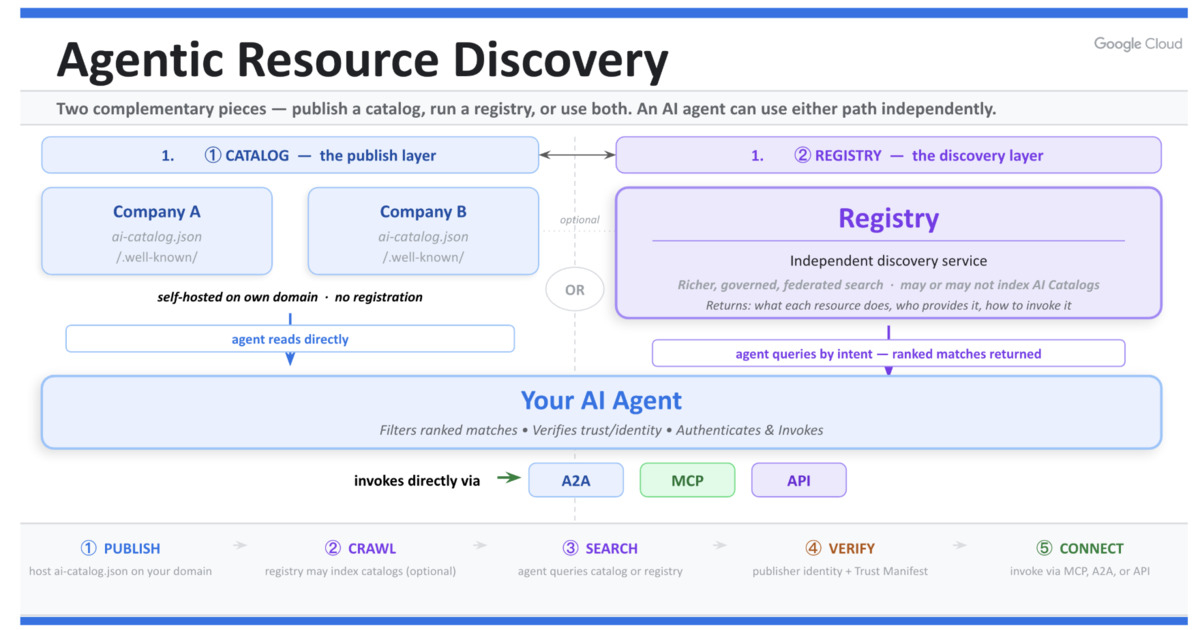
The announcement of the Agentic Resource Discovery (ARD) Specification from Google and its partners is the most grounded step yet toward making AI agents genuinely useful rather than merely impressive. For anyone who has spent time wrestling with the limitations of current tools, this is a signal that the industry is finally addressing the messy, unglamorous problem of discovery. We have spent the last year learning how to connect agents to data and actions through protocols like MCP, but a connection is only as good as your ability to find it. ARD introduces a catalog and registry layer, which is precisely the missing piece that turns a chaotic ecosystem of APIs and tools into something an agent can navigate with confidence.
This matters to you if you have ever built a workflow that depends on a specific API, only to watch it become obsolete or get lost in a sea of internal documentation. The specification does not try to replace MCP or OpenAPI; it sits on top of them, adding a means for agents to ask "what can you do?" and "can you prove it?" before they commit to an action. This is a subtle but profound shift. We saw the promise of dynamic capability discovery in the recent Scale AWS Server Deployments Effortlessly with Stateless Model Context Protocol piece, where the focus was on simplifying the connection layer. ARD takes that further by asking not just how to connect, but what to connect to in the first place. And for those of us who have struggled with the practical realities of Unlocking MCP: A Visual Guide to Empower Your Workflow, this feels like the next logical chapter in a story that is still being written.
Our take is straightforward: this is a trust play disguised as a technical standard. The emphasis on verification is what separates this from earlier, more naive attempts at agent interoperability. Without a way to verify that a tool does what it claims, any agent is just a confident liar. ARD does not solve that problem entirely, but it creates a framework where trust is something you can build into your architecture rather than hope for. The practical takeaway here is that if you are building agentic systems, you should start thinking about how your internal tools are published and described today. The teams that treat this as a first-class concern will be the ones whose agents actually work in production.
The open question we are watching is whether the industry rallies around this as a shared foundation or fragments into proprietary catalogs. We would tell a reader who asks about this to pay attention to the governance model. Who controls the registry? Who decides what gets listed? That will determine whether this becomes a utility or a gatekeeper. For now, the specification is worth exploring, not because it is a finished product, but because it forces the conversation about discovery and trust into the open. That is a conversation worth having.