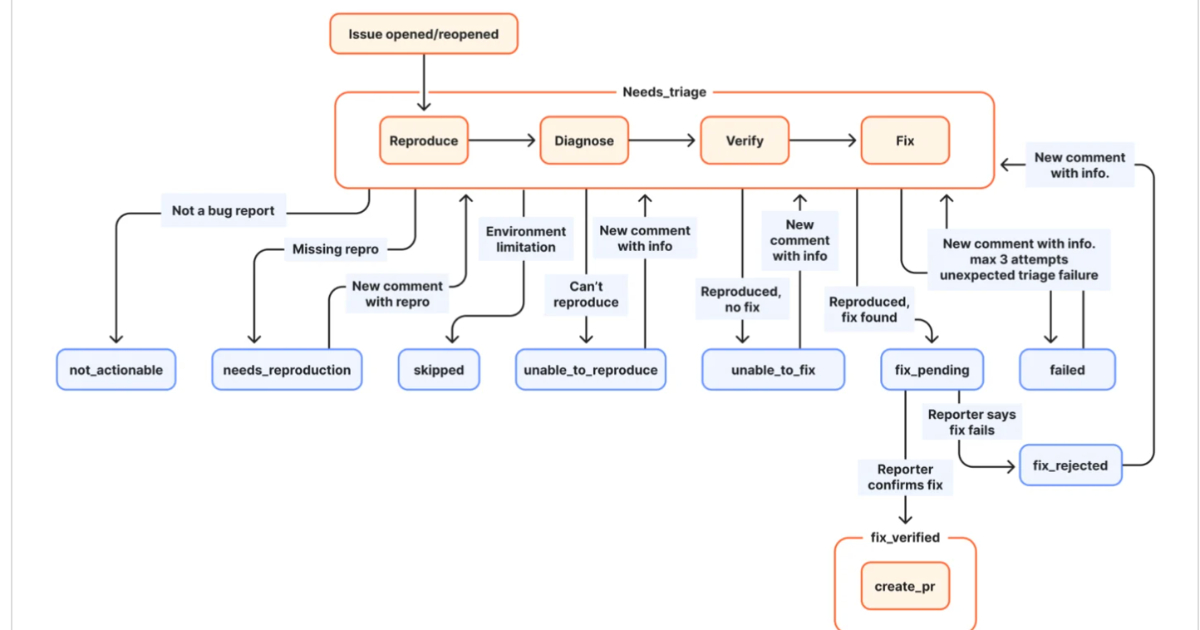
Cloudflare's report that its AI agents cut Astro's GitHub issue backlog by 85% is the kind of number that makes you stop and reconsider what maintenance work actually looks like in open source. This wasn't a flashy feature launch or a benchmark on a curated dataset. It was triage, the unglamorous grind of classifying, prioritizing, and routing bug reports. That Cloudflare chose to document the process with Astro's maintainers, and that they used GitHub Actions and Cloudflare Workers to run these agents, tells us more about the near-term trajectory of software engineering than any demo ever could. For our readers, this is a concrete signal that agentic AI has moved from coding assistance into operational stewardship. You are no longer just delegating code generation; you are delegating the judgment calls about what deserves a human's attention in the first place.
The most reassuring detail here is the human-in-the-loop component. This wasn't a fully autonomous system left to close tickets on its own authority. Cloudflare and Astro kept a human reviewer in the loop, which is exactly the right architectural decision. We have seen enough cautionary tales about AI agents making irreversible changes to codebases. The smart play is to let the agents do the exhausting, high-volume sorting work, then hand a curated list to a maintainer for a final decision. That workflow mirrors what we discussed in our piece on Unlock LLM Training: A Practical Guide to Distributed Algorithms, where the emphasis was on understanding the underlying systems rather than trusting the output blindly. The same principle applies here: the value is not in the model's ability to guess, but in the architecture that contains its output and routes it to a human who can say yes or no with context.
What strikes us as genuinely progressive is that this wasn't about replacing maintainers. It was about removing the friction that makes open source maintenance a burnout factory. For every maintainer who has spent a Sunday afternoon triaging duplicate bug reports, this is the future you have been waiting for. The 85% reduction is not a layoff statistic; it is a capacity unlock. Those hours go back into actual feature work, code review, and mentoring. We saw a similar philosophy in Cloudflare's own migration to its EmDash CMS, documented in Cloudflare's Blog Finds Performance Gains with EmDash, Its New CMS, where the goal was operational efficiency without sacrificing control. The pattern is consistent: automate the mechanical, preserve the human judgment.
Do not wait for GitHub to ship this as a default feature. The fact that Cloudflare built this with open source tools like Flue and triagebot means the playbook is available, but it still requires deliberate architecture. The open question we are watching is how these agent workflows handle the long tail of nuanced, emotionally charged issue reports that require empathy, not just classification. An 85% reduction is impressive, but the remaining 15% is where the real relationship-building with users happens. The concrete takeaway to quote: "AI agents are not replacing maintainers; they are absorbing the noise so maintainers can focus on the signal." And if you are considering adopting a similar system, start with a narrow scope like triage, measure the impact on contributor satisfaction, and only then expand the agent's permissions. The future of open source maintenance is not fully autonomous; it is thoughtfully augmented.