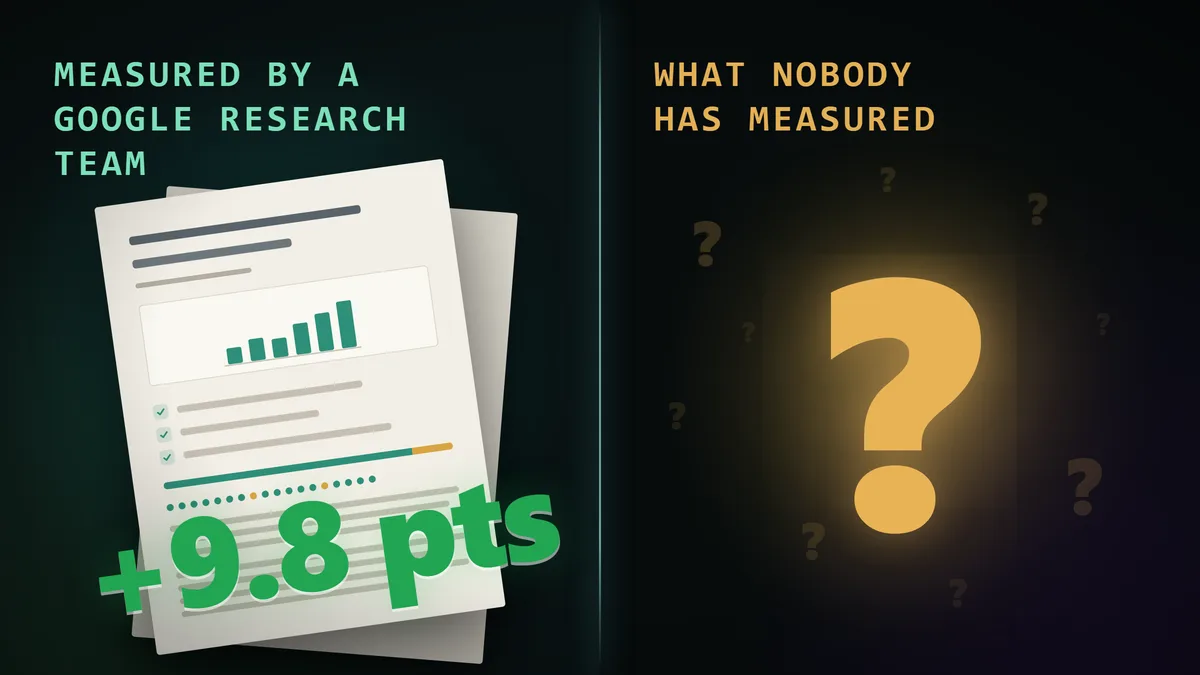
Data validation is a powerful thing, but what happens when the data only validates half your argument? That is the honest tension at the heart of a recent experiment from a Google team, which measured part of a bold claim about spec-driven test automation and left the rest open for exploration. It is a rare moment of intellectual humility from a company known for shipping at scale, and it offers a practical lesson for anyone building with AI today: the most valuable tools are the ones that tell you what they don't know yet.
This approach mirrors the mindset we have been watching emerge across the industry. In our piece Turn AI into a Thinking Partner That Accelerates How You Learn, we argued that the real power of AI lies not in giving final answers but in becoming a collaborator that surfaces gaps in your reasoning. Google's team did exactly that. They ran the numbers on one half of the argument, likely the quantifiable half, and found it held up. But they stopped short of declaring victory on the second half, acknowledging that some dimensions of the problem simply resist measurement. That is not a flaw in the experiment; it is the most honest result they could have delivered.
For readers working with spreadsheets, databases, or any data pipeline, this has a direct consequence. When you automate testing against a spec, you gain speed and consistency, but you also inherit the spec's blind spots. A spec is a model of reality, and every model has edges. Google's measured result tells you that the model works where it was tested. The unmeasured half tells you where your judgment still matters. This is where AI-native spreadsheets can shine, not by hiding the uncertainty but by flagging it, letting you decide whether to trust the automated result or dig deeper.
We put four AI assistants through a similar wringer in We Put Four AI Assistants to the Test With Forecasting Traps, and the results reinforced the same point. Every assistant handled structured data well, but each stumbled on the same kind of contextual traps, leakage, reporting delays, promotion effects, that no spec can fully anticipate. The lesson is consistent: treat partial validation as a feature, not a failure. The specific takeaway here is straightforward. When you adopt spec-driven automation, build a feedback loop that captures what the tests cannot measure. Google left that half open deliberately. You should, too.