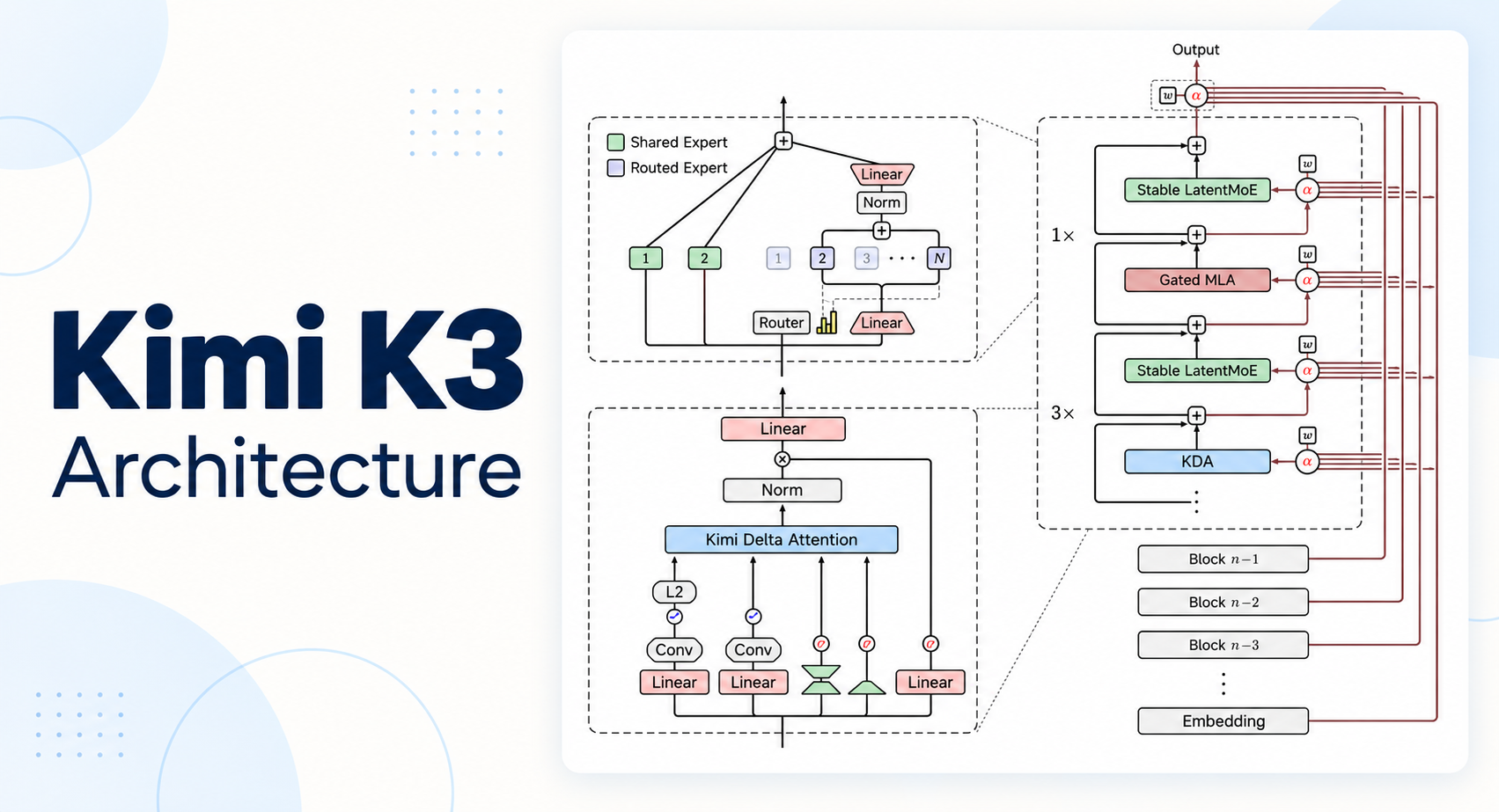
Moonshot AI's Kimi K3 architecture, a 2.8-trillion-parameter model, is an impressive engineering feat, but what matters more is *how* it runs efficiently. We believe the real story here is not the raw scale, but the architectural choices that make such scale practical. For anyone wrestling with the cost and complexity of deploying large models, the details of K3's design offer a concrete blueprint for balancing power with performance. This is especially relevant when you consider how smarter architectures, not just bigger models, are the key to enterprise success, a theme we explore in Six Architectures for Smarter Enterprise AI Beyond Basic RAG.
The efficiency of the K3 model hinges on a few specific design principles. Moonshot has focused on a mixture-of-experts (MoE) approach, which activates only a fraction of the 2.8 trillion parameters for any given task. This is a stark contrast to dense models that fire every parameter, making K3 both more compute-efficient and more memory-efficient. The fact that the newer K3.1 Pro, which builds on the same base model with additional post-training, retains these efficiencies proves that the architecture itself is the foundation. It is a validation that smart design, not just brute-force scaling, is the path forward. This aligns with a broader trend we see: improving performance without swapping out the entire model, as detailed in Boost Your AI Agent's Performance Without Changing the Model.
What does this mean for practitioners? It means the barrier to entry for leveraging massive models is lowering. You do not need a supercomputer to run a 2.8T model if the architecture is designed to be sparse and efficient. The practical takeaway is clear: when evaluating AI models, look past the parameter count and examine the activation sparsity. A model that activates only 10-20% of its parameters per token can deliver the knowledge of a 2.8T model with the inference cost of a much smaller one. This is a direct challenge to the assumption that bigger always means slower and more expensive. The choice of activation functions also plays a role here; as we discuss in Discover how GELU helps AI models learn more naturally than ReLU, subtle architectural decisions compound into significant real-world performance differences.
The most concrete consequence of this architecture is its impact on deployment costs. If K3's efficiency translates to lower GPU hours per query, then companies can either serve more users with the same hardware or reduce their cloud spending. This is not a theoretical future benefit; it is an immediate economic advantage. The open question that remains is how well this sparse architecture handles tasks requiring deep, multi-step reasoning, where the model might need to draw on many different expert sub-models simultaneously. That is the detail to watch as Moonshot releases more benchmarks and real-world usage data.