OpenAI Details GPT-Live’s Architecture for Continuous Stateful Voice Interaction
Our take
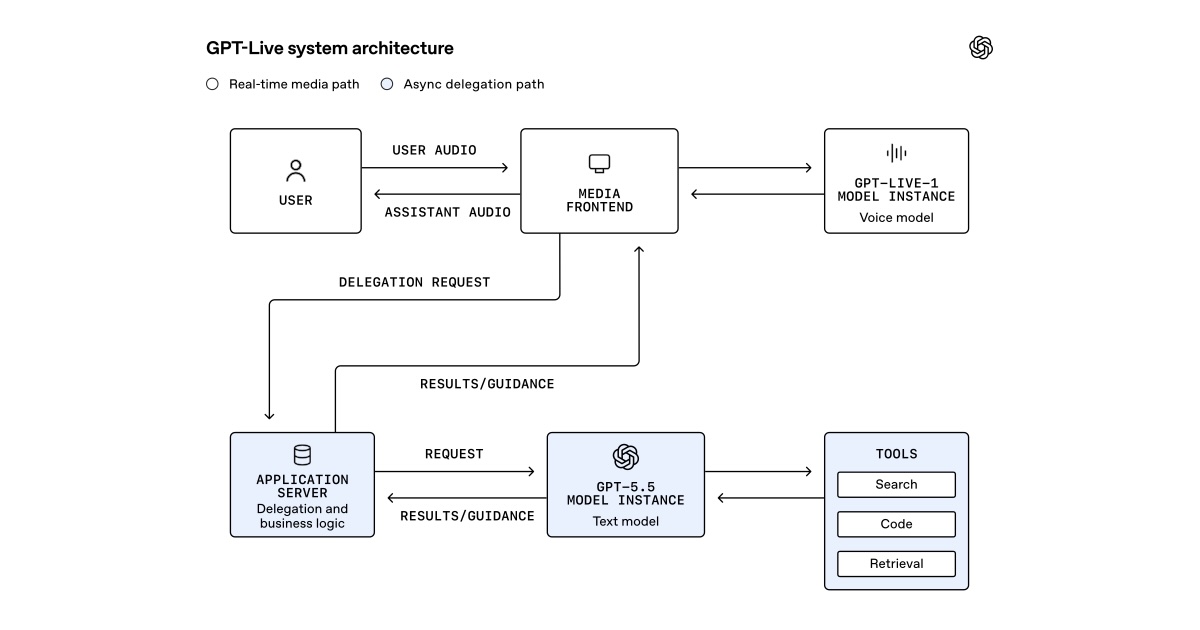
OpenAI’s recent engineering deep dive into GPT-Live is a fascinating look under the hood of a technology rapidly shaping the future of conversational AI. The architecture, designed for continuous, real-time voice interaction, elegantly separates the immediate demands of media processing and inference from the broader, more complex tasks of application logic. This separation, achieved through an asynchronous RPC boundary, is a crucial step toward building truly responsive and adaptable AI agents. It’s not entirely surprising to see this approach given the challenges highlighted in articles like Open AI’s Astra model is on the way — and very good at breaking into computer systems, which underscores the growing need for robust security and control mechanisms within advanced LLMs, and the complexities that arise when integrating these models into sensitive environments. The ability to isolate and manage these broader application functions—delegation, tool use, persistence—is key to ensuring both performance and safety.
The brilliance of GPT-Live's design lies in its recognition that real-time responsiveness is paramount for natural voice interaction. Traditional LLM architectures often struggle to maintain this immediacy, leading to noticeable delays and a less fluid conversational experience. By prioritizing the low-latency “live path” – the media pipeline and inference loop – OpenAI has created a system that feels significantly more intuitive and engaging. This is particularly relevant when considering the burgeoning applications of AI in healthcare, as demonstrated by the ChatGPT Health adds Epic integration for clinicians to import patient data integration. The need for near-instantaneous responses in a clinical setting is undeniable, and architectures like GPT-Live represent a significant stride towards meeting that demand. We’ve also seen discussions around the rigor required in AI research, as explored in First A submission (AAMAS): how much theory is enough when your experiments went sideways?, highlighting the importance of solid engineering foundations to support these ambitious AI endeavors.
Beyond the technical specifics, GPT-Live’s architecture represents a broader shift in how we approach AI agent design. The separation of concerns allows for greater modularity and scalability, enabling developers to build more complex and specialized AI applications without sacrificing performance. This is a welcome move away from monolithic models and toward a more composable approach, where different AI components can be seamlessly integrated and adapted to specific tasks. The asynchronous RPC boundary also opens up possibilities for integrating external services and tools, further expanding the capabilities of the AI agent. It’s a move toward empowering developers to build AI systems that are not just intelligent, but also adaptable, extensible, and deeply integrated into real-world workflows.
Looking ahead, the implications of GPT-Live’s architecture are substantial. The ability to maintain continuous, low-latency voice interaction will unlock a new wave of applications in areas like virtual assistants, interactive gaming, and real-time language translation. However, the focus on separation of concerns also raises intriguing questions about the future of AI agent development. Will we see a proliferation of specialized AI components, each optimized for a specific task, that are orchestrated by a central control layer? And how will this modular approach impact the overall coherence and consistency of AI interactions? It's a space to watch closely as the industry moves beyond simple chatbot experiences and towards genuinely intelligent, adaptive AI companions.
OpenAI recently published an engineering account of GPT-Live. It described how they designed the system to maintain continuous voice interaction while separating latency-sensitive media processing from broader application work. The live path contains the media pipeline and inference loop, while delegation, tool use, persistence, and other application logic run behind an asynchronous RPC boundary.
By Eran StillerRead on the original site
Open the publisher's page for the full experience