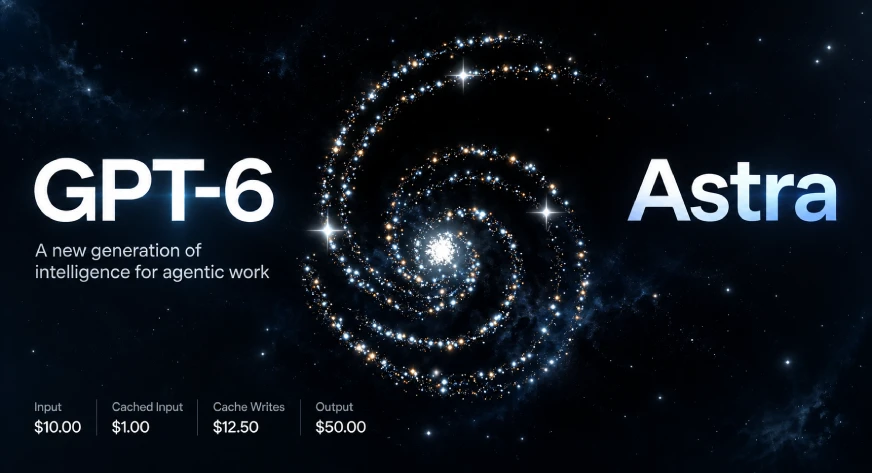
OpenAI's GPT-6 Astra arrives less than a week after Anthropic's Claude Fable 5.1, and the timing alone tells you something about how these companies now compete. But the more interesting story is what Astra actually does. The headline claim is that it's the world's most intelligent and aligned model, which sounds impressive until you remember every frontier release says something similar. What stands out is the shift in emphasis: Astra is built to do more, not just answer more. That is a meaningful distinction, and it's worth pausing on because it signals where the entire category is heading.
For anyone who has spent years wrestling with spreadsheets, this kind of progress is not abstract. We've written before about how Exploring Real-World Computer Vision shows that the real challenge in machine learning is rarely the model itself, but getting it to act reliably in messy, real-world conditions. Astra seems designed with that same lesson in mind. It's not about knowing more facts or generating cleaner text; it's about taking actions, using tools, and completing tasks that would normally require a human to stitch together multiple steps. That is a different kind of capability, and it changes what we should expect from an AI assistant. Instead of asking "what do you know?", the more useful question becomes "what can you actually get done?"
This is also why we'd push back on the urge to compare benchmark scores. If you're a data professional or a business analyst, the gap between a model that answers well and one that acts well is the difference between a tool that suggests a formula and one that builds the dashboard for you. The Forrester function piece we published touches on how mathematical abstractions often need a practical bridge to become useful. Astra is trying to be that bridge for AI, turning raw reasoning into tangible outcomes. We'd tell a reader who's feeling overwhelmed by the release cycle to focus on that action-oriented layer, because that's where the productivity gains will actually come from. The intelligence claims will get louder and more frequent, but the real test is whether the model can reliably execute in your workflow without constant supervision.
There's also a quieter but important point about alignment. OpenAI says Astra is its most aligned model, and while that word gets thrown around loosely, in this context it likely means the model is better at following instructions without drifting into unwanted behavior. That matters more as models gain the ability to act. An agent that can send emails or manipulate data is only useful if it does what you meant, not what you literally said. We'd suggest watching how Astra handles ambiguous instructions in real tasks, because that's where alignment becomes practical rather than philosophical. The concrete thing to track in the coming months is whether Astra's tool use holds up outside demo scenarios, especially in regulated environments where errors carry real cost. That's the detail that will separate a genuinely useful frontier model from another impressive but ultimately shallow release.