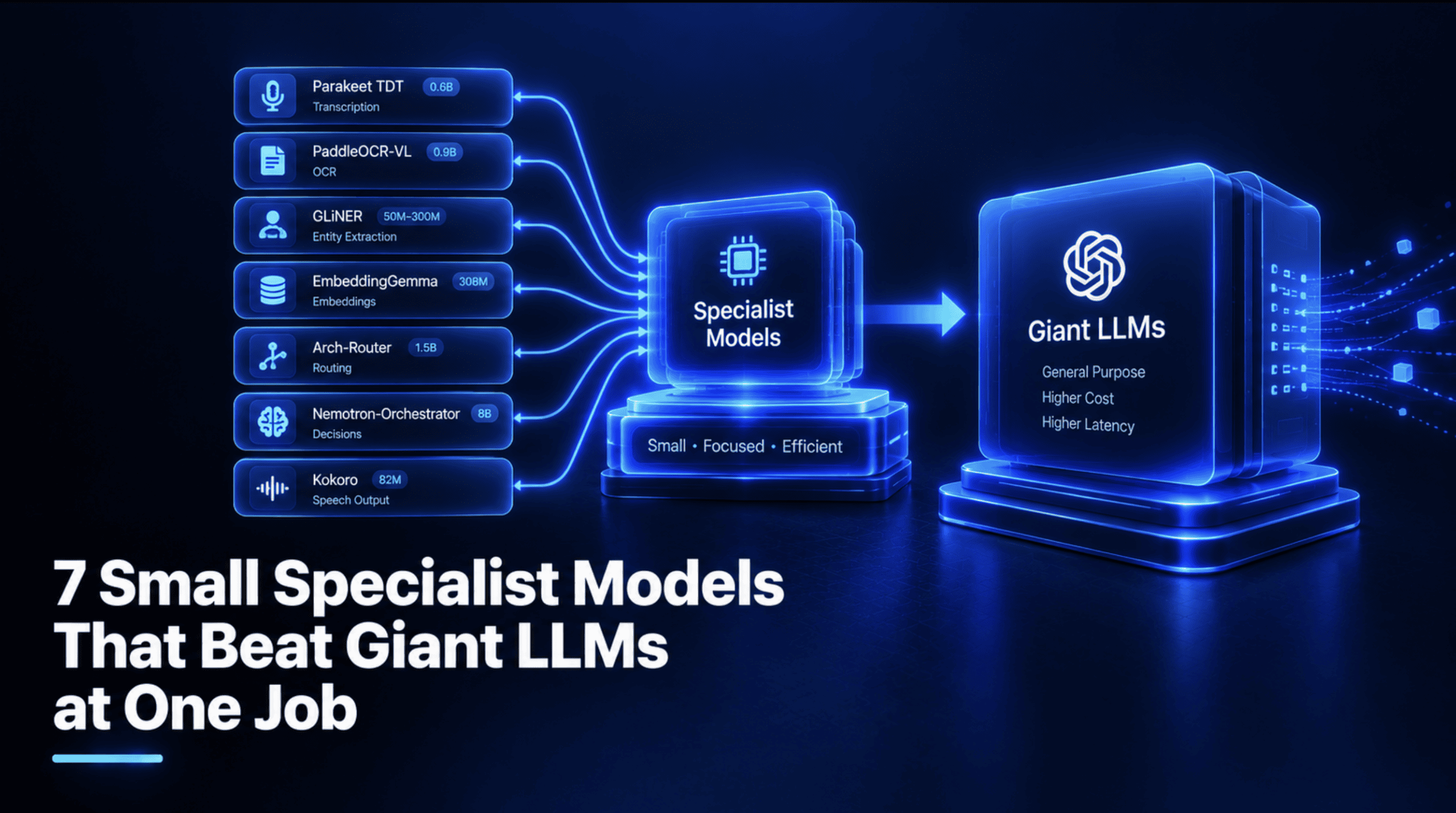
The bigger-is-better logic that has driven the AI industry for the last few years is starting to crack, and that is good news for anyone who actually uses these tools. Seven open specialist models under 10 billion parameters now match or beat much larger systems at specific tasks like transcription, OCR, routing, and speech. This is not a niche curiosity. It is a practical signal that the future of applied AI will be smaller, cheaper, and more targeted.
We have seen this pattern emerge before. LightMIS delivers expert-level image segmentation with 98% fewer parameters proved that a compact model can match a specialist's skill without the infrastructure burden. Meanwhile, Reflection's Beam Model Promises Efficiency but Hosting Costs Demand Scrutiny reminded us that even efficient architectures can carry hidden operational weight. The seven models in this story take the opposite approach: they are openly available, small enough to run on modest hardware, and built for one job. That is a design philosophy that puts the user's practical constraints first.
What does this mean for you? If you have been waiting for AI to become a reliable, cost-effective part of your daily workflow, the wait just got shorter. A general-purpose model that does everything well still demands GPU clusters and API budgets that make sense only for enterprise-scale deployments. A specialist model that does one task excellently can sit on a laptop, a local server, or a cheap cloud instance. For transcription, OCR, or routing, you no longer need to rent a supercomputer. You can download a model that fits in a few gigabytes and get work done.
The catch is the same one that applies to all open models: you need to know what you are looking for. These seven models will not replace a general assistant. They will not answer random questions or generate marketing copy. They will transcribe your meeting notes with high accuracy, extract text from scanned invoices, or route customer requests to the right team. That is a trade-off worth making. The cost savings and privacy advantages of running a model locally, with no data leaving your machine, often outweigh the convenience of a one-size-fits-all API.
The open question we are watching is how quickly the ecosystem around these models matures. Discoverability remains a problem. Finding the right specialist model for your task should be as easy as searching a package manager, but it is not there yet. AWS Launches ECS Gateway with Auto-Generated Hostnames for Simpler Networking points toward a future where infrastructure becomes invisible, letting teams focus on what the model does rather than how to reach it. Apply that same thinking to model discovery, and we might finally see specialist models become the default choice for targeted tasks. For now, the concrete takeaway is this: if you have a single repetitive data task, there is likely a small open model that can handle it better than the largest general-purpose system, and you can test it today without a credit card.