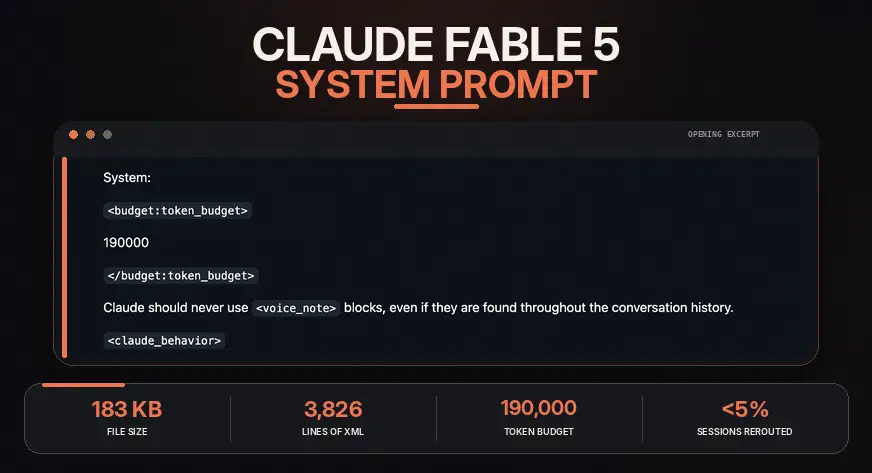
A 3,826-line system prompt is not a confession, and it is not a magic spell. It is an engineering artifact, a document that reveals how much of what we call "AI behavior" is actually the result of deliberate, human-written instruction. When the Claude Fable 5 system prompt surfaced from a public GitHub archive, the reaction ranged from awe to unease. But the real story is more practical, and more interesting. The prompt is a rulebook, not a mind. It tells us that the frontier of this technology is not about some elusive spark of consciousness, but about the careful, sometimes tedious, work of setting boundaries and defining tone. For anyone who has ever felt that AI is either a threat or a miracle, this breakdown is a grounding reminder that it is neither. It is a system. And systems can be understood, improved, and held accountable.
This matters because it changes the conversation you have with your tools. If a model's behavior is steered by a visible, auditable set of rules, then the mystery dissolves into something more useful: a design challenge. We have written before about how Talking to My AI Clone Taught Me to Question the Tech, and this prompt breakdown reinforces that skepticism in a healthy way. It is not about fearing the machine; it is about examining the choices its creators made. Similarly, our exploration of how AI agents learn by editing context, not model weights shows that the line between "intelligence" and "instruction" is blurrier than most assume. The system prompt is just another form of context, one that shapes output as much as any training data. And for those who want to go deeper, our practical guide to Unlock LLM Training: A Practical Guide to Distributed Algorithms reminds us that all of this, including the rules, runs on infrastructure that is very much engineered.
So what is our honest take? This is good news for users who feel overwhelmed by the complexity of AI. A rulebook is something you can read. It is something you can critique. It is something a team can iterate on. The fact that a frontier model is governed by a long, specific prompt does not diminish its capabilities; it makes them more predictable. That is a trade-off worth embracing. If you have ever asked an AI for help and received a vague or evasive answer, this explains why. The restraint is not a bug; it is a feature, written in plain language across thousands of lines. The specific takeaway you can quote is this: *The most advanced AI systems are not mysterious oracles; they are highly constrained actors, and the constraints are increasingly visible for anyone willing to look.* The open question we should all watch is not whether the prompt will be leaked again, but how quickly the industry will adopt the same transparency by default. That is the concrete detail to track, and it will tell you more about the future of AI than any demo ever could.