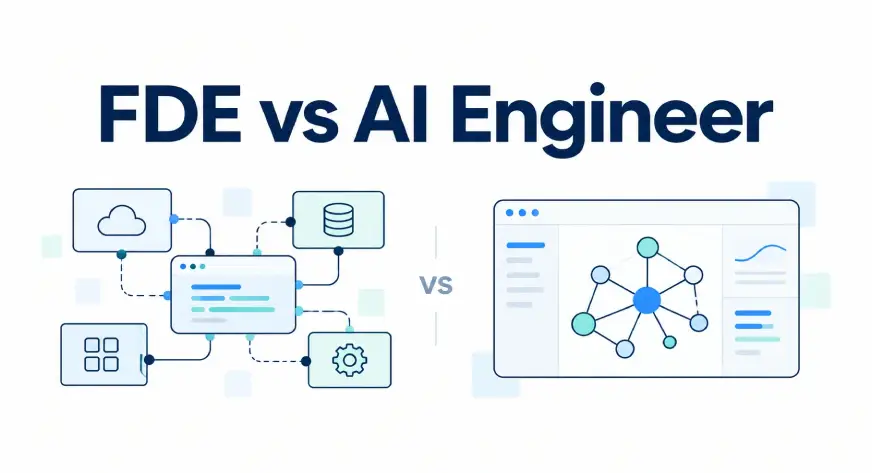
The same job posting, different working day. That is the story at the heart of the comparison between forward deployed engineers and AI engineers, and it matters more than the skills overlap suggests. Both roles demand Python, APIs, and cloud deployment, but the context of that work changes everything. An FDE traces a customer's approval process before writing an integration; a product AI engineer investigates why a model behaves unexpectedly. One is anchored to a specific user's workflow, the other to a model's internal logic. For anyone building a career in this space, the choice is not about which tools you learn, but which problems you want to own.
This distinction becomes sharper when you consider how AI is evolving from offline experiments into real-world deployment. In our piece on From offline precision to real-world robotics: testing AI action generation in motion, we saw how moving a diffusion-based action generator from a lab setting to a physical robot introduced friction that no benchmark could predict. That gap, between what works in isolation and what survives in the wild, is exactly where the FDE lives. The AI engineer may train the model, but the FDE is the one who finds out whether it actually works inside a customer's approval chain. Both roles need to understand the model, but one must also understand the person staring at the error screen.
The practical takeaway is this: if you are choosing between these paths, ask yourself where you want your feedback loop to come from. An AI engineer's feedback comes from metrics, logs, and evaluation sets, clean, measurable, and often delayed. An FDE's feedback comes from a customer who says "this integration broke my process," which is messy, immediate, and deeply human. That is not a knock on either role; it is a design constraint on your career. And as we saw when testing GPT-6.1 Terra in From Code to Calendars: Putting GPT-6.1 Terra's Practical Skills to the Test, even the most capable AI still struggles with context that shifts from one user to the next. That context is the FDE's daily reality.
One detail worth watching is how these roles converge as AI agents become more autonomous. If an AI agent can eventually trace a customer's approval process and write the integration itself, the distinction between the two roles could blur. But that is still a future question. For now, the difference is not in the skills listed on the job description. It is in who you talk to at the end of the day: a model or a person.