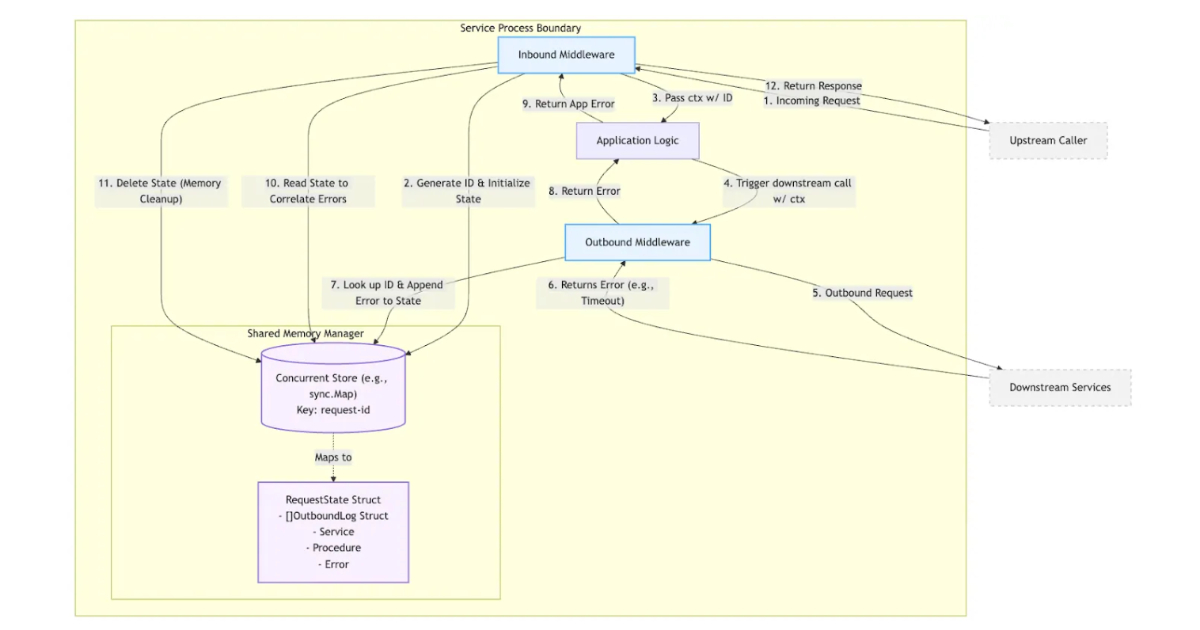
Uber's move beyond sampled tracing to classify dependency failures is a pragmatic step that many large-scale engineering teams will want to study closely. The company has built an automated system that uses RPC middleware and production metrics to determine whether a dependency is fail-close, fail-open, or unknown, directly addressing the blind spots that sampled distributed tracing leaves open. For anyone operating a service mesh of significant size, this is not just an incremental improvement, it is a necessary evolution in how we think about reliability.
The core problem Uber solved is a familiar one. Sampled tracing works well for common failure patterns, but rare failures in large meshes often slip through. When a downstream service degrades intermittently, traditional tracing might miss the correlation entirely. Uber's approach instead monitors every RPC call and correlates caller and downstream metrics in real time, classifying the dependency behavior without relying on a representative sample. This means teams can now distinguish between a dependency that fails gracefully (fail-open) and one that takes the entire caller down with it (fail-close). The practical takeaway is straightforward: if your organization depends on distributed tracing alone to understand failure modes, you are almost certainly missing a meaningful portion of your incident surface.
This kind of engineering pragmatism aligns with what we are seeing elsewhere in the industry. Ramp crosses $2B in revenue as 85,000 customers adopt its AI platform shows how companies are investing heavily in automation to scale financial operations, but that automation is only as reliable as the infrastructure underneath it. Similarly, Grafana Tempo 3.1 Empowers Operators to Redact Traces with Simple Queries highlights the industry's broader push to make observability data more manageable and actionable. Uber's system fits into this pattern: it is not about collecting more data, but about making the data you already have tell a clearer story about dependency health.
What makes Uber's approach noteworthy is that it does not require a new tracing standard or a complete infrastructure overhaul. By working at the middleware layer and using existing production metrics, the system can be adopted incrementally. That is a design choice worth applauding. Too many observability solutions demand that teams rip and replace their tooling before seeing any benefit. Uber's engineers chose a path that starts with what already exists and layers intelligence on top.
The open question is how this classification system will hold up as the mesh scales further. Uber's environment is already vast, and classifying dependencies as fail-close or fail-open is only useful if the system can keep pace with new services and changing traffic patterns. If this approach proves durable, expect to see similar patterns adopted by other organizations running large microservice architectures. The specific detail to watch is how Uber handles the "unknown" category, those dependencies that do not fit neatly into either bucket. That is where the next set of insights will come from.