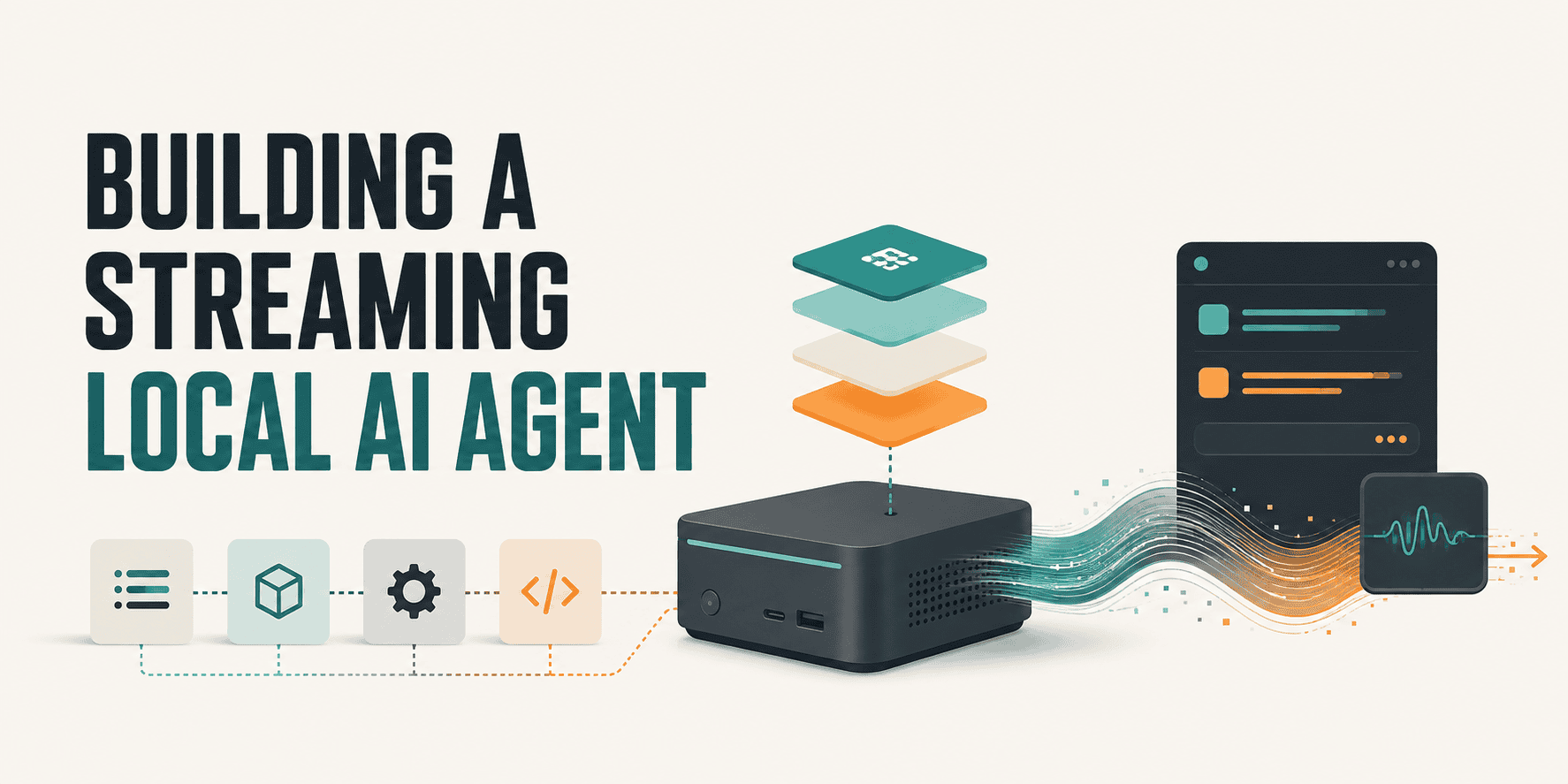
There's a quiet confusion at the heart of the current AI agent boom, and it's not about model quality or latency. It's about the word "streaming." When developers say they're building a streaming local AI agent, they often mean two entirely different things. One is token-by-token output, the other is event-driven, stateful execution. "Building a Streaming Local AI Agent" takes a scalpel to that ambiguity, and honestly, it's about time.
Here's the practical split. The first interpretation is what most users see: text appearing word by word, like a chat interface that feels alive. That's streaming as a presentation layer. The second is far more consequential: streaming as an architecture, where the agent continuously ingests data, reacts to events, and updates its own state in real time. That's not a cosmetic choice; it's a fundamental design decision. Conflating the two leads to agents that look responsive but aren't actually adaptive. We've seen this pattern before in the broader orchestration conversation. When Orchestrate AI Agents: Google Open-Sources AX for Enhanced Efficiency hit the scene, the emphasis was on managing autonomous workloads, not just firing off requests. And when Multi-Agent Coding Isn't Enough — Agents Need a Commitment Layer argued that communication gaps sink multi-agent systems, it was really making the same underlying point: the hard problem isn't generating output, it's managing state and intent over time.
So what's our honest take? The pushback on the lazy use of "streaming" is right, but it could go further. The real takeaway for builders is that if you're designing a local AI agent, you need to decide early whether streaming means "fast feedback" or "continuous reasoning." These are not interchangeable. A local agent that streams tokens but processes in rigid, batched cycles is still a batch system with a nicer face. Conversely, an agent that streams events but has no way to surface partial results to a user feels like a black box. The best path forward is to treat streaming as a spectrum, not a checkbox. Use token streaming for user experience, but build an event loop that can handle interruptions, new data, and mid-task corrections. That's the difference between a demo and a tool.
We'd tell a reader this: if you're evaluating or building a local AI agent, ask the streaming question twice. First, "Does it stream output?" Second, "Does it stream input and state?" If you only get a yes to the first, you're not building an agent; you're building a glorified autocomplete. The real contribution is giving you the vocabulary to ask that second question. And that matters because the industry is already moving toward more complex orchestration, as seen in Presentation: Context Engineering at LinkedIn: How We Built an Organizational Context Layer for AI Agents with MCP, where the challenge isn't generating a response but maintaining a coherent, live context across systems.
Here's the concrete thing to watch: when you read the next agent announcement, count how many times "streaming" refers to the architecture versus the animation. If the answer is zero for the former, you're likely looking at a static system with a real-time costume.