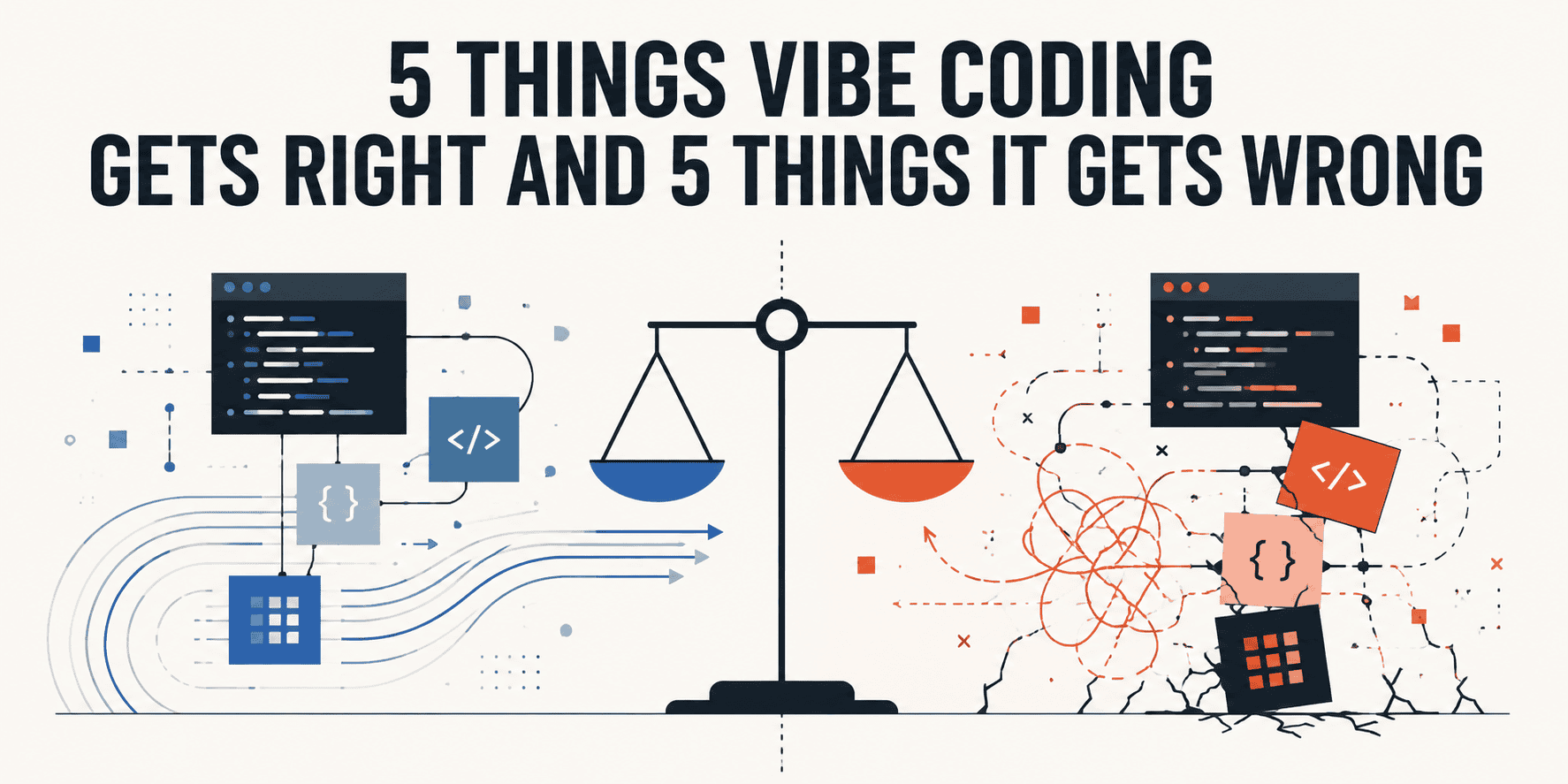
The debate around vibe coding usually collapses into caricature: either it is the end of programming as we know it, or it is a moral failing dressed up as productivity. Asking what vibe coding gets right and wrong is more honest than most, because the real answer is that it is neither. It is a new constraint set. And like any constraint, it rewards those who understand its edges. For our readers, the practical question is not whether vibe coding is good or bad, but where it fits in a workflow that already demands judgment.
Start with what it gets right. Vibe coding lowers the activation energy for turning an idea into something runnable. That matters more than most critics admit, because the hardest part of software is often the first blank page. The related success story of Vibe Coding Drives Lovable Past $600M in Annual Revenue suggests that this is not a niche experiment. People are paying real money to move faster, and they are getting nearly a billion monthly views on what they build. That is not a shortcut to nowhere. That is a signal that the demand for speed is not going away just because purists prefer deliberation.
But here is where the voice of experience has to step in. Vibe coding gets it wrong when it confuses momentum with mastery. What comes easily is also what is hardest to debug later. The same frictionless generation that lets you ship a prototype in an afternoon can produce a codebase that no one fully understands by Friday. This is not a knock on the tool. It is a reminder that the skill is still in the reading, not the writing. As we noted in Unlock Python's Potential: Advanced Techniques for Smarter Coding, leveling up rarely means new syntax. It means learning what the language already promised you. The same applies here: vibe coding is a new way to express intent, but it does not replace the need to understand what the intent should be.
What we would tell a reader who asks whether they should embrace this is simple: use it for the parts of your work that are exploratory, not for the parts that are contractual. Prototypes, internal tools, data munging, throwaway scripts. That is where the leverage is real. But if you are building something that will be maintained by others, or that needs to behave predictably under load, then the discipline of review, testing, and explicit structure still applies. The tools are changing, but the bar for what counts as working software is not. And if you are curious about how the ecosystem is evolving beyond the hype, the customizable platform approach in Empower Robotics Development with Feather's Customizable Platform shows that even hardware-adjacent teams are betting on developer control over pre-built magic.
The honest take is that vibe coding is not the future of programming. It is the present of a specific kind of programming, and the mistake is treating those two as the same. The concrete point to watch is not whether the code gets written, but who is left holding the maintenance burden six months from now. That is the bill that always comes due. And no amount of vibe is going to pay it.