Why DeepSeek-V4.1-Flash Is Such an Exciting Open Model Release
Our take
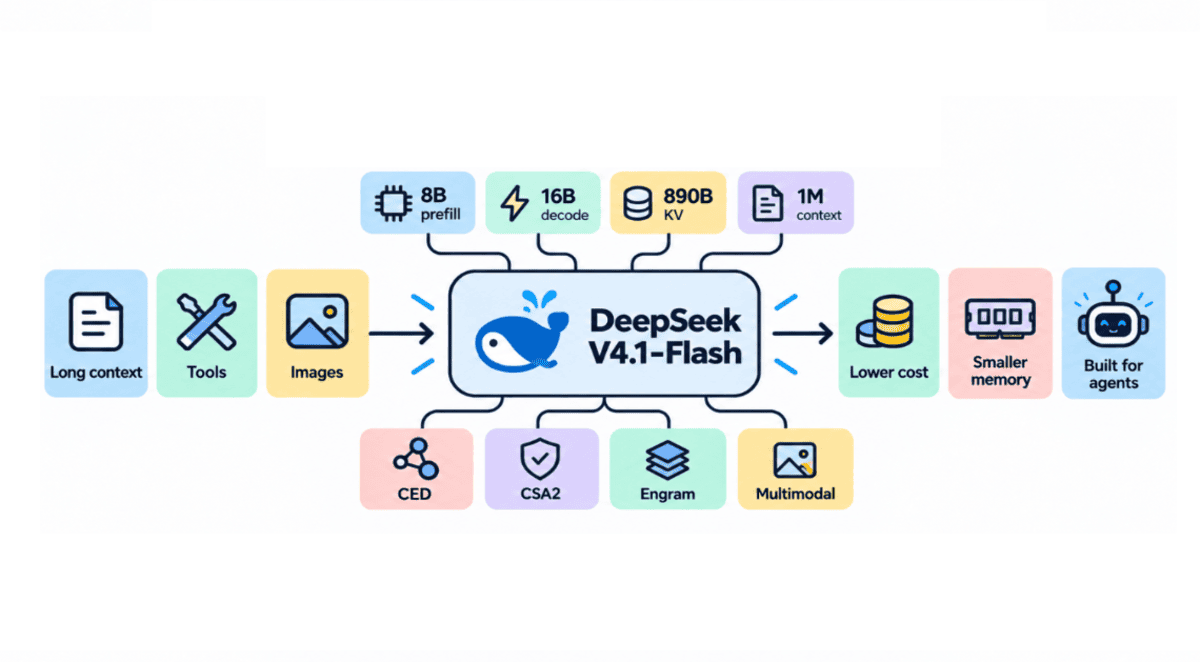
The recent release of DeepSeek-V4.1-Flash is generating considerable excitement, and rightfully so. It represents a significant step forward in the accessibility of powerful AI models, demonstrating that frontier-level performance doesn't necessarily demand exorbitant computational resources. The model’s architecture, leveraging a Causal Encoder-Decoder structure combined with innovations like MoE (Mixture of Experts), KV cache compression, CSA2 (Context Sequence Attention 2), and efficient decoding techniques, fundamentally shifts the landscape for open-source AI development. We’ve seen similar efforts to optimize model size and efficiency, such as Cloudflare's exploration of [Cloudflare Tests Cache Transcoding to Reduce Storage Requirements], which highlights the broader industry push to minimize resource demands. Furthermore, the ongoing discussion around the importance of technical reports in academic applications, as explored in [How much do tech reports matter for a PhD application? [D]], underscores the value of publicly accessible models and research, enabling wider scrutiny and collaboration within the AI community.
What makes DeepSeek-V4.1-Flash particularly compelling is its focus on efficiency without sacrificing quality. The integration of techniques like KV cache compression and CSA2 directly addresses the bottlenecks that often plague large language models, allowing for faster inference and reduced memory footprint. This isn’t merely an incremental improvement; it’s a demonstration of how intelligent architectural choices can unlock substantial gains in performance per unit of compute. This is especially relevant given the growing complexity of models and the escalating costs associated with training and deployment. The work done by GitHub on Project HydraFusion, detailed in [GitHub Copilot's Project HydraFusion Promises Frontier Level Performance Through Multi-Model Routing], further illustrates the industry’s focus on optimizing performance through innovative architectural approaches and runtime strategies – DeepSeek’s release aligns seamlessly with this broader trend. The ability to run powerful models on more accessible hardware democratizes access to advanced AI capabilities, potentially fostering innovation across a wider range of applications and user bases.
The implications of this development extend beyond simply reducing operational costs. Efficient models open up new possibilities for edge computing, allowing AI to be deployed directly on devices rather than relying on cloud-based infrastructure. This has profound implications for applications requiring low latency or operating in environments with limited connectivity, such as autonomous vehicles, robotics, and personalized healthcare. Moreover, the open-source nature of DeepSeek-V4.1-Flash encourages community contributions and accelerates the pace of innovation. Researchers and developers can build upon this foundation, fine-tuning the model for specific tasks and exploring new applications. This collaborative approach fosters a more vibrant and diverse AI ecosystem, moving beyond the control of a few large corporations. The ease of access also empowers smaller teams and individual researchers to experiment with state-of-the-art models, leveling the playing field and potentially uncovering unforeseen breakthroughs.
Ultimately, DeepSeek-V4.1-Flash isn't just about a single model; it's about a paradigm shift in how we approach AI development. It demonstrates that achieving impressive performance doesn’t require an ever-increasing scale of resources, but rather a more thoughtful and innovative application of architectural principles. As the cost of compute continues to be a significant barrier to entry, the focus on efficiency will only intensify. The question now becomes: will this trend toward optimized architectures become the defining characteristic of the next generation of open-source AI models, and how will this impact the broader landscape of AI research and deployment?
Read on the original site
Open the publisher's page for the full experience