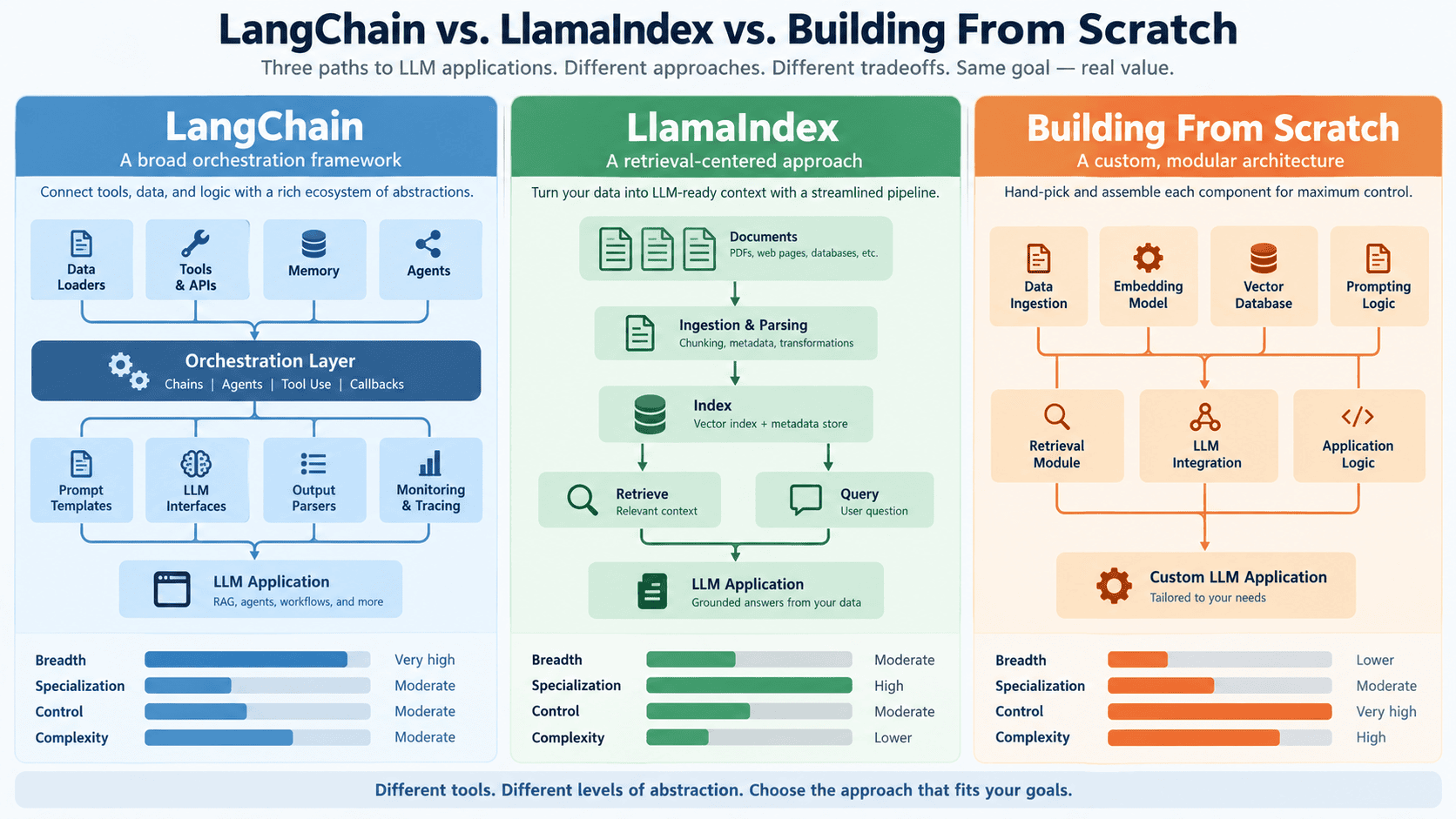
Choosing the right framework for your large language model application isn't about picking the most popular name or the one with the most stars on GitHub. It comes down to one honest question: what are you actually optimizing for? As more teams build with LLMs, this question surfaces a tension that too many developers avoid until it's too late. We think the answer should drive your choice from day one, not after you've already committed to a stack.
This framing matters because a framework that excels at rapid prototyping often struggles under production load, and one built for strict governance may crush your team's ability to iterate. Consider the work Google researchers recently released: Explore How Adaptive Training Environments Help AI Agents Learn from Weaknesses. That framework optimizes for dynamic adaptation, letting agents improve by confronting their own gaps. It's a different goal than, say, the constraint-heavy approach American Express is taking with its shopping agents. Their American Express gives AI shopping agents a clear rulebook for authorized purchases framework optimizes for safety and auditability above all else. Neither is wrong. They're optimizing for different outcomes, and that distinction is exactly what you need to name for yourself.
If you're building an internal tool where speed and experimentation win, you likely want a lightweight framework that stays out of your way. If you're deploying an agent that handles financial transactions, you probably need the guardrails Amex is betting on. The mistake is assuming that because a framework worked for someone else's use case, it will work for yours. We see teams waste months retrofitting a framework that was designed for a different set of trade-offs. Start by writing down the single metric that matters most for your application, latency, cost per call, developer velocity, compliance, and let that be your north star. Everything else is negotiable.
One concrete takeaway: before you evaluate any framework, write down what failure looks like for your application. If the worst case is a slightly off response, optimize for flexibility. If the worst case is an unauthorized purchase or a compliance violation, optimize for control. That distinction will save you more time than any feature comparison. The frameworks themselves are evolving fast, as the work on smarter resource use like Smarter resource use: how batching transforms LLM performance shows, but the core question remains unchanged. The right framework is the one that matches your optimization target, not the one that promises to do everything.