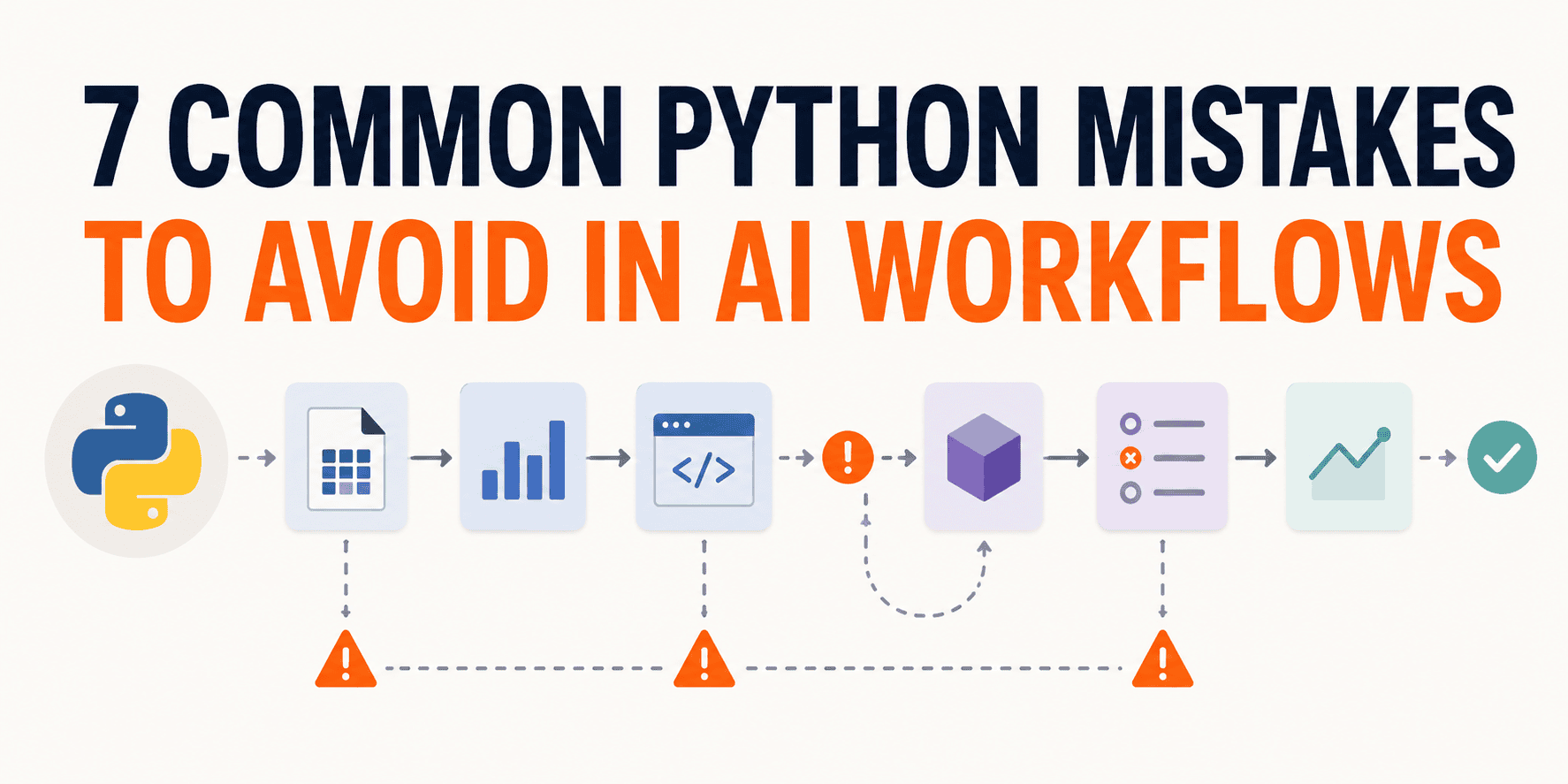
A clean run in Python is satisfying. The script executes, the logs roll by, and the process exits with a zero. It feels like progress. But a clean run only proves the process executed. It says nothing about what the pipeline learned, from which rows, in what state, or whether the saved result can be trusted anywhere else. That distinction matters more as AI workflows mature, because the cost of a silent failure is not a crash. It is a confident, wrong answer.
The piece on avoiding common Python mistakes in AI workflows is really about the gap between code that runs and code that reasons. Most practitioners have been burned by this. You train a model, the loss curve looks healthy, and the validation metrics are solid. Then you push the artifact to production and the behavior falls apart. The issue is rarely the algorithm. It is the data lineage, the preprocessing steps, the feature order, or the random seed that was not pinned. The focus correctly shifts from syntax errors to structural errors: the assumptions you make about your data and your environment that quietly invalidate your results. This is not a beginner problem. It is an expert problem dressed in beginner clothing.
We would tell a reader who asks about this: stop treating your notebook as a deliverable and start treating your pipeline as a product. The related pieces we have published reinforce this view. For example, Unlock LLM Training: A Practical Guide to Distributed Algorithms shows that distributed training fails for the same reason local scripts fail: a lack of reproducibility across nodes. Meanwhile, Verify Your AI's Understanding: A Simple Check for Tax Season demonstrates that verification is not a nice-to-have when the output has real consequences. And Navigating AI/ML Job Requirements: A Shift in Expected Skills suggests that the market is finally demanding engineers who understand the difference between writing code and building systems. These are not separate conversations. They are the same conversation.
The practical takeaway here is not to memorize a list of common mistakes. It is to change your definition of done. A task is not finished when the script runs. It is finished when you can trace every row of data, every transformation, and every model weight back to a reproducible state. That means logging the data version. It means freezing your dependencies. It means checking that your saved model loads correctly in a fresh environment, not just in the one where you trained it. The warning against assuming a clean run means a correct run is right. We would go further: assume the opposite. Treat every unverified step as a potential source of error until you have evidence otherwise.
The specific consequence to watch is this: as AI workflows become more automated, the pressure to trust outputs without inspection will grow. The teams that survive that pressure will be the ones that build verification into their process from the start. The ones that do not will ship models that fail quietly, and they will not know why until the data tells them. That is the open question we are watching: how long until the industry treats reproducibility as a non-negotiable requirement rather than an afterthought? The evidence suggests that shift is already underway. The question is whether you are leading it or catching up.