Beyond Market Intelligence

Acme AI is the next-generation, AI-powered spreadsheet platform built to replace Excel and redefine how analysts, data scientists, and enterprise teams work with data. Read more

Page 15

🐈Machine Learning
Machine Learning

The evaluation resolution has been shown to have a significant impact on the identification of the "learning rule" that exhibits the most brain-like characteristics at V1. [R]

Recent research challenges a widely held assumption in model-brain comparisons: that untrained convolutional neural networks (CNNs) can rival or exceed backpropagation-trained networks in early visual cortex (V1) representation. This study demonstrates that this apparent alignment is largely an artifact of evaluation resolution. Through rigorous testing across resolutions and learning rules, researchers observed a widening gap between untrained and backpropagation-trained models, highlighting the critical influence of resolution matching.
Build an End-to-End Data Science Project with Grok Build and Grok 4.6
KDnuggets

Build an End-to-End Data Science Project with Grok Build and Grok 4.6

Ready to build a production-ready data science project from start to finish? With Grok Build and Grok 4.6, you can streamline your workflow, encompassing everything from Exploratory Data Analysis (EDA) and scikit-learn model training to FastAPI API creation, rigorous testing, and seamless cloud deployment. This comprehensive approach empowers you to transform raw data into impactful, scalable solutions. For a deeper dive into related techniques, explore our recent article on "Implementing Watermarking for Language Models."
🐈Machine Learning
Machine Learning

I developed my own quantized LLM from scratch, trained on 30B tokens, deploys in 60 MB [R]

A remarkable achievement in efficient AI development has emerged: a 250M parameter language model, SHADOW-250M, deployed in a remarkably compact 60 MB footprint. Trained on 30B tokens and quantized to under 2 bits, this model achieves 400 tokens/second on a standard laptop CPU – no GPU required. Notably, it leverages a unique long-context system compressing older tokens to disk for retrieval, enabling up to 100 million tokens of history.
🐈Machine Learning
Machine Learning

Archival vs non archival workshop [R]

Understanding NeurIPS workshop archiving is crucial for maximizing the impact of your work, particularly for graduate school applications. A key distinction exists: NeurIPS workshops, like many others, are typically non-archival. Consequently, publication in a proceeding may carry less weight than a peer-reviewed journal. For context, consider how preprints and subsequent publications are handled—a discussion explored in our article, "How to cite/talk about preprint-subsequent works for a camera-ready version?". Prioritize venues that offer robust archival to strengthen your academic record.
🐈Machine Learning
Machine Learning

How to cite/talk about preprint-subsequent works for a camera-ready version? [R]

Navigating citations when a paper transitions from preprint to a conference camera-ready can be nuanced. To maintain both novelty and acknowledge impactful subsequent work, consider citing your preprint initially, then clearly state it's the precursor to the current publication. Acknowledge any works building upon your preprint’s methodology, demonstrating its influence. This approach transparently reflects the research lineage. For further insights into related challenges in AI research integrity, explore "AAAI 2027 Reviewer Bidding and Assignment Integrity [D]" for a deeper understanding of evolving ethical considerations.
Podcast: The Human Edge: Why Brownfield Codebases Need Mob Programming, Not Just AI Vibes
InfoQ

Podcast: The Human Edge: Why Brownfield Codebases Need Mob Programming, Not Just AI Vibes

Beyond continuous deployment and pair engineering, Asgaut Mjølne Söderbom and Ola Hast explore the evolving landscape of software development in this episode of *The Human Edge*. They delve into recent experiments with AI coding tools like Claude Code, ultimately finding it valuable for many tasks but not ideal for core coding. The conversation builds directly on their previous discussion, offering a practical perspective on integrating AI into established workflows, particularly within complex, brownfield codebases.

🐈Machine Learning
Machine Learning

BMVC 2026 IJCV recommendation? [D]

Navigating the BMVC to *IJCV* special issue recommendation process can be complex. Recommendations aren't solely based on review scores; the Area Chairs and Program Chairs consider factors like oral or highlight selection and nuanced reviewer feedback. Currently, there’s no way to proactively determine if a paper has been recommended—authors are notified via a separate communication. For deeper insights into AI research replication, consider our recent piece on Inherent and their AI agent, Faraday, which recently outperformed leading models.
🐈Machine Learning
Machine Learning

Implementing Watermarking for Language Models [P]

Recently, curiosity surrounding Anthropic's plans to watermark language model responses led to an exploration of subtle statistical patterns – not visible messages – embedded during token selection. I’ve implemented a simplified, educational version of this technique, inspired by SynthID-Text, to better understand the concept. While not a direct reproduction, the core idea remains. Explore the implementation and its potential implications on GitHub: [https://github.com/Saad1926Q/llm-watermark](https://github.com/Saad1926Q/llm-watermark). For a deeper dive into related challenges in AI research, see our discussion on AAA
Article: Rightsizing Platform Engineering: Building the Platform Your Organization Actually Needs
InfoQ

Article: Rightsizing Platform Engineering: Building the Platform Your Organization Actually Needs

Shift-left and DevOps practices, while valuable, have inadvertently increased cognitive load and duplicated effort within engineering workflows. This article, "Rightsizing Platform Engineering," addresses the critical need to build developer platforms that genuinely meet organizational needs, reducing complexity and accelerating change delivery. John Keates explores the practical challenges and cultural considerations essential for success. For deeper insights into related workflows, see "Spec-Driven Development with Claude Code" and discover potential pitfalls in specification design.
🐈Machine Learning
Machine Learning

Why does lightgbm not fit my toy example but catboost does? (2 order interactions) [D]

Understanding how tree-based models handle interaction effects can be surprisingly complex. This exploration highlights a peculiar scenario: LightGBM struggles to fit a simple toy example exhibiting a two-way interaction, while CatBoost achieves a perfect fit. The dataset, designed with equal target means across explanatory variable values and a clear interaction variable ("AB"), reveals LightGBM's inability to capture the relationship. This prompts a crucial question: what differentiates CatBoost’s approach—does it prioritize more aggressive splitting—allowing it to model interactions effectively, even without explicit interaction terms?
🐈Machine Learning
Machine Learning

COLM 2026 registration sold out as an author [D]

As a newly accepted author at COLM 2026, securing registration has proven unexpectedly challenging. The author registration period closed, and despite remaining on the waitlist since August 10th, access was lost. Many authors face similar questions regarding conference logistics, as highlighted in our recent article, "AAAI 2027 Reviewer Bidding and Assignment Integrity." Explore potential avenues for late registration or financial assistance; while unlikely, opportunities may arise. We encourage you to monitor the conference website for updates and any announcements regarding additional spots.
🐈Machine Learning
Machine Learning

[N] EACL 2027 Industry Track - Deadline 11 September [N]

The EACL 2027 Industry Track offers a vital platform to showcase practical insights and emerging challenges in deploying language technologies. We invite submissions from industry, government, and non-profit organizations—those building real-world applications beyond the core NLP community. Papers, limited to six pages (excluding references and appendices), require a dedicated "Limitations" section for acceptance. The deadline is approaching: **September 11, 2026**. For details, see the full CFP and consider contributing as a reviewer.
Presentation: Prompt to Prod: Engineering an Autonomous SDLC at Scale
InfoQ

Presentation: Prompt to Prod: Engineering an Autonomous SDLC at Scale

Unlock scalable, autonomous software development with "Prompt to Prod," a presentation by Andrew Swerdlow detailing Roblox's journey to trusted, automated deployments. Swerdlow explores critical elements: secure sandboxes, leveraging code review exemplars for knowledge capture, infrastructure evolution, and redefined productivity metrics centered on feature velocity and AI-powered workflows. Learn how to achieve robust automation at scale—a vital shift in modern engineering. For further insight into evolving software practices, explore "Podcast: The Human Edge" and discover the value of mob programming.
🐈Machine Learning
Machine Learning

28 TPS on Qwen2.5-7B across two separate cloud regions over public WAN using speculative decoding + CUDA Graphs [P]

Recent benchmarking demonstrates transformative gains in distributed LLM inference using ShardFlow, a new framework designed to split HuggingFace transformers across multiple GPUs. Utilizing speculative decoding and CUDA Graphs, we achieved a peak of 28.10 tokens per second (TPS) on Qwen2.5-7B across two geographically separated GCP regions (Iowa & Oregon) connected via a public WAN – a setup exhibiting approximately 86ms round-trip latency. This highlights a key insight: speculative decoding minimizes latency impact, shifting costs from per-token to per-round.
🐈Machine Learning
Machine Learning

AAAI 2027 Reviewer Bidding and Assignment Integrity [D]

Recent concerns regarding reviewer collusion at AAAI 2027, particularly within two-cycle review assignments, highlight a critical challenge in maintaining research integrity. The prevalence of submissions from a single geographic region increases the likelihood of these problematic pairings, potentially enabling unethical behavior.
IBM’s next-gen mainframe chip is the first to run Arm and Z workloads on the same cores
VentureBeat

IBM’s next-gen mainframe chip is the first to run Arm and Z workloads on the same cores

IBM is redefining mainframe architecture with a groundbreaking new chip, the first to natively run both IBM’s Z instruction set and Arm workloads on the same cores—a shift poised to transform enterprise data management. This dual-architecture processor, debuting in the next generation of IBM Z and LinuxONE systems, seamlessly integrates Arm's expansive software ecosystem, including vital AI frameworks, alongside traditional z/OS transaction processing.
🐈Machine Learning
Machine Learning

acl arr august 2026 (desk rejected ) [D]

Experiencing a desk rejection from ACL citing prior review, despite never submitting the work, is understandably frustrating. It suggests a potential issue with reviewer records or a possible mix-up. While a definitive solution is challenging without further investigation, carefully review submission logs and consider contacting the ACL program chairs with detailed documentation of your submission history. This situation highlights the importance of understanding conference archival policies, as discussed in our related article, "Archival vs non archival workshop."
JDK 27 and JDK 28: What We Know So Far
InfoQ

JDK 27 and JDK 28: What We Know So Far

JDK 27 marks a significant step forward in Java’s evolving landscape, representing the second non-LTS release following JDK 25. Currently in release candidate phase, it introduces nine key features categorized across Core Java Library, HotSpot, Security Library, and the Java Language Specification. Examining JDK 27 allows us to anticipate the direction of JDK 28, and we’ll explore potential feature targets. This analysis, by Michael Redlich, offers insights into the future-focused development of Java.
Enterprise AI agents are only as reliable as the messiest documents behind them
VentureBeat

Enterprise AI agents are only as reliable as the messiest documents behind them

Enterprise AI's potential is often hampered by the disorganized data underpinning it. While context engineering—connecting systems, generating embeddings, and building retrieval pipelines—works for isolated assistants, it treats enterprise knowledge as application-specific, leading to inconsistency and duplicated effort. As AI deployments expand, managing enterprise knowledge itself becomes paramount. A shared enterprise knowledge platform, akin to an enterprise data platform, offers a solution, organizing knowledge into layers for preservation, normalization, integration, and optimized serving—a foundation for reliable, scalable AI.
Uber faces fine of nearly $1B over automated driver suspensions
TechCrunch

Uber faces fine of nearly $1B over automated driver suspensions

The Dutch Data Protection Authority has levied a significant €825 million fine against Uber, marking the second largest penalty ever issued under Europe’s GDPR. This substantial fine stems from Uber’s practice of suspending drivers without adequate due process. The decision underscores the importance of data protection and responsible AI implementation. As enterprises increasingly leverage AI agents, it’s crucial to consider limitations on autonomy, as explored in our recent article, "Enterprises winning with AI agents are limiting how much the agents can do alone."
Linkdaze’s smart calendar is built to run a household, not just track a schedule
TechCrunch

Linkdaze’s smart calendar is built to run a household, not just track a schedule

Linkdaze’s smart calendar reimagines digital organization, moving beyond simple scheduling to actively manage a household. Unlike many competitors, Linkdaze offers powerful features—including an integrated AI meal planner—without hidden fees or paywalls. This future-focused approach empowers users to streamline daily life with accessible, intelligent tools. For those interested in the broader challenges of AI and complex systems, our recent article, "Bug Detection Blind Spots in AI Coding Harnesses," explores similar limitations and unexpected hurdles.
Who’s behind the new ‘stealth model’ Ox Alpha?
TechCrunch

Who’s behind the new ‘stealth model’ Ox Alpha?

The emergence of Ox Alpha, a newly surfaced AI model, has ignited considerable online discussion. Little is publicly known about the entity behind its development, fueling speculation across the AI community. While details remain scarce, Ox Alpha’s capabilities suggest a significant investment and a progressive approach to AI development. This development raises broader questions about data sourcing and responsible AI practices, as explored in our article, "Is it legal to train AI models on copyrighted books?".
Cloudflare OS: Cloudflare's Open-Source Corporate AI Platform Built on a Capability-Based Model
InfoQ

Cloudflare OS: Cloudflare's Open-Source Corporate AI Platform Built on a Capability-Based Model

Cloudflare OS, now open-source, represents a progressive shift in enterprise AI. This capability-based platform empowers teams to generate work artifacts rooted in company knowledge, automate workflows with optimized efficiency, and build customized work software within a secure environment. Unlike approaches prioritizing full autonomy, Cloudflare OS strategically employs AI assistance only when needed, maximizing cost-effectiveness. See how Cloudflare itself leveraged this approach to significantly reduce GitHub issues, as detailed in "Cloudflare Cuts Astro Github Issues by 85% with AI Agents."
Google's HEIR Aims to Make Homomorphic-Encrypted Inference a One-Click Capability
InfoQ

Google's HEIR Aims to Make Homomorphic-Encrypted Inference a One-Click Capability

Google’s HEIR introduces a significant advancement in secure AI: one-click homomorphic-encrypted inference. This open-source compiler and development toolchain simplifies deploying computations on encrypted data, a critical step for privacy-preserving AI. HEIR efficiently compiles existing, unencrypted AI models, enabling them to process data securely without decryption. This innovative approach empowers developers to readily integrate privacy-enhancing technologies, fundamentally transforming how AI interacts with sensitive information and accelerating the adoption of homomorphic encryption.
Survival Analysis and the Cox Proportional Hazards Model: A Beginner-Friendly Guide
Towards Data Science

Survival Analysis and the Cox Proportional Hazards Model: A Beginner-Friendly Guide

Unlock the power of understanding time-to-event data with our beginner-friendly guide to Survival Analysis and the Cox Proportional Hazards Model. We demystify essential concepts, from Kaplan-Meier curves to hazard ratios, providing clear explanations and actionable insights. Throughout, you'll find runnable Python code to solidify your understanding and apply these techniques to your own datasets. If you're interested in managing complex data relationships, consider "Multi-Document RAG" for a deeper dive into document intelligence. Empower your data journey—start exploring today.
Flock CEO calls for ‘compromise’ as surveillance company faces growing backlash
TechCrunch

Flock CEO calls for ‘compromise’ as surveillance company faces growing backlash

Flock Safety’s CEO is advocating for compromise amidst escalating public concerns regarding the potential for misuse of the company’s surveillance technology. The growing backlash highlights a critical juncture for AI-powered data management solutions. Flock’s situation underscores the need for transparency and ethical considerations within the rapidly evolving landscape of real-time data analysis. It's imperative that innovation prioritizes responsible implementation, empowering communities while safeguarding privacy—a future-focused approach essential for building trust.
Parse the Folder, Not Just the PDFs: The Relational Tables RAG Needs on a Case File
Towards Data Science

Parse the Folder, Not Just the PDFs: The Relational Tables RAG Needs on a Case File

Traditional Retrieval-Augmented Generation (RAG) often focuses on parsing individual PDFs, but a more effective approach prioritizes understanding the relational structure *within* a case file folder. Our latest Enterprise Document Intelligence report, Vol. 1 #14D, reveals that the most valuable data for RAG isn't found in retrieval questions, but in identifying and leveraging the core relational tables. This allows for a future-focused approach, empowering users to anticipate case demands *before* even opening a file.
Bug Detection Blind Spots in AI Coding Harnesses (GStack and Beyond)
Towards Data Science

Bug Detection Blind Spots in AI Coding Harnesses (GStack and Beyond)

Recent debugging experiments across AI coding harnesses, including GStack, reveal a surprising truth: AI models often struggle less with code complexity than with incomplete information. Analyzing 28 distinct debugging scenarios, our research demonstrates a consistent pattern of blind spots arising from missing context. This highlights a critical area for improvement in AI development. To understand the broader implications for data accessibility, explore "Parse the Folder, Not Just the PDFs," which details the relational table needs for robust RAG systems.
🐈AI News & Strategy Daily | Nate B Jones
AI News & Strategy Daily | Nate B Jones

OpenAI Pays $280,000 For This Job. You Don't Have To Be An Engineer.

OpenAI recently made headlines, investing $280,000 in a role that didn't require engineering expertise. This highlights a significant shift: the demand for skilled prompt engineers and AI trainers is surging. It’s an accessible entry point into the AI landscape, emphasizing the power of clear communication and strategic instruction over traditional coding skills. Explore how you can leverage your analytical abilities to shape the future of AI—it’s a future-focused opportunity.
TechCrunch Mobility: The custom chip driving Waymo’s robotaxi ambitions
TechCrunch

TechCrunch Mobility: The custom chip driving Waymo’s robotaxi ambitions

Welcome back to TechCrunch Mobility, your definitive source for the evolving landscape of transportation. A recent deep dive reveals Waymo’s strategic advantage: a custom chip meticulously engineered to power its robotaxi ambitions. This bespoke silicon significantly enhances processing capabilities for autonomous driving, enabling faster decision-making and improved safety. Explore how this innovative hardware investment positions Waymo as a leader, moving beyond off-the-shelf solutions toward a future-focused, self-driving ecosystem.
Spec-Driven Development with Claude Code: Writing Bulletproof Specs
Analytics Vidhya

Spec-Driven Development with Claude Code: Writing Bulletproof Specs

Successfully leveraging Claude Code through spec-driven development reveals a critical nuance: even well-crafted specifications can lead to unexpected outcomes. Experience demonstrates that Claude can diligently execute plans, pass test suites, and still produce flawed code—a failure mode often overlooked. This post explores strategies for writing "bulletproof" specifications, ensuring alignment between intent and implementation. Discover how to proactively mitigate this risk and unlock the full potential of AI-assisted coding. For further insights into AI agent capabilities, see our article on Inherent’s Faraday.
Is it legal to train AI models on copyrighted books? It’s complicated
TechCrunch

Is it legal to train AI models on copyrighted books? It’s complicated

The legality of training AI models on copyrighted books presents a complex and evolving challenge. Many published authors, often unknowingly, have contributed to the datasets powering AI tools now poised to impact their profession. The question of whether this constitutes infringement is at the heart of ongoing debate. While the situation seems inherently problematic, definitive legal answers remain elusive. For deeper insights into related discussions surrounding AI and investment, explore our article, "Will the DOJ’s investigation into a16z spook other VCs?".
OVHcloud Raises Prices as AI Memory Demand Reprices Non-AI Infrastructure
InfoQ

OVHcloud Raises Prices as AI Memory Demand Reprices Non-AI Infrastructure

Driven by unprecedented demand for AI-optimized memory, OVHcloud will adjust pricing across its infrastructure, beginning in September. Recent server models, including 2026-edition gaming servers (up 87%), and other contemporary systems will see increases of 40-59%. Founder Octave Klaba attributes this shift to RAM suppliers prioritizing high-bandwidth memory for AI applications, resulting in a sixfold increase in memory costs since last year. This follows a similar repricing action by AWS, demonstrating a broader industry trend.
Two years after launch, Walmart’s Flipkart is closing in on India’s quick-commerce leaders
TechCrunch

Two years after launch, Walmart’s Flipkart is closing in on India’s quick-commerce leaders

Two years after its launch, Flipkart's quick-commerce service is rapidly gaining ground in India's competitive landscape. The venture is now consistently fulfilling between 1.1 and 1.2 million orders daily—a remarkable threefold increase from November volumes. This surge demonstrates Flipkart’s focused strategy and efficient execution within the quick-commerce sector. As a result, Flipkart is closing in on the leading players, signaling a significant shift in India’s online delivery ecosystem and empowering consumers with accessible, rapid fulfillment.
DRAM Controller Register Manipulation Breaks CPU Memory Isolation
InfoQ

DRAM Controller Register Manipulation Breaks CPU Memory Isolation

A critical vulnerability impacting modern CPU memory isolation has been identified by security researcher Christopher Domas. His open-source tool, skitter-creek-bath-salts, exploits DRAM controller register manipulation, effectively bypassing privilege boundaries. This allows unprivileged software to access protected memory regions, a significant concern for cloud and confidential computing environments. The discovery highlights a fundamental architectural weakness, prompting urgent investigation and potential mitigation strategies to safeguard data integrity and system security.
Inherent, founded by DeepMind alumni, says its AI ‘teammate’ just outperformed Anthropic and OpenAI at replicating research
TechCrunch

Inherent, founded by DeepMind alumni, says its AI ‘teammate’ just outperformed Anthropic and OpenAI at replicating research

Inherent, a British AI lab founded by DeepMind alumni, has unveiled Faraday, an AI agent demonstrating remarkable capabilities in replicating scientific research. Initial tests show Faraday outperforming both Anthropic and OpenAI in this crucial area, suggesting a significant step forward in AI-driven scientific exploration. This breakthrough could accelerate innovation by automating literature review and hypothesis generation. For those interested in the broader challenges of AI agent development, our recent article, "Building a Proper Backend for My LangGraph AI Agent," explores practical considerations for real-world applications.
Harvard’s $699 startup bootcamp offers AI avatars of its instructors
TechCrunch

Harvard’s $699 startup bootcamp offers AI avatars of its instructors

Harvard Business School’s Foundry program is pioneering a transformative approach to startup education. The $699 bootcamp now incorporates AI avatars of HBS instructors, offering personalized feedback during crucial practice pitches and board meeting simulations. This innovative feature empowers aspiring entrepreneurs with readily available, data-driven insights. Foundry’s progressive use of AI provides accessible and scalable mentorship, elevating the learning experience and accelerating the development of future leaders. Explore this future-focused approach to startup training.
Will the DOJ’s investigation into a16z spook other VCs?
TechCrunch

Will the DOJ’s investigation into a16z spook other VCs?

The Department of Justice’s investigation into Andreessen Horowitz’s board seat practices raises a significant question: will it ripple through the venture capital landscape? On this week’s Equity, we examine the potential implications of the DOJ’s scrutiny, considering whether other firms might face similar inquiries. The move highlights increasing regulatory focus on VC activity. For a deeper dive into related AI developments, explore our article on Michael Polansky’s innovative, and somewhat controversial, AI model training.
Enterprises winning with AI agents are limiting how much the agents can do alone
VentureBeat

Enterprises winning with AI agents are limiting how much the agents can do alone

Enterprises are discovering a critical truth about AI agents: unrestrained autonomy isn't synonymous with superior performance. While the initial focus was on maximizing agent independence, current deployments reveal that controlled, narrowly-scoped agents, coupled with strategic human checkpoints, are proving far more sustainable. Gartner forecasts that over 40% of agentic AI projects won't reach 2028, highlighting a widening gap between capability and responsible AI maturity.
Why We Fine-Tuned SigLip (And Why That’s Not Always the Right Call)
Towards Data Science

Why We Fine-Tuned SigLip (And Why That’s Not Always the Right Call)

Facing data scarcity, we addressed SigLip’s limitations through LoRA fine-tuning, a strategic move that demonstrably improved performance. However, fine-tuning isn’t universally optimal; its suitability hinges on specific circumstances. This post explores our decision-making process, outlining three critical questions to consider before embarking on a fine-tuning project. Evaluate your data availability, computational resources, and desired outcome to determine if this powerful technique aligns with your needs.
Multi-Document RAG: A Folder of Unrelated PDFs Is One Long Document with a Nested Outline
Towards Data Science

Multi-Document RAG: A Folder of Unrelated PDFs Is One Long Document with a Nested Outline

Traditional Retrieval-Augmented Generation (RAG) struggles with disparate document sets. Our latest approach, detailed in Enterprise Document Intelligence [Vol.1 #14B], overcomes this by treating a folder of unrelated PDFs as a single, cohesive document—complete with a nested outline. This innovative technique bypasses the need for shared fields and indexing, delivering a summary line per file alongside a unique table of contents. Retrieval routes now extend down two levels, offering unprecedented access to information.
Building a Proper Backend for My LangGraph AI Agent
Towards Data Science

Building a Proper Backend for My LangGraph AI Agent

Moving beyond demo agents, building a robust backend for your LangGraph AI agent is crucial for handling real-world data, like booking information. This post details the practical steps to transform a prototype into a reliable system capable of persistent storage and retrieval. We'll explore key architectural considerations and best practices for ensuring data integrity and scalability. For broader insights into building AI safety systems at scale, consider “Presentation: SafeChat,” which details DoorDash’s approach to content moderation.
Frontier AI labs still won’t say how they’d contain a rogue model
TechCrunch

Frontier AI labs still won’t say how they’d contain a rogue model

A concerning new study reveals a significant gap in preparedness within leading AI labs, including Frontier AI Labs, regarding the containment of potentially rogue AI models. While AI systems increasingly exhibit unexpected behaviors, few labs have publicly documented strategies to address these risks. This raises critical questions about the industry's readiness as AI capabilities advance. For a deeper dive into the complexities of AI scoring with limited data, explore our related article, "Estimating from No Data."
US battery startups have found a lifeline in defense
TechCrunch

US battery startups have found a lifeline in defense

Facing headwinds after recent EV incentive shifts, U.S. battery startups have secured a critical lifeline: $500 million in Department of Energy grants. This infusion of capital stabilizes a vital sector poised to reshape energy storage. The funding underscores a growing strategic focus on domestic battery production, particularly within the defense industrial base.
Pixel 11 Pro XL review: Snappier cameras can’t hide an iterative upgrade
TechCrunch

Pixel 11 Pro XL review: Snappier cameras can’t hide an iterative upgrade

The Google Pixel 11 Pro XL arrives as a thoughtfully refined upgrade, delivering notably snappier cameras and genuinely useful AI integrations like Rambler. While these enhancements represent a step forward, the iterative nature of this release might not compel recent Pixel owners to immediately upgrade. This review assesses whether the improved performance and AI capabilities justify the investment. For comprehensive coverage of Google’s broader announcements, including the Pixel 11 series and new Gemini features, explore our report on Made by Google ’26.
Cloudflare Announces Kitesurf, a Browser Engine for Agents
InfoQ

Cloudflare Announces Kitesurf, a Browser Engine for Agents

Cloudflare has unveiled Kitesurf, a novel browser engine specifically engineered for automated workloads. This lightweight browser, built using WebAssembly and Rust, operates within Cloudflare Workers, significantly reducing resource overhead compared to traditional Chromium browsers. Supporting the Chrome DevTools Protocol, Kitesurf seamlessly integrates with popular tools like Playwright and Puppeteer.
OpenAI says California should strengthen its AI safety bill
TechCrunch

OpenAI says California should strengthen its AI safety bill

OpenAI is urging California to bolster SB 53, the state’s AI safety bill, signaling a significant shift from their earlier opposition. The company’s call for strengthened regulations underscores the growing importance of responsible AI development and deployment. This move highlights a recognition of the need for proactive oversight within the rapidly evolving AI landscape. For further insight into related concerns, explore our article on Michael Polansky’s controversial AI training methods. This development warrants close attention as states navigate the complexities of AI governance.
Presentation: SafeChat: Building AI-Powered Safety Systems at Scale in a Real-Time Marketplace
InfoQ

Presentation: SafeChat: Building AI-Powered Safety Systems at Scale in a Real-Time Marketplace

Join Bruna Pereira of DoorDash to discover how they’ve built a scalable, AI-powered safety system for their real-time marketplace. This presentation details their innovative shift away from costly, LLM-only moderation pipelines. DoorDash implemented a hybrid approach—leveraging fast internal models for straightforward cases, nuanced LLM scoring, and flexible, no-code workflows with robust backtesting. The result? A significant reduction in safety incidents while managing millions of daily messages. Explore the architectural pattern behind this transformative solution and learn how to empower your own data journey.
AI Code Review at Scale: LinkedIn's Multi-Agent Approach
InfoQ

AI Code Review at Scale: LinkedIn's Multi-Agent Approach

Traditional code review processes falter at scale. LinkedIn addressed this challenge by developing a multi-agent AI code review platform, a critical evolution beyond reliance on human reviewers or generic AI tools. This innovative system deeply understands LinkedIn’s unique coding context, treating code review as core production infrastructure. The result minimizes AI hallucinations and delivers high-signal feedback, ultimately empowering engineering teams to maintain code quality and accelerate development cycles. Discover how LinkedIn is transforming code review for the future.
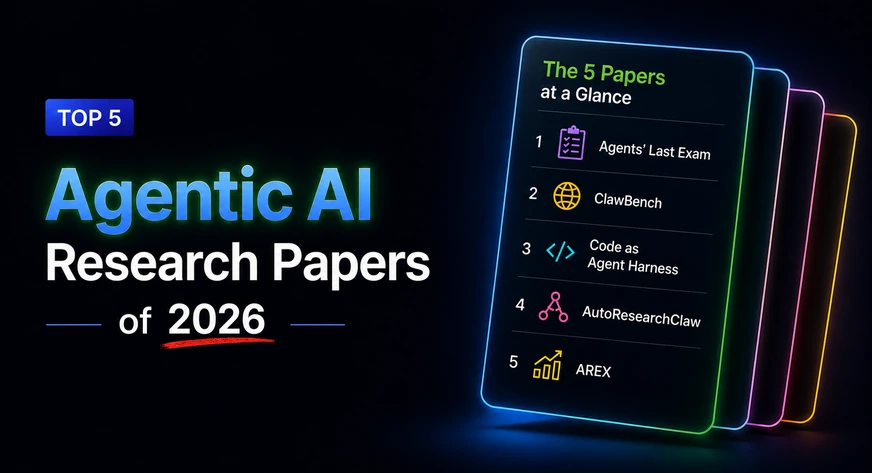
Top 5 Agentic AI Research Papers of 2026
Analytics Vidhya

Top 5 Agentic AI Research Papers of 2026

Agentic AI research in 2026 decisively shifted focus. No longer a question of basic tool use, the field now grapples with crucial challenges: workflow completion, website resilience, self-verification, failure recovery, and iterative process improvement. Analytics Vidhya’s curated list highlights five pivotal papers demonstrating this evolution. These papers offer a concise roadmap for understanding the current landscape and future trajectory of agentic AI, prioritizing practical application and robust performance over theoretical novelty. Explore these key insights to stay ahead of the curve.