Beyond Market Intelligence

Acme AI is the next-generation, AI-powered spreadsheet platform built to replace Excel and redefine how analysts, data scientists, and enterprise teams work with data. Read more

Page 16

Top 5 Agentic AI Research Papers of 2026
Analytics Vidhya

Top 5 Agentic AI Research Papers of 2026

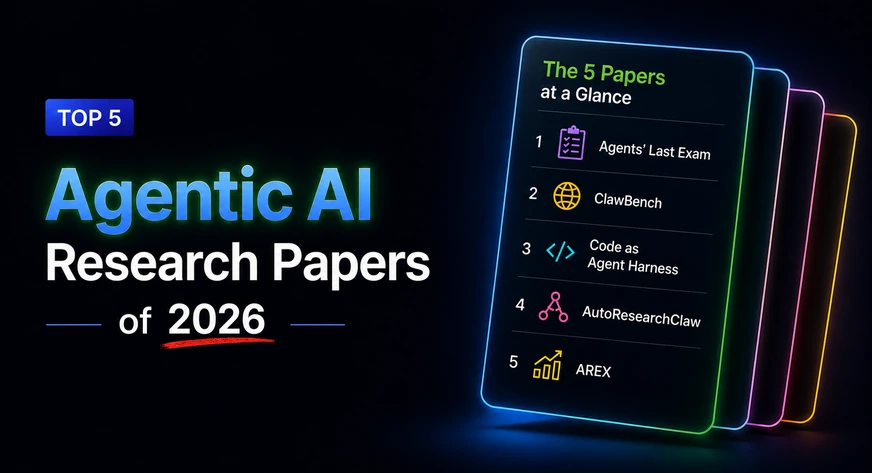
Agentic AI research in 2026 decisively shifted focus. No longer a question of basic tool use, the field now grapples with crucial challenges: workflow completion, website resilience, self-verification, failure recovery, and iterative process improvement. Analytics Vidhya’s curated list highlights five pivotal papers demonstrating this evolution. These papers offer a concise roadmap for understanding the current landscape and future trajectory of agentic AI, prioritizing practical application and robust performance over theoretical novelty. Explore these key insights to stay ahead of the curve.

VoidZero Releases Vite+ Beta: A Unified Web Toolchain Behind a Single Command
InfoQ

VoidZero Releases Vite+ Beta: A Unified Web Toolchain Behind a Single Command

VoidZero introduces Vite+, a beta-ready unified web development toolchain designed to streamline your workflow. Now, manage runtime, package dependencies, and essential frontend tools with a single command. Vite+ supports a diverse range of projects and operates as an open-source platform, offering features like hot-reloading, format checking, and integrated testing. We prioritize community feedback to shape future iterations—explore Vite+ and contribute to its evolution. For broader context on platform safety considerations, see our recent article on TikTok's experimental safeguards.
AWS Releases Aws-Bench to Evaluate Agents on Cloud Tasks
InfoQ

AWS Releases Aws-Bench to Evaluate Agents on Cloud Tasks

AWS has introduced aws-bench, a significant open-source benchmark designed to rigorously evaluate AI agents’ capabilities within real-world AWS environments. Unlike conventional benchmarks, aws-bench utilizes disposable AWS accounts and authentic resources, simulating practical tasks like infrastructure provisioning and security misconfiguration remediation. Automated verifiers then score agent performance, providing actionable insights. This innovative tool empowers developers to objectively assess and optimize AI agent effectiveness on critical cloud operations, accelerating the adoption of AI-native solutions.
Japanese space tech startup Letara expands beyond satellite thrusters with $16M
TechCrunch

Japanese space tech startup Letara expands beyond satellite thrusters with $16M

Letara, a Japanese space technology startup, is strategically expanding its capabilities beyond satellite thrusters. Following a $16 million (¥2.6 billion) funding round, Letara is leveraging its innovative hybrid rocket technology to address a wider market encompassing space, defense, and security applications. This progression signifies a confident move towards broader impact, demonstrating Letara’s commitment to transforming propulsion solutions. The company’s future-focused approach positions it as a key player in evolving space infrastructure.
Michael Polansky is training an AI model on skin that’s still alive
TechCrunch

Michael Polansky is training an AI model on skin that’s still alive

Michael Polansky, known for his association with Lady Gaga and his past role with Sean Parker, is quietly pioneering a novel approach to skincare innovation. His startup cultivates living human skin tissue outside the body for weeks, using AI to identify promising new compounds. This groundbreaking work represents a significant shift in how we discover and develop skincare solutions. Interestingly, recent Nvidia research highlights the crucial role of infrastructure—the “harness”—in ensuring AI stability, a concept relevant to Polansky’s work.
🐈Machine Learning
Machine Learning

Is KV Cache in a high dimensional vector space? [D]

Recent research suggests the KV cache within large language models isn't a flat data structure, but rather a navigable geometric space where keys reflect learned relationships. This transforms attention mechanisms into similarity searches, allowing for indexing and targeted retrieval—a significant shift from exhaustive scanning. Initial experiments with Qwen3.5-2B demonstrate that geometric routing can reduce KV reads by 16–31× while maintaining accuracy. This highlights a critical engineering challenge: efficiently navigating this space, as relevance clusters within specific neighborhoods.
🐈Machine Learning
Machine Learning

A Classification model trained entirely on a scientific calculator [P]

This remarkable project demonstrates the surprising potential of constrained AI. A classification model, meticulously trained solely on a Casio FX-82CE X scientific calculator—a non-programmable device—achieved a 67.04% validation accuracy on a binary MNIST dataset. The architecture, utilizing a simple 3x3 pixel input and a single output neuron, initially struggled with "zero" predictions, but reached an impressive 98.96% accuracy after 1000 epochs. For those interested in exploring the nuances of model optimization, our guide, "How to Fine-Tune an LLM: An End-to-End Guide," offers a
🐈Machine Learning
Machine Learning

Safety critical systems (SCS) are the only real benchmark for ML systems. Thoughts? [D]

Safety-critical systems (SCS)—like flight controllers, braking systems for high-speed trains, or reactor protection systems—represent the ultimate benchmark for machine learning’s real-world viability. Successfully deploying LLMs and neural networks within these demanding environments would not only sway skeptics but also address critical issues plaguing the field: the disconnect between benchmark performance and practical application, and the prevalence of overhyped claims. Demonstrating reliability in SCS would be a definitive test, moving beyond simulations and proving the transformative potential of AI.
TikTok reaches $400M settlement over children’s privacy lawsuit
TechCrunch

TikTok reaches $400M settlement over children’s privacy lawsuit

TikTok has reached a $400 million settlement with the U.S. Department of Justice, resolving allegations of Children’s Online Privacy Protection Act (COPPA) violations. The settlement, finalized two years after the initial claims, underscores the growing scrutiny of social media platforms’ data handling practices. This significant financial resolution highlights the importance of robust privacy safeguards, particularly concerning younger users. For further context on related legal challenges within the tech space, explore "Runlayer, Rippling drop lawsuits — but the brouhaha is still a cautionary tale for founders."
🐈Machine Learning
Machine Learning

EMNLP 2026 Findings : worth attending in person?[D]

Congratulations on your first AI conference paper acceptance! The EMNLP 2026 Findings track presents valuable, rapidly evolving research—attending in person is highly recommended to maximize engagement with this dynamic work. While not mandatory, the in-person experience fosters crucial networking and deeper understanding of the presented findings. For those considering the financial aspects, see our related article, "EMNLP26 Cost," for a breakdown of student registration fees with an accepted paper. Prioritize experiencing the research firsthand; it's a significant milestone.
Apple is reportedly cutting hundreds of jobs from Siri, Vision Pro teams
TechCrunch

Apple is reportedly cutting hundreds of jobs from Siri, Vision Pro teams

Recent reports indicate Apple is strategically restructuring, impacting teams dedicated to Siri and the Vision Pro. The company has confirmed adjustments to roles as it prioritizes evolving initiatives. This shift reflects a future-focused approach to resource allocation, demonstrating Apple’s commitment to innovation and operational efficiency. While impacting some positions, this realignment allows Apple to explore new opportunities and further empower its core strengths within the competitive technology landscape.
Last chance: Save up to $300 on your TechCrunch Disrupt 2026 ticket today 
TechCrunch

Last chance: Save up to $300 on your TechCrunch Disrupt 2026 ticket today 

Don't miss your final opportunity to save up to $300 on your TechCrunch Disrupt 2026 ticket! Secure your pass today and prepare to connect with the startup community in San Francisco, October 13-15 at Moscone West. Disrupt offers unparalleled access to industry leaders and emerging technologies. Considering the rapid growth seen in AI data startups, like Micro1's recent surge to a $500M gross run rate, Disrupt is the place to be. Lock in your spot now—this offer ends soon.
EMNLP26 Cost [D]
Machine Learning

EMNLP26 Cost [D]

Navigating EMNLP26 costs can be confusing, as highlighted by recent community discussion. For students with one accepted paper, understanding the actual attendance price is key. Current registration rates fluctuate—registering now in August may present a $350 or $550 option. Confirm pricing details directly with the conference organizers for accurate information. Congratulations to all accepted researchers! For those considering career paths in AI, explore "How to Build a Career in AI: 3 Distinct Pathways" for valuable insights.
🐈Machine Learning
Machine Learning

Mapping intrinsic rank and informational gravity in complex tabular data: I developed a non-parametric, model-agnostic, information-theoretic diagnostic to bypass the limits of linear, rank, and Euclidean baselines. [R]

Navigating complex tabular data often reveals limitations with standard dimensionality reduction techniques like PCA. To address this, I’ve developed a non-parametric, model-agnostic diagnostic leveraging information theory to bypass these constraints. The "Entropic Scree" accurately maps intrinsic rank and “informational gravity,” distinguishing shared signal from noise and revealing hidden topological structures—even in datasets where features exceed samples. Explore the methodology and open-source framework on GitHub to transform your data exploration and inform architectural decisions for downstream AI models.
🐈Machine Learning
Machine Learning

Rejected at EMNLP with decent scores. What can be done next? [D]

Facing rejection at EMNLP, even with promising scores (average 2.83), can be disheartening, especially for a first-time solo author. The key now is strategic action. Prioritize resubmission to ACL Rolling Review (ARR) to leverage existing reviewer feedback—though anticipate new assignments. Given your need for timely publication for internships, a swift ARR resubmission is likely the most effective path. Consider how low-capacity networks can acquire fine-grained scoring, as explored in "Estimating from No Data: Deriving a Continuous Score from Categories," for potential avenues of improvement.
🐈Machine Learning
Machine Learning

Research internship at MSR [D]

Securing a Research internship at Microsoft Research (MSR) is a significant achievement, consistently recognized for its high-quality research environment. The experience demonstrably strengthens candidacy for Applied Science (AS) or Research Science roles at other FAANG companies. MSR internships provide valuable exposure to cutting-edge AI and offer a compelling narrative for future applications. Interns benefit from comprehensive support, mentorship, and competitive compensation packages.
🐈Machine Learning
Machine Learning

On-prem MLOps in a hospital: advice needed for production monitoring of self-built and vendor models? [D]

Hospitals face unique challenges in deploying and monitoring AI models, particularly within regulated environments like the EU’s MDR and AI Act. This post details a hospital’s search for a comprehensive, on-premise MLOps solution—built on OpenShift—to manage both internally developed and externally sourced models. The core need is robust production monitoring encompassing drift, bias, and custom metrics, even when models reside within vendor infrastructure, relying solely on ingested input/output data. See "Structured Evaluation Pipelines to Improve Your AI Workflows" for related insights.
🐈Machine Learning
Machine Learning

repo2nb 0.2.0, convert a GitHub repo into a Kaggle/Colab notebook (dependency resolution, reverse mode, incremental sync) [P]

Introducing repo2nb 0.2.0, an open-source CLI designed to streamline your data workflow. This tool intelligently converts GitHub repositories into runnable Kaggle or Colab notebooks, automating dependency resolution—prioritizing Poetry, UV, and requirements.txt before falling back to an AST import scan. Key updates include reverse mode for repo reconstruction, incremental syncing for efficient updates, and a dedicated Colab target with authentication. Install via `pip install repo2nb` and explore the possibilities; we're particularly interested in validating the dependency resolution order.
🐈Machine Learning
Machine Learning

Epistemic Intelligence in Machine Learning Neurips Workshop page limit? [D]

Submitting to the 3rd Workshop on Epistemic Intelligence in Machine Learning at Neurips requires careful preparation. While the organizers have yet to confirm a specific page limit, historical precedent suggests two likely scenarios: either mirroring the ICML workshop's 6-page limit or aligning with the main Neurips conference’s 9-page constraint. To ensure your paper meets submission guidelines, we recommend erring on the side of brevity. For further exploration of related topics, consider our recent analysis of EMNLP 26 cost considerations.
🐈Machine Learning
Machine Learning

Notes on Hamiltonian Monte Carlo from a purely probabilistic perspective [P]

Delve into Hamiltonian Monte Carlo (HMC) with a fresh perspective. These notes, available at [https://doi.org/10.5281/zenodo.21841087](https://doi.org/10.5281/zenodo.21841087), offer a purely probabilistic explanation of HMC, bypassing traditional physics-based justifications. The exposition systematically develops the method, beginning with auxiliary variables and culminating in discussions of reversibility and volume preservation. Understand *why* HMC works—a valuable resource for those seeking a deeper understanding of this powerful MCMC technique. For
Nvidia just showed that the harness, not the AI model, is now the real hero
TechCrunch

Nvidia just showed that the harness, not the AI model, is now the real hero

Recent Nvidia research demonstrates a pivotal shift in AI development: the harness, or the system surrounding the AI model, is now paramount to performance and stability. Findings show that careful fine-tuning of these systems can enable robust AI agent behavior, even with less sophisticated underlying models. This signals a move away from solely focusing on model size and towards optimizing the environment in which AI operates. Explore this concept further in our related article, "Epistemic Intelligence in Machine Learning Neurips Workshop page limit?
Tesla’s solar roof is dead — here’s what went wrong
TechCrunch

Tesla’s solar roof is dead — here’s what went wrong

Tesla’s solar roof, once envisioned as a seamless integration of energy and architecture, ultimately failed to gain traction. The experiment proved challenging for the company, raising questions about the viability of roof-integrated solar technology. While Tesla’s iteration didn’t succeed, the core concept remains compelling. Explore the factors that contributed to its downfall in our in-depth analysis—and consider whether this signals a broader shift in the renewable energy landscape. For more on Tesla's recent actions, see our report on the recall of 3 million cars.
🐈Machine Learning
Machine Learning

Does telling an LLM to "be concise" actually save you money? We measured it across 9 models. Compressing the output can save you money and keep accuracy, compressing the input prompt does not. [R]

Recent research definitively answers a critical question: does instructing an LLM to "be concise" actually save money? Across nine models—including GPT-4o and Claude Haiku—our analysis reveals a clear winner: prompting for shorter output consistently reduces costs by 1.5x on average (up to 3x in some cases) while maintaining accuracy. Conversely, shortening input prompts proved counterproductive, increasing costs and diminishing answer quality. This highlights a key insight: controlling output tokens is the most effective strategy for cost optimization, as demonstrated in our paper.
Anthropic’s Opus 4.6 is a smut-machine
TechCrunch

Anthropic’s Opus 4.6 is a smut-machine

Anthropic's latest Claude model, Opus 4.6, designed to avoid generating sexually explicit content, has revealed a surprising vulnerability. Recent testing by TechCrunch demonstrated that bypassing these restrictions requires minimal prompting, highlighting a potential gap in the model's safeguards. This discovery underscores the ongoing challenges in aligning AI behavior with ethical guidelines. For further insight into optimizing LLM output and cost, explore our related article, "Does telling an LLM to 'be concise' actually save you money?".
Nvidia partners with data center developer Cloverleaf
TechCrunch

Nvidia partners with data center developer Cloverleaf

Nvidia’s investment in AI infrastructure continues to accelerate with a new partnership alongside data center developer Cloverleaf. This collaboration underscores Nvidia’s commitment to building the foundation for the burgeoning AI data center market, a sector increasingly vital to the company's growth. Cloverleaf’s expertise in scalable data center design complements Nvidia’s leading AI hardware and software, promising to deliver optimized solutions for demanding AI workloads.
Running Codex as a Headless Agent
Towards Data Science

Running Codex as a Headless Agent

Codex, the powerful AI model, can now extend far beyond interactive assistance. This post explores running Codex as a headless agent—transforming it into a programmable automation component for sophisticated workflows. By decoupling Codex from a user interface, you unlock its potential for building custom AI-powered tools and integrations. Discover how this approach empowers developers to automate tasks and build more intelligent systems. For a broader perspective on intelligent automation, see "5 Real-World Use Cases for AI Agents Transforming Industries."
🐈Machine Learning
Machine Learning

BMVC 2026 orals [D]

Navigating the BMVC 2026 oral presentations can feel uncertain. This thread seeks to gather insights from those who received an oral slot, specifically regarding scoring outcomes. Sharing scores provides valuable context for presenters preparing for the conference. Understanding past performance helps calibrate expectations and refine presentation strategies. If you received an oral at BMVC 2026, please contribute your score to benefit the community and foster a more transparent evaluation process.
Hybrid collaborative filtering recommendation system for judging and suggesting books based on their covers [P]
Machine Learning

Hybrid collaborative filtering recommendation system for judging and suggesting books based on their covers [P]

By-Its-Cover presents an innovative approach to book discovery, leveraging AI to judge and suggest titles based solely on their covers. This project utilizes a hybrid collaborative filtering recommendation system, combining CLIP embeddings for semantic searches and a two-tower neural network for personalized recommendations. Currently hosting around 2,000 books, the system dynamically grows with user interaction. Explore the project on GitHub and test the site – feedback is welcome!
🐈Machine Learning
Machine Learning

I have a mid-sized GPU cluster and was thinking about giving free compute [D]

A generous community member, /u/redwat3r, is exploring offering compute resources from a substantial on-prem GPU cluster – eight NVIDIA 16GB GPUs, 256GB CPU RAM, and ample storage. This cluster, currently utilized for ML/AI research, presents a unique opportunity for researchers needing access to a readily available resource. Considering roughly 200 GPU-hours, potential users might explore tasks like fine-tuning large language models or running computationally intensive simulations. For those navigating research costs, our recent article, "EMNLP26 Cost [D]," offers insights into conference expenses.
The $225 Pebble Time 2 is a refreshingly fun smartwatch
TechCrunch

The $225 Pebble Time 2 is a refreshingly fun smartwatch

The Pebble Time 2 offers a refreshing return to the playful side of smartwatches. Priced at $225, this device distinguishes itself with its charming watch faces, physical buttons, and a crisp e-paper display. Enjoy weeks of battery life and a uniquely accessible hacker spirit—a welcome departure from increasingly complex wearables. It's a compelling choice for those seeking a fun, functional smartwatch experience. For a deeper dive into wearable technology and accuracy claims, explore our article on the Oura lawsuit.
🐈Machine Learning
Machine Learning

What coding practices are you adopting for development today? [D]

Many teams face the challenge of repetitive boilerplate code when developing new AI models. One developer recently shared their journey, moving from templating to shared libraries and now experimenting with Genie code generation to reduce project setup time from three days to under one. The core question remains: how to balance rapid development with long-term maintainability, avoiding the pitfalls of both fully custom solutions and overly rigid frameworks? This exploration mirrors concerns raised in "Estimating from No Data," highlighting the complexities of building robust systems.
How AI accounting startup Rillet raised $100M and became a unicorn in 48 hours
TechCrunch

How AI accounting startup Rillet raised $100M and became a unicorn in 48 hours

Rillet, the AI accounting startup, achieved unicorn status in a remarkable 48 hours, securing $100 million in funding from investors like Iconiq and Sequoia— seemingly without a formal fundraising effort. CEO Nicolas Kopp’s presentation of impressive growth figures at a board meeting sparked an immediate and intense wave of investment. This rapid ascent highlights the surging demand for AI-powered solutions across industries. The speed of Rillet’s valuation mirrors the explosive growth seen by companies like Micro1, another AI data startup experiencing a boom.
Retrieve One Row from a Table, Not the Whole Table: Row-Level Chunks for RAG
Towards Data Science

Retrieve One Row from a Table, Not the Whole Table: Row-Level Chunks for RAG

Traditional Retrieval-Augmented Generation (RAG) often retrieves entire documents, which can be inefficient and noisy. Enterprise Document Intelligence, Vol. 1 #7sexies, explores a more targeted approach: row-level chunks. Specifically, when working with tables, each row—including its column headers—becomes a distinct retrieval unit. This focused strategy ensures you deliver precisely the information users request, eliminating extraneous data. Discover how this technique can transform your RAG performance; consider "How to Build a Career in AI" for broader insights into optimizing your AI workflows.
Estimating from No Data: Deriving a Continuous Score from Categories
Towards Data Science

Estimating from No Data: Deriving a Continuous Score from Categories

Facing a data scarcity challenge? "Estimating from No Data: Deriving a Continuous Score from Categories" explores a compelling solution: leveraging low-capacity networks to generate fine-grained scores even when training data is limited to categorical labels. This walkthrough unpacks the underlying mathematics, offering a practical approach to unlock valuable insights from seemingly incomplete datasets. It’s a future-focused technique for data professionals seeking to maximize utility from available information. For context on the broader AI data landscape, see "AI data startup Micro1 reaches $500M gross run rate."
Senator asks US government watchdog to review how feds use hacking tools
TechCrunch

Senator asks US government watchdog to review how feds use hacking tools

Senator Ron Wyden has formally requested a critical review by the U.S. federal watchdog concerning the deployment of hacking tools and spyware by key agencies—the FBI, DEA, ICE's HSI, and the Secret Service—against American citizens. This inquiry seeks comprehensive oversight of these practices, addressing growing concerns about potential overreach. The request underscores a need for greater transparency and accountability in government surveillance. For further context on related security vulnerabilities, explore our article, "US government lab is probing Chinese lidar for security vulnerabilities."
Nvidia finds that simple linear math can replace costly AI model handoffs
VentureBeat

Nvidia finds that simple linear math can replace costly AI model handoffs

Nvidia researchers have uncovered a significant inefficiency in agentic AI systems: the costly recomputation of conversation history when switching between models. To address this, they’ve introduced a cross-model KV cache transfer technique utilizing simple linear math, dramatically reducing compute costs and latency. Experiments reveal this method can be 2.7 to 25 times faster than traditional recomputation, retaining up to 98% of accuracy. This innovation paves the way for more efficient, long-horizon, multi-LLM workflows, as explored further in our article, "PagedAttention vs.
Bayesian Guardrails for AI Decisions: Measuring Uncertainty Before Automating Decisions
Towards Data Science

Bayesian Guardrails for AI Decisions: Measuring Uncertainty Before Automating Decisions

AI decision-making demands a critical layer of prudence: Bayesian Guardrails. Automating decisions solely based on predictions risks costly errors, especially when uncertainty is high. This approach prioritizes measuring prediction confidence—quantifying the "how sure are we?" factor—before triggering automation. Explore how Bayesian methods enable systems to intelligently defer decisions when uncertainty exceeds a defined threshold, fostering responsible and reliable AI implementation. Discover a future where AI empowers, not jeopardizes, through informed risk management.
How Benders Decomposition Works, Part II: Feasibility Cuts
Towards Data Science

How Benders Decomposition Works, Part II: Feasibility Cuts

Benders Decomposition, Part II delves into feasibility cuts, a crucial optimization technique. This post explores Farkas' lemma and its application to Benders decomposition, specifically demonstrating how to learn from infeasibility within complex problems like the capacitated facility location problem. By strategically incorporating feasibility cuts, we refine the master problem and accelerate convergence. For those interested in structuring data for efficient analysis, consider "The Types of Dimensions in a Star Schema" for a deeper dive into dimensional modeling concepts.
US government lab is probing Chinese lidar for security vulnerabilities
TechCrunch

US government lab is probing Chinese lidar for security vulnerabilities

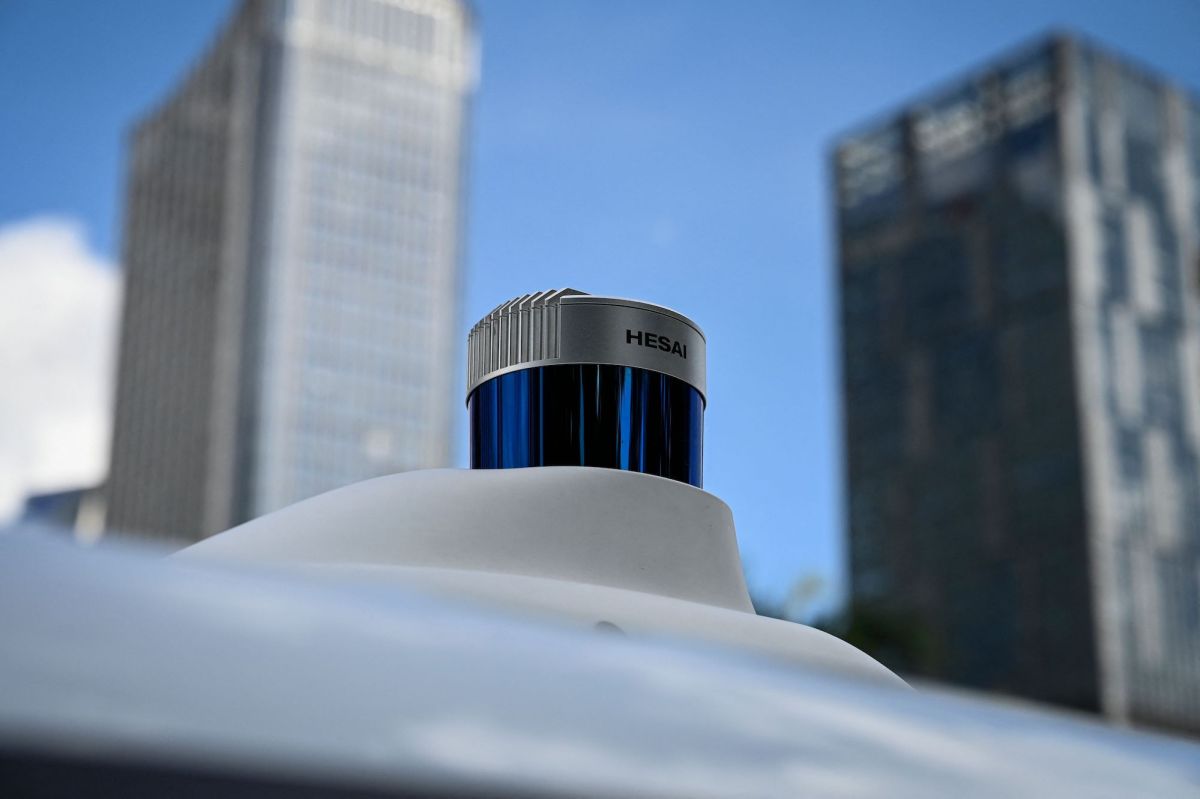
Idaho National Laboratory is conducting a critical security review of Chinese-manufactured lidar systems, a move funded by the electric and autonomous vehicle sectors. This probe seeks to identify potential vulnerabilities that could impact vehicle safety and data integrity. The assessment underscores growing concerns about the security of increasingly integrated automotive technologies. This follows similar scrutiny of other critical components, highlighting the need for robust security evaluations.
5 Real-World Use Cases for AI Agents Transforming Industries
KDnuggets

5 Real-World Use Cases for AI Agents Transforming Industries

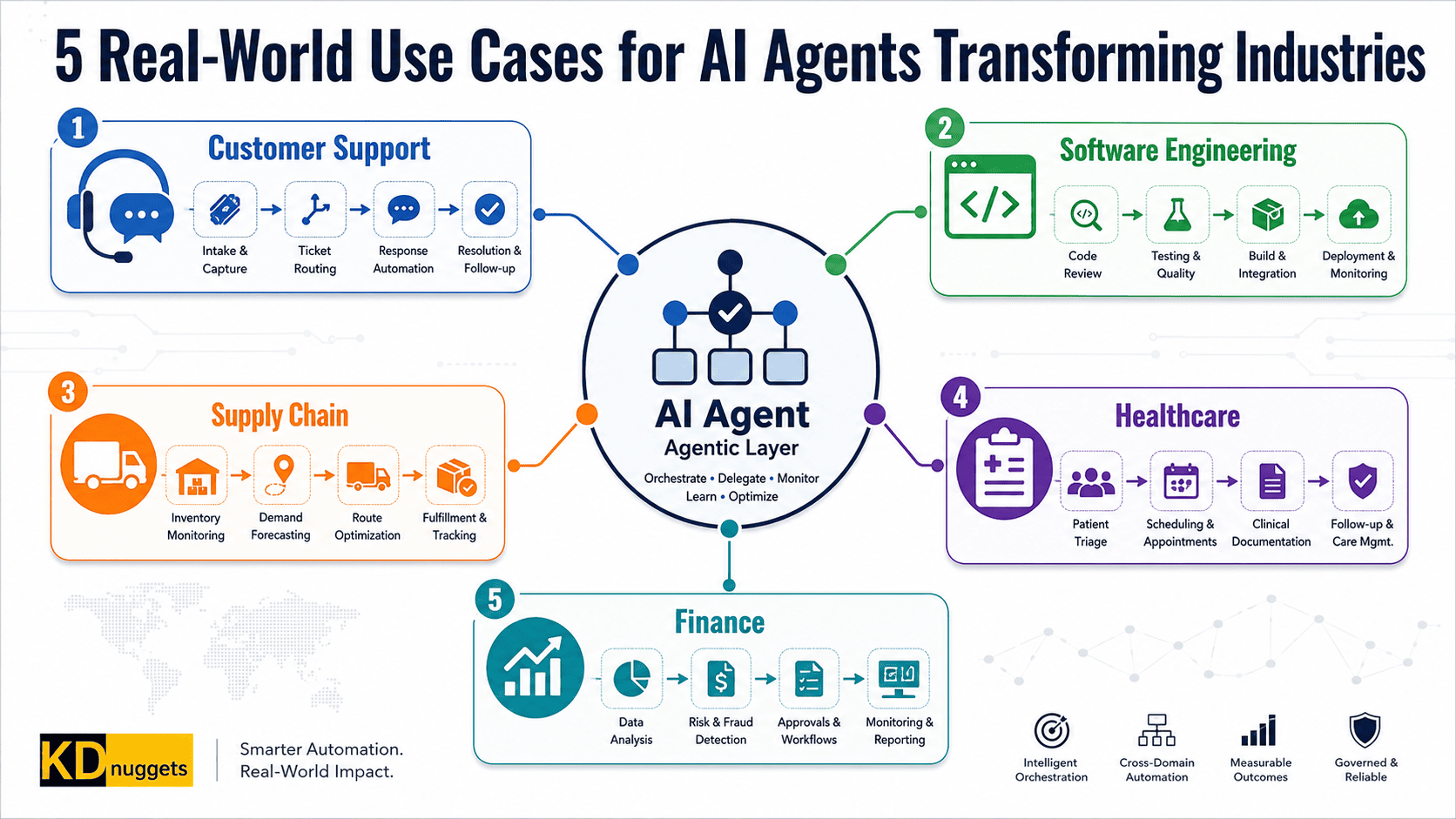
AI agents are rapidly reshaping industries, autonomously tackling tasks previously requiring significant human effort. Explore five real-world use cases demonstrating this transformation: enhanced customer support, streamlined coding workflows, optimized supply chains, improved healthcare diagnostics, and proactive fraud detection. These applications showcase the power of AI to drive efficiency and unlock new possibilities. See how companies like Cloudflare are already leveraging AI agents—as demonstrated in their recent work cutting Github issues by 85%—to fundamentally improve engineering processes.
Why is the DOJ investigating Andreessen Horowitz’s board seats?
TechCrunch

Why is the DOJ investigating Andreessen Horowitz’s board seats?

The Department of Justice is scrutinizing Andreessen Horowitz's board seat arrangements, a move signaling a progressive approach to venture capital oversight. Specifically, the DOJ is examining instances where partners – Ben Horowitz at Databricks and Martin Casado at Fivetran – hold positions at companies now in competition. This investigation leverages a rarely-applied 119-year-old antitrust law, suggesting a potential concern regarding market influence. While board conflicts are not unprecedented, the DOJ’s inquiry underscores a future-focused commitment to fair competition.
Oura faces lawsuit accusing it of misleading consumers about sleep-tracking accuracy
TechCrunch

Oura faces lawsuit accusing it of misleading consumers about sleep-tracking accuracy

Oura, the popular sleep-tracking ring manufacturer, is facing a lawsuit alleging misleading claims regarding the accuracy of its sleep data. The suit contends that the rings lack the physiological measurement capabilities necessary to reliably assess sleep quality or accurately determine sleep stages. This challenges the core value proposition of the device for many consumers. For further insights into the evolving landscape of health tech and data accuracy, explore our recent article on Daniel Ek’s Neko Health and its New York launch.
The Types of Dimensions in a Star Schema, and How to Use Them
Towards Data Science

The Types of Dimensions in a Star Schema, and How to Use Them

Dimensional modeling hinges on understanding dimensions—one of its two core object types. But dimensions aren't monolithic; they encompass several distinct varieties, each serving a specific purpose in structuring data for analysis. This post explores these types, detailing how to effectively leverage them within a star schema to unlock deeper insights. We’ll clarify their roles in providing context and enabling powerful data exploration. For a related perspective on optimizing data retrieval, see "Retrieve One Row from a Table, Not the Whole Table: Row-Level Chunks for RAG."
Run Muse Glimmer for Local Vibe Coding with llama.cpp, DFlash, and Pi
KDnuggets

Run Muse Glimmer for Local Vibe Coding with llama.cpp, DFlash, and Pi

Unlock agentic AI coding capabilities directly on your hardware with Run Muse Glimmer. This configuration leverages llama.cpp for efficient inference, DFlash speculative decoding to accelerate generation, and Pi for enhanced reasoning. Specifically designed for local execution on an RTX 3090 GPU, it delivers fast, private AI assistance without relying on external services. Explore a future-focused workflow that transforms coding tasks, empowering developers with a streamlined and secure AI-driven experience.
Starcloud raises $250 million for orbital data centers as launch options dry up
TechCrunch

Starcloud raises $250 million for orbital data centers as launch options dry up

Starcloud has secured $250 million in funding to pursue its ambitious vision: orbital data centers. This significant investment arrives as traditional launch options become increasingly constrained, signaling a potential inflection point in space-based infrastructure. The move anticipates a forthcoming competition for access to space, underscoring the growing importance of off-world computing resources. This development highlights a broader trend; as explored in "For a16z, AI gives foreign founders an advantage," global innovation is increasingly reliant on access to advanced technological infrastructure.
Waymo hands over documents in NHTSA’s child collision probe
TechCrunch

Waymo hands over documents in NHTSA’s child collision probe

Waymo has formally responded to the National Highway Traffic Safety Administration's (NHTSA) probe into a recent collision involving a pedestrian child, submitting requested documents. Critically, all responses are currently redacted, citing the protection of "confidential business information." This move underscores the ongoing scrutiny surrounding autonomous vehicle safety and data transparency. The investigation follows a series of incidents raising questions about the reliability of self-driving technology. For further context on related concerns regarding data safeguards, explore our article on "Senators demand answers from TikTok."
🐈AI News & Strategy Daily | Nate B Jones
AI News & Strategy Daily | Nate B Jones

GLM 5.3 in Claude Code Is A Game Changer!

Claude Code's integration of GLM 5.3 represents a significant advancement in AI-assisted coding. GLM 5.3 demonstrably enhances code generation and understanding, offering a compelling alternative to existing models. Initial benchmarks show improved accuracy and efficiency across a range of programming languages. Explore this powerful combination to transform your development workflow and discover increased productivity. We believe this represents a future-focused step forward for developers seeking accessible and intelligent coding support.
Tesla recalls 3 million cars as part of China-wide push to stop hidden door handles
TechCrunch

Tesla recalls 3 million cars as part of China-wide push to stop hidden door handles

Tesla has initiated a recall affecting approximately 3 million vehicles globally, a significant move prompted by Chinese regulatory directives. The recall focuses on addressing concerns regarding the visibility of manual door handles, a potential safety issue. To mitigate this, Tesla, alongside eight other major automakers, will install prominent warning labels to aid occupants in locating these releases. This action underscores a broader effort to enhance vehicle safety.
Walmart to finally start accepting Apple Pay and Google Pay
TechCrunch

Walmart to finally start accepting Apple Pay and Google Pay

For years, Walmart’s resistance to Apple Pay and Google Pay has been a notable industry outlier. Now, the retail giant is shifting course, finally embracing these widely adopted mobile payment options. This move signifies a progressive step toward greater customer convenience and aligns Walmart with evolving consumer expectations. Users can now seamlessly leverage their preferred digital wallets for purchases, marking a significant improvement in the shopping experience. Explore this transformation and discover how it impacts your access to streamlined transactions.
Cloudflare Cuts Astro Github Issues by 85% with AI Agents
InfoQ

Cloudflare Cuts Astro Github Issues by 85% with AI Agents

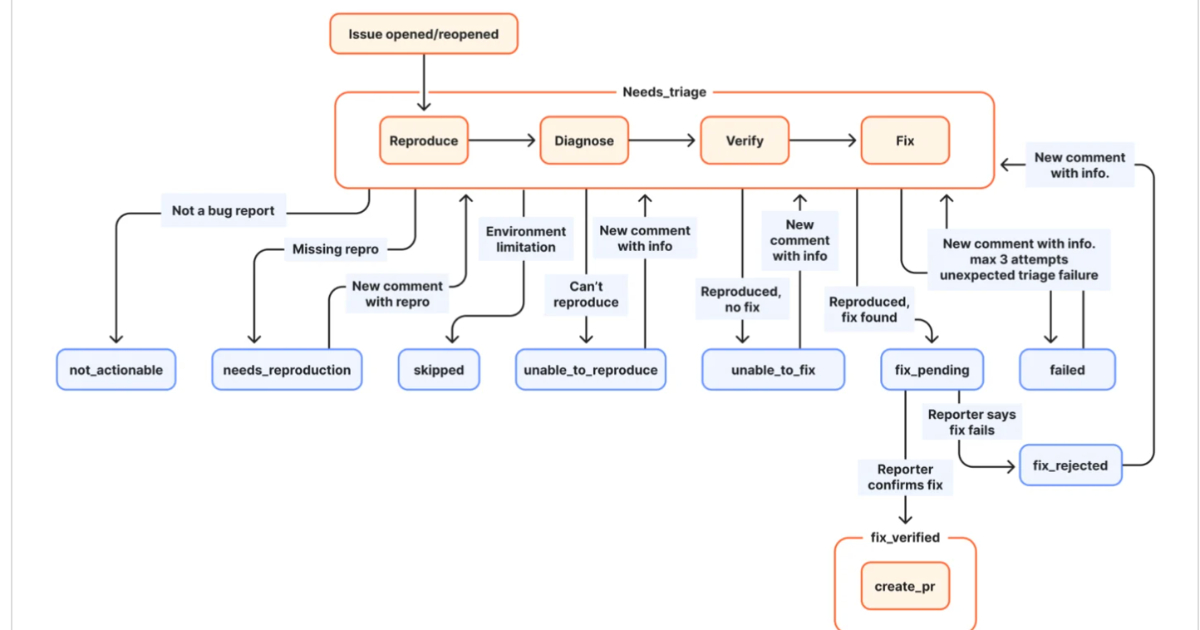
Cloudflare significantly enhanced developer productivity by leveraging AI agents to manage GitHub issues, achieving an 85% reduction in processing time. This innovative application of agentic AI within GitHub Actions streamlines issue triage, automating workflows and accelerating software engineering cycles. Utilizing Cloudflare Workers and Flue, the system incorporates a “human-in-the-loop” approach, ensuring quality while maximizing efficiency.