5 Free Courses to Go From AI Beginner to Practitioner
Our take
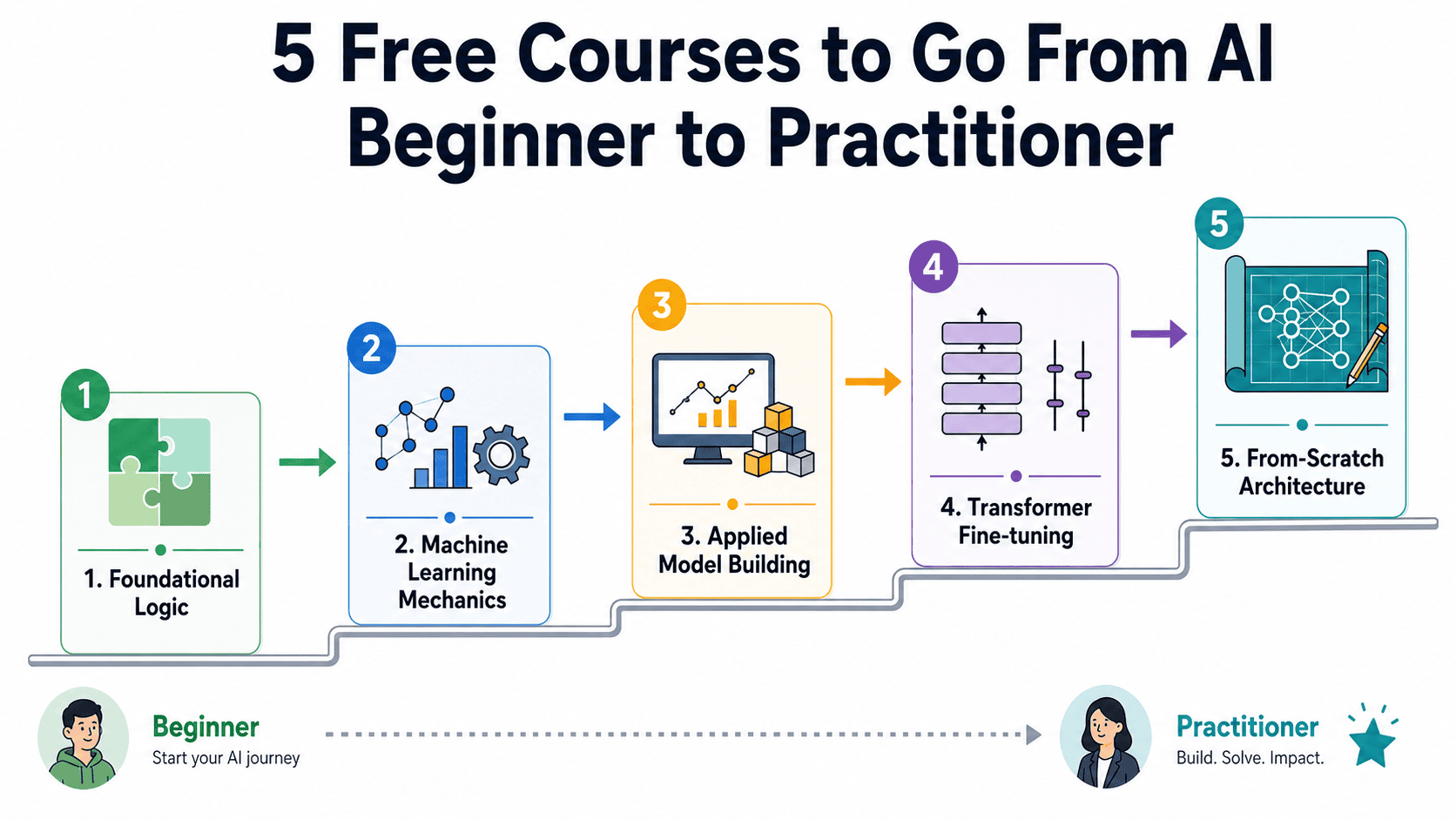
The democratization of AI skills is a welcome and increasingly vital trend, and the roadmap of five free courses detailed in the recent article represents a significant step in that direction. For too long, access to meaningful AI training has been gatekept by expensive programs and specialized institutions. This curated list provides a tangible, accessible path for individuals to move beyond introductory concepts and build practical capabilities, progressing from foundational algorithms to the complex world of training Large Language Models (LLMs). It's particularly encouraging to see a curriculum that doesn't shy away from the fundamentals; a robust understanding of classical algorithms forms the bedrock for navigating the more sophisticated landscape of modern AI. As we've explored in Are Your ML Experiments a Mess? Here’s the Fix, a solid methodological foundation is essential, and this roadmap implicitly acknowledges that need by starting with the basics. This focus on building a strong base is key to avoiding the pitfalls of simply leveraging pre-trained models without understanding the underlying principles.
The ability to train LLMs from scratch, even on a relatively small scale, is a transformative skill. While the hype surrounding massive models often overshadows the practical application of smaller, more targeted LLMs, the reality is that many organizations can benefit significantly from customized solutions. This roadmap’s emphasis on that capability speaks to a broader shift in the AI landscape – away from a one-size-fits-all approach and towards greater specialization. Consider Yelp’s work in unifying model training with their Training Orchestrator—as detailed in Yelp Unifies ML Model Training with Training Orchestrator—this highlights the operational challenges of managing even internally developed models at scale, and the roadmap’s practicality in equipping individuals with the skills to build and manage these systems becomes even more valuable. The ability to tailor AI solutions to specific business needs, rather than relying solely on generic offerings, is a key differentiator for organizations seeking a competitive advantage. Furthermore, the process of building and training models, regardless of their size, offers invaluable learning opportunities that simply aren't available when solely using pre-built tools.
What’s particularly compelling is the potential for this roadmap to empower a new wave of AI practitioners. The current shortage of skilled AI talent is well-documented, and initiatives like this directly address that challenge. Providing accessible, high-quality training allows individuals from diverse backgrounds to enter the field and contribute to its advancement. More importantly, it fosters a deeper understanding of AI’s capabilities and limitations, leading to more responsible and effective implementation. As Bhavuk Jain discussed in Presentation: Engineering AI for Creativity and Curiosity on Mobile, adapting foundational AI to real-world applications requires both technical skill and a creative approach. This roadmap equips individuals with the technical skills and, by starting with fundamentals, encourages that creative problem-solving. The emphasis on practical application, rather than purely theoretical knowledge, is a crucial element in bridging the gap between academic research and real-world implementation.
Ultimately, the proliferation of accessible AI training resources like this one signals a positive evolution for the field. While the complexity of AI continues to grow, the barriers to entry are steadily diminishing. This roadmap isn’t just about acquiring new skills; it’s about fostering a more inclusive and empowered AI community. As we move further into an AI-driven future, the ability to understand, build, and deploy AI solutions will become increasingly essential across a wide range of industries. The question now becomes: how can we continue to expand access to this type of practical training, and ensure that it remains aligned with the evolving demands of the AI landscape?
Read on the original site
Open the publisher's page for the full experience