5 Real-World Use Cases for AI Agents Transforming Industries
Our take
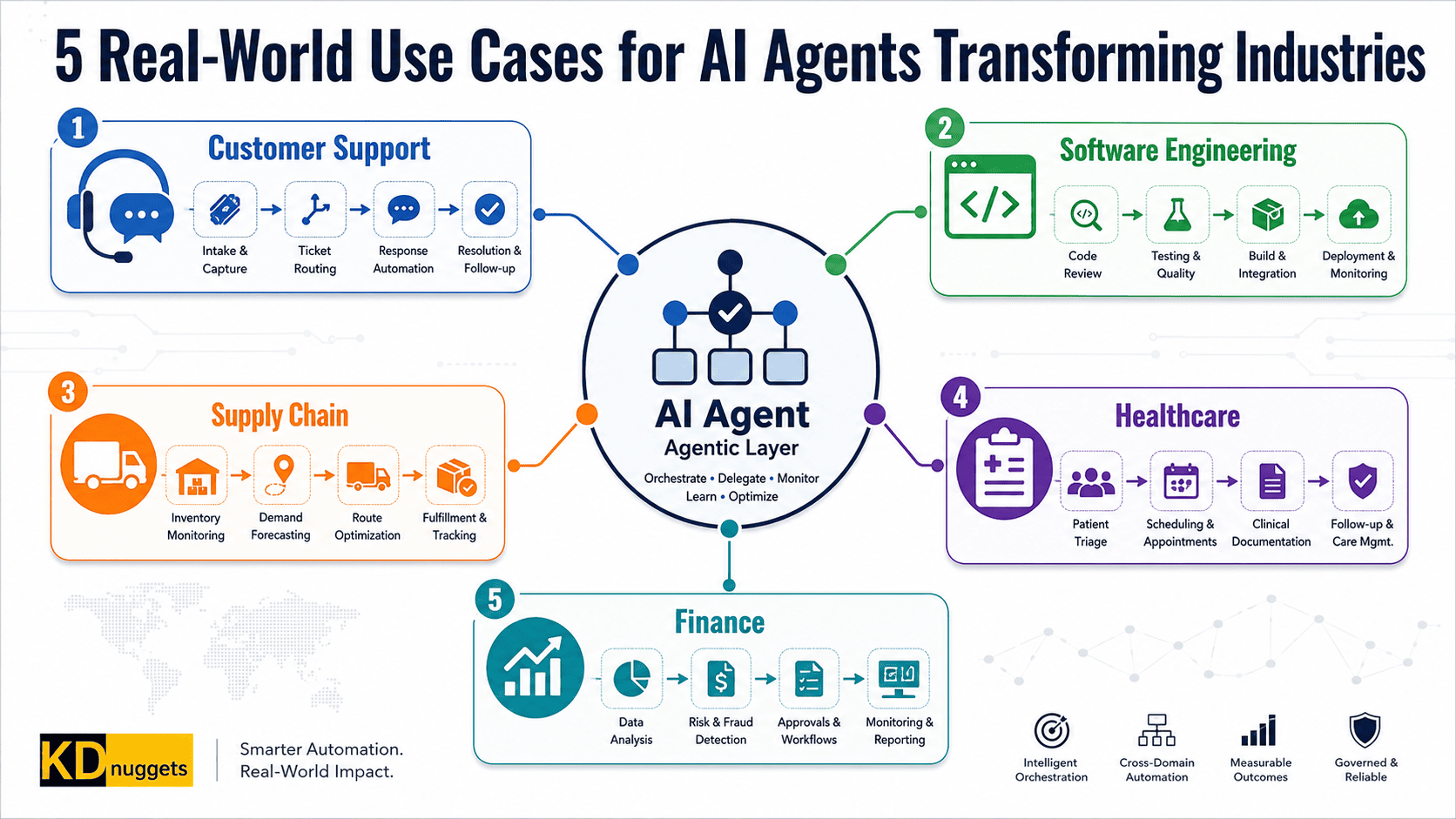
The proliferation of AI agents across diverse industries isn't a distant future; it's happening now. The article highlighting five real-world use cases – support, coding, supply chains, healthcare, and fraud detection – effectively demonstrates the tangible impact of this shift. We’ve been tracking this evolution closely, and seeing AI agents autonomously handle these traditionally complex tasks validates the transformative potential we’ve long anticipated. The ability of AI to shoulder routine burdens, analyze vast datasets, and proactively address challenges frees up human capital for higher-level strategic initiatives. Consider Cloudflare's recent work; they've demonstrated impressive results, Cloudflare Cuts Astro Github Issues by 85% with AI Agents by leveraging AI agents to streamline their GitHub workflow, a clear signal of the efficiency gains possible. This isn’t about replacing human workers, but rather augmenting their capabilities and enabling them to focus on work requiring creativity, critical thinking, and emotional intelligence.
The applications detailed in the article are particularly compelling because they highlight the breadth of AI agent applicability. From automating customer support interactions to optimizing intricate supply chain logistics, the potential for increased efficiency and reduced operational costs is substantial. It’s also significant to note the growing sophistication of these agents. They're moving beyond simple rule-based automation to incorporate machine learning and natural language processing, allowing them to adapt to changing circumstances and handle more nuanced situations. This evolution is further underscored by Cloudflare’s broader efforts to embed AI into their engineering processes, as detailed in Cloudflare Turns Engineering Standards Into an AI-Enforced Control System. The ability to dynamically enforce standards and proactively identify potential issues represents a paradigm shift in how engineering teams operate. Furthermore, the challenges of managing AI-generated code, specifically addressing the risks of unowned code in production, are becoming increasingly apparent, prompting discussions around tools and techniques like eBPF, as explored in Presentation: Enchant Your AI and APIs with eBPF Magic 🪄.
The adoption of AI agents isn’t without its considerations. Ensuring data security, maintaining transparency in decision-making processes, and addressing potential biases within AI algorithms remain paramount. However, the benefits—increased productivity, improved accuracy, and enhanced decision-making—are compelling enough to drive continued investment and adoption. We believe the current wave of implementation represents a crucial inflection point. Early adopters are already demonstrating significant advantages, and those who delay exploring AI agent solutions risk falling behind. The shift is less about whether AI agents will become commonplace, and more about *how* organizations strategically integrate them into their workflows to maximize their impact. The focus needs to be on identifying the right use cases, building robust governance frameworks, and fostering a culture of experimentation and continuous improvement.
Looking ahead, we anticipate a significant increase in the complexity and sophistication of AI agents. They will likely become more integrated with existing business systems, capable of handling increasingly complex tasks and collaborating seamlessly with human workers. The question is not just *what* tasks AI agents can automate, but *how* they can augment human intelligence and unlock new levels of productivity and innovation. As these agents become more pervasive, understanding the ethical implications and ensuring responsible deployment will be critical to realizing their full potential and mitigating potential risks. The convergence of agentic AI with technologies like eBPF suggests a future where AI’s influence is woven deeply into the fabric of our digital infrastructure – a future we’re actively shaping.
Read on the original site
Open the publisher's page for the full experience