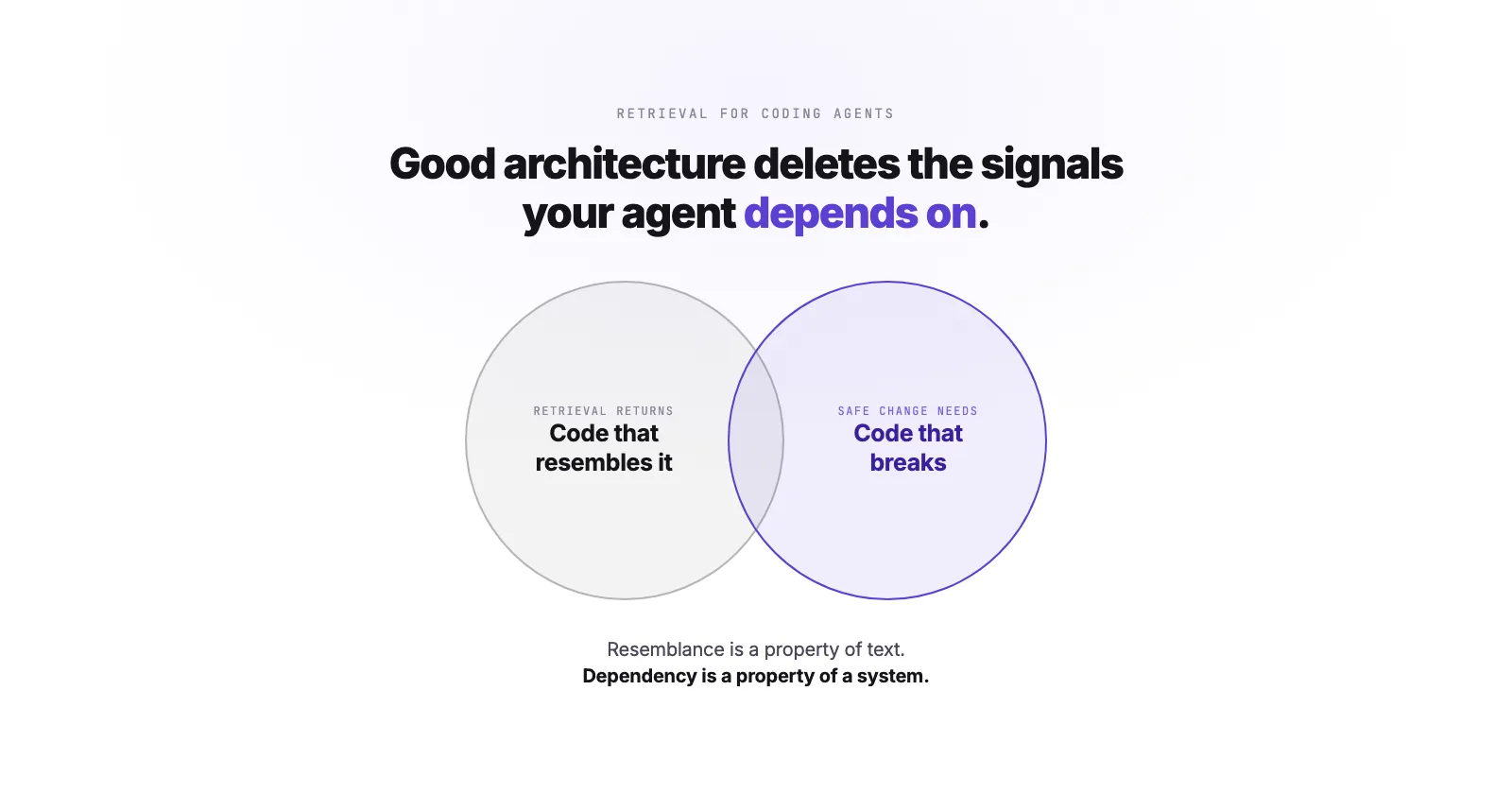
There is a quiet assumption hiding inside most clean architecture advice: that the boundaries we draw between components are neutral, that they organize complexity without changing what the system can communicate. The article "Good Architecture Deletes the Signals Your Agent Depends On" challenges that assumption directly. Every layer you insert, every abstraction you introduce, every interface you define to keep things tidy is also a filter. It removes signals. And when the tooling consuming that system is an AI agent, those removed signals are not just metadata. They are the difference between a model that understands your codebase and one that is guessing from fragments.
This is a structure problem, not a search problem. The author is not saying your agent needs better retrieval or more context windows. They are saying the architecture itself is the bottleneck. If you have ever watched an agent struggle to trace a data flow through three layers of indirection, you have seen this principle in action. The agent does not fail because it is unintelligent. It fails because the signals it needs were deleted by design. This resonates with a broader pattern we see across the AI-native tooling space: the most effective systems are not the ones with the most sophisticated models, but the ones whose underlying structure aligns with how agents actually reason. As we explore in Explore how Swift 6.4 simplifies subprocesses and accelerates Wasm performance, even language and tooling updates are increasingly judged by how they reduce friction for automated processes. The principle holds: simplicity is not just a developer experience win, it is an operational requirement.
For our readers, this shifts the conversation from "how do I make my agent better" to "what am I willing to give up to make it work." The trade-off is real. Clean architecture gives you testability, separation of concerns, and long-term maintainability. But it does so by hiding the very details that agents use to build accurate mental models of your system. This does not mean you should abandon good design. It means you need to be deliberate about where you draw boundaries and what you expose. If you are building a system that an AI agent will interact with, consider whether your interfaces are self-describing, whether your domain events carry enough context, and whether your naming conventions survive the journey through an embedding model. The related piece on Exploring Real-World Computer Vision: Deployments, Edge Models, and Current Challenges shows a similar tension in a different domain: models only perform as well as the data pipeline feeding them. Here, the data pipeline is your architecture itself.
The honest takeaway is uncomfortable but actionable. If your agent cannot navigate your codebase, do not assume the agent is broken. Look at the boundaries you drew. Ask yourself whether each abstraction is serving a human need at the cost of machine clarity, and whether that trade is worth it. One concrete question to bring back to your team: if an agent had to explain your system's behavior from the code alone, would it succeed? If the answer is no, you have not built a bad system. You have built a system that is honest about its intended audience. The question is whether you are ready to redesign for a new one.