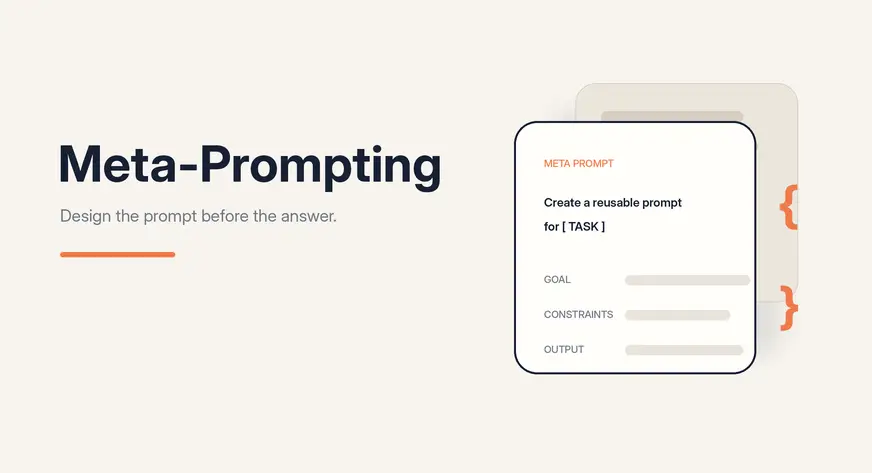
Every interaction with a large language model is a negotiation, and the quality of what you get back depends almost entirely on how you frame the ask. Clear instructions produce focused, useful responses, while vague ones often lead to inconsistent results. That much is familiar. Meta-prompting highlights a step beyond simply writing better prompts: it asks the model to design the very prompt, template, or workflow you should use in the first place. Instead of you wrestling with the perfect phrasing, you hand that problem to the AI and let it build a reusable structure. It is a small inversion with outsized consequences, especially for teams that need the same task completed repeatedly in a fixed format, tone, or structure.
This is where the practical value becomes clear. Most people treat prompting as a one-off transaction: you ask, the model answers, and you move on. But in a collaborative environment, consistency matters more than spontaneity. If you have ever tried to get a weekly report from a language model and found yourself rewriting the same instructions every Monday, you already understand the pain. Meta-prompting addresses that by having the model generate a reusable prompt, checklist, or even a full workflow before you begin. It shifts the burden from constant improvisation to intentional design. And that aligns with a broader trend we have been watching closely, like how AI agents learn by editing context, not model weights. The idea is the same: the model's knowledge stays fixed, but its behavior can be shaped by the structure around it.
Our take is straightforward: if you are still treating prompt engineering as a purely manual craft, you are leaving efficiency on the table. Meta-prompting is not about replacing human judgment; it is about offloading the repetitive part of it. You still decide what the outcome should be, but you let the model figure out the most reliable path to get there. That is a meaningful distinction. It also raises a question we have been circling in pieces like Talking to My AI Clone Taught Me to Question the Tech: how much of the thinking are we willing to delegate before we lose sight of what we are trying to accomplish? The answer is not to resist the tool, but to use it with intention.
What we would tell a reader who asked us about meta-prompting is simple: start small. Pick one recurring task, ask the model to generate a reusable prompt for it, and then audit the output. Does it capture the tone you need? Is the structure repeatable without constant edits? If yes, you have just saved yourself hours. If not, refine and try again. The real opportunity here is not in the prompt itself but in the workflow it unlocks. And the detail to watch is whether these AI-generated structures become more sophisticated over time, especially as they learn to adapt across tasks. That is the specific consequence worth tracking. Because once the model starts designing better workflows than we would, the question stops being about how to prompt and starts being about how much of the process we are willing to shape. That is not a hypothetical future. It is the next iteration of the same shift we are already living through.