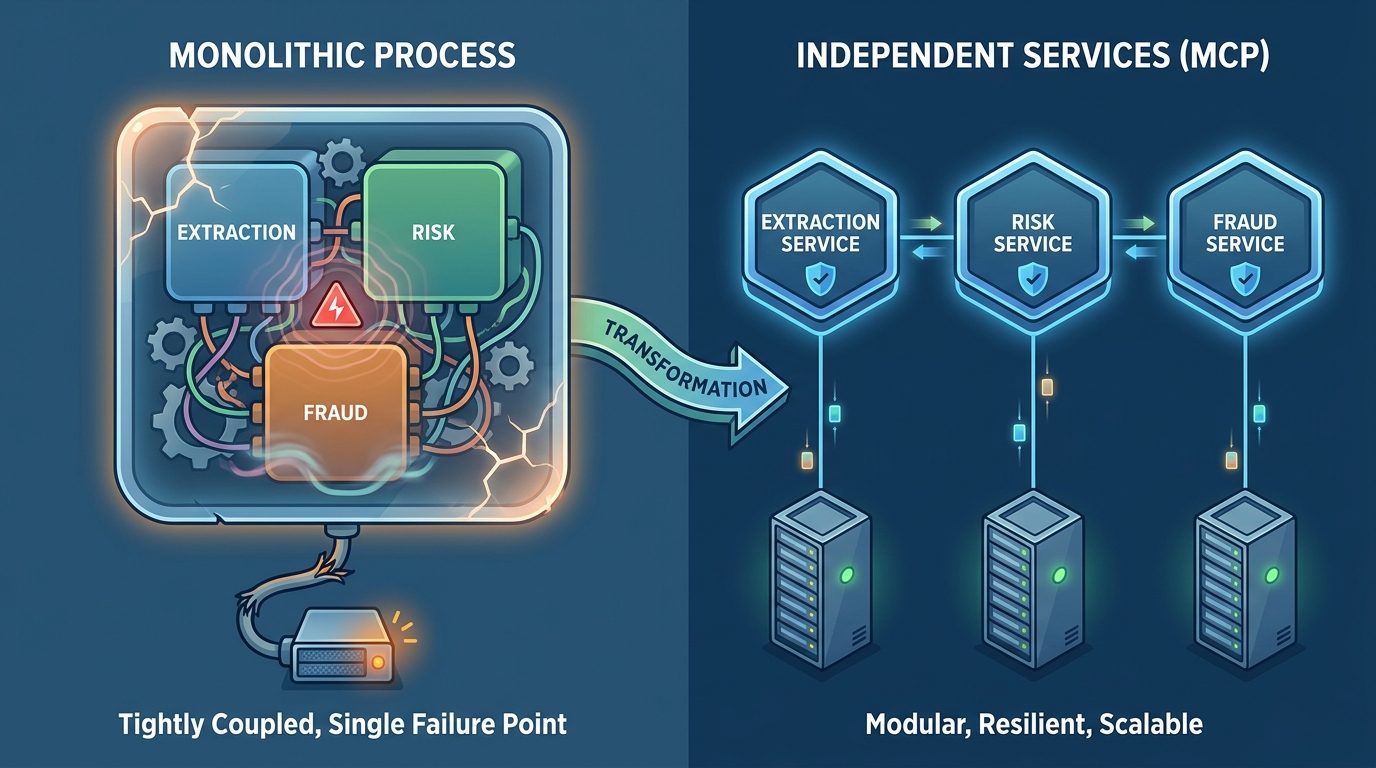
There's a moment in every data project when the pipeline stops being the solution and starts being the problem. Splitting a tightly coupled Python pipeline into independently deployable MCP services captures that transition with refreshing honesty. It's not a story about shiny new architecture for its own sake. It's about the practical reckoning that happens when a single process becomes too slow, too fragile, or too tangled to extend. That moment is familiar to anyone who has watched a well-intentioned script grow into a monolith that no one wants to touch. The authors didn't just refactor for elegance; they responded to a real constraint, and that's exactly the kind of grounded engineering thinking we value.
What stands out here is the discipline of treating the split as a series of deliberate trade-offs rather than a wholesale rewrite. A monolithic pipeline, once cohesive, starts to fight against you as dependencies blur, debugging becomes archaeology, and every small change risks a cascade of failures. Dependencies blur, debugging becomes archaeology, and every small change risks a cascade of failures. Splitting it into MCP services isn't about chasing microservices trends; it's about creating boundaries that match the natural seams in the work. This resonates with broader lessons we've explored, like how Exploring Real-World Computer Vision: Deployments, Edge Models, and Current Challenges shows that real-world systems demand more than just clever models, they require deployment strategies that acknowledge operational reality. Similarly, the decision to decouple here isn't a theoretical exercise; it's a response to the same pressure that pushes teams to rethink how data flows through their stack.
This case earns its place not because it introduces a novel concept, but because it demonstrates judgment about *when* to act. Too often, teams either cling to a monolith out of fear or prematurely decompose into a distributed mess. The sweet spot, as this case shows, is recognizing the signals: a pipeline that's hard to reason about, deploy, or scale independently. The authors make a compelling case that MCP services offer a middle path, one that preserves cohesion while enabling independent evolution. This connects to the idea in Evolve Your Recommendations: Real-World Insights on Adaptive Systems that complexity often lives outside the model itself, in how systems adapt to changing conditions. Here, the adaptation is structural, but the principle holds: resilience comes from designing for change, not just for the current state.
If a reader asked us whether they should follow this playbook, we'd say: don't wait for the pain to become unbearable. But also don't split for its own sake. Start by mapping your pipeline's failure modes and deployment bottlenecks. If a single process means a one-hour test cycle for a one-line change, that's your cue. The concrete takeaway worth quoting: *"A split is only worthwhile if it reduces the cost of change, not just the size of the codebase."* That's the lens to apply. How far to push the decomposition before operational overhead outweighs the gains remains an open question. That's a watch item for teams considering similar moves, because the next bottleneck after service boundaries is often data consistency and network latency. Watch for that trade-off to surface in your own work.