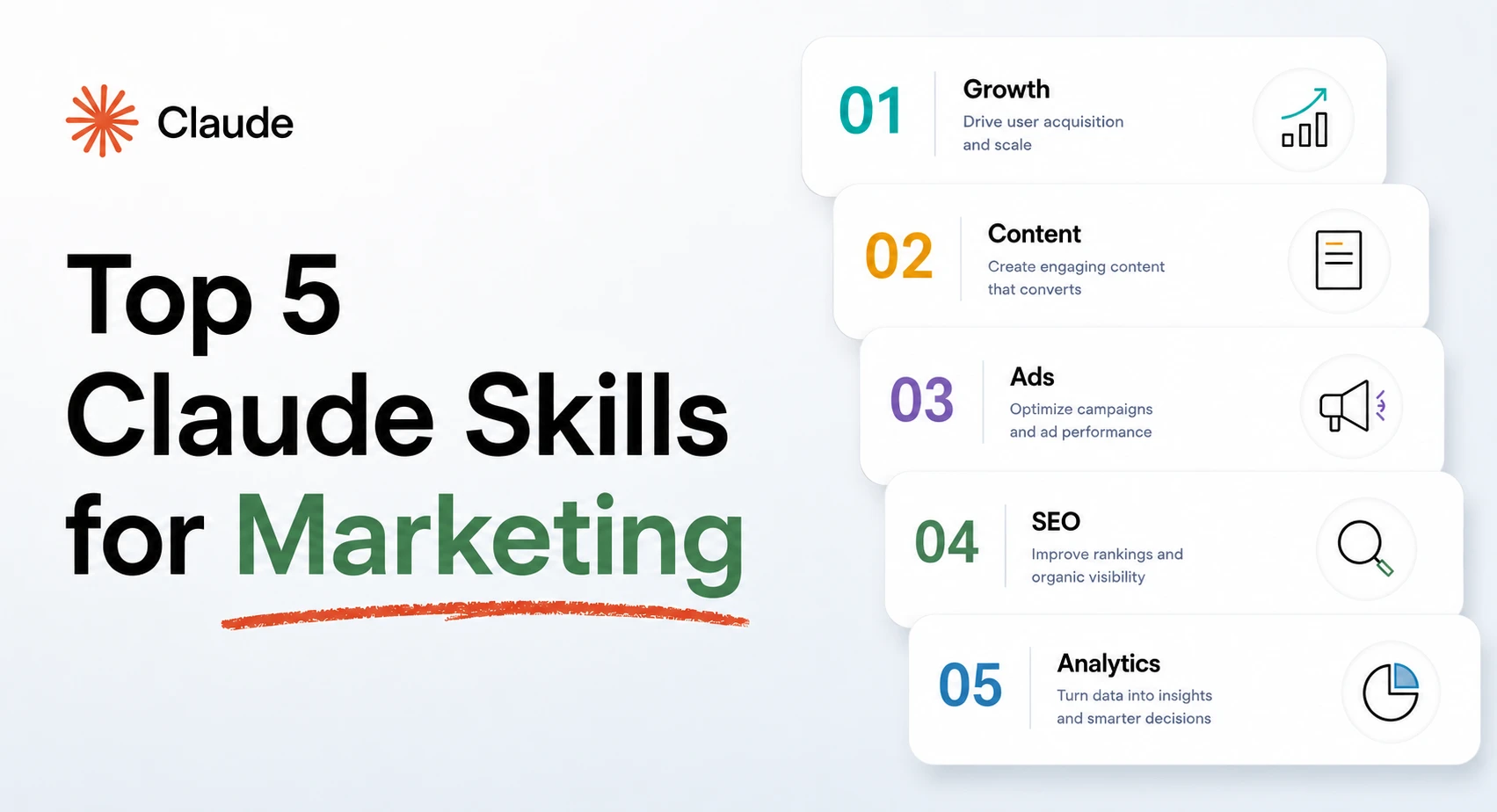
There is a quiet assumption buried in the way most of us use AI writing tools. We treat a prompt like "write an ad" as if it were the entire job, when in reality it is just the final flourish on a much longer process. A generated email is useful, but it is not a system. The research, the positioning, the channel planning, the quality checks, the reporting, those are the unglamorous processes that turn a clever sentence into a campaign. Search results for marketing skills often lump dedicated repositories in with massive general-purpose libraries, which makes it harder to find something that actually fits a structured workflow.
This is where we find ourselves at a familiar crossroads. We have explored how AI agents learn by editing context, not model weights and seen how much capability lives in the surrounding structure rather than the model itself. The same logic applies here. A skill that simply outputs copy is not a process; it is a component. The real value appears when those components are stitched into a repeatable system that includes review and iteration. That is why the search problem matters. If you cannot reliably find the right skill, you are back to manual assembly, which defeats the purpose of automation. We also recently considered how talking to an AI clone taught a user to question the technology, and the same healthy skepticism applies here. The output is only as trustworthy as the process that produced it, and a flashy demo can hide a fragile workflow.
For a marketing team, the practical takeaway is both simple and demanding. Do not adopt a skill because it exists in a library. Map your own process first. Identify where the manual effort actually lives, then look for a skill that fits that specific gap. If you cannot find one, build it. The tools are now accessible enough that constructing a small, focused skill is often faster than adapting a bloated general-purpose one. The question is not whether Claude can write an ad. It can. The question is whether you have a system for turning that ad into a measurable outcome, and whether you can validate the quality before it ships. That requires human judgment, which is exactly where the work should remain.
The detail worth watching is how quickly these libraries mature. Right now, the signal-to-noise ratio is poor, and the mix of dedicated and general-purpose repositories is rightly called out. But that will change as more teams publish their internal skills and as the community builds better curation methods. When that happens, the differentiator will not be access to a model. It will be the quality of the process around it. So when someone asks you which Claude skill to use for marketing, push back. Ask them what they are trying to build, not what they want the model to say. That is the question that actually leads somewhere.