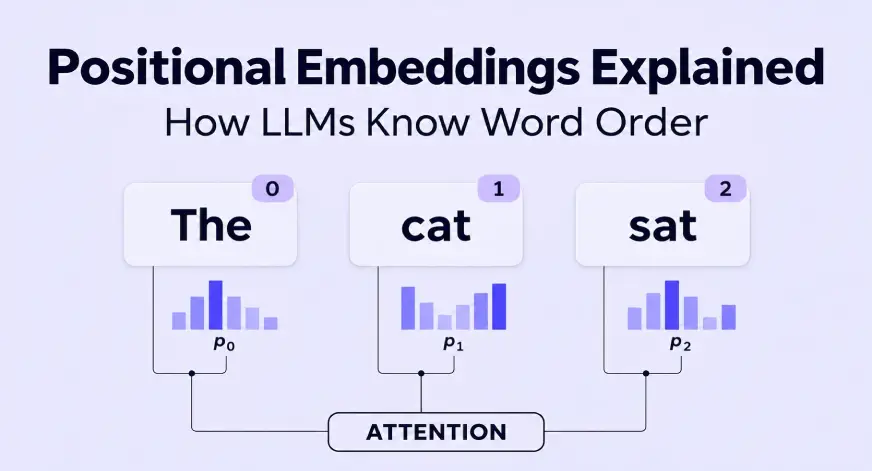
The dog hunted the fox. The fox hunted the dog. Same words, opposite outcomes. A transformer model sees a bag of tokens; it cannot tell which animal is the aggressor without positional embeddings. This is not an obscure academic footnote, it is the fundamental reason your AI spreadsheet still struggles with temporal logic, sequence-dependent formulas, and anything that requires tracking order. Understanding how these embeddings work is the first step toward knowing when to trust your AI tools and when to double-check them.
Positional embeddings are the mechanism that gives a language model a sense of sequence. Without them, "sort column A then apply filter" reads the same as "apply filter then sort column A." The recent explainer from Analytics Vidhya makes this concrete by showing how transformers encode position into high-dimensional vectors. For anyone building workflows on top of LLMs, whether you are using one to generate GPT-6.2 Unpacked: Which AI Model Matches Your Workflow or to power a decision engine, this is the layer where context becomes computable. If you have ever wondered why an LLM can write elegant code but then misorder a simple list, the answer lives inside these embeddings.
The practical takeaway is direct: when you ask an AI to process a spreadsheet, you are relying on positional embeddings to preserve the row-and-column logic you take for granted. Traditional spreadsheets are static grids; an AI-native sheet must reconstruct that structure from a token stream. That is why models like the one described in How to Turn an LLM Into a Faster Decision Engine need explicit architectural choices to maintain ordering. The same positional logic that lets a model distinguish "hunter" from "prey" lets it distinguish "revenue in Q1" from "revenue in Q4." Ignore this layer, and your AI may treat January and December as the same data point.
One detail worth watching is how different embedding strategies handle long sequences. The transformer in the "dog and fox" example works with a fixed position scheme, but real-world data workflows often involve hundreds of rows or nested operations. Some newer models experiment with relative positional embeddings that adapt to variable-length inputs. If you are evaluating an AI tool for your own work, ask whether it uses absolute or relative positioning, the answer will tell you how well it handles spreadsheets that grow beyond a single screen. That is the difference between a tool that scales with your data and one that quietly loses the plot.