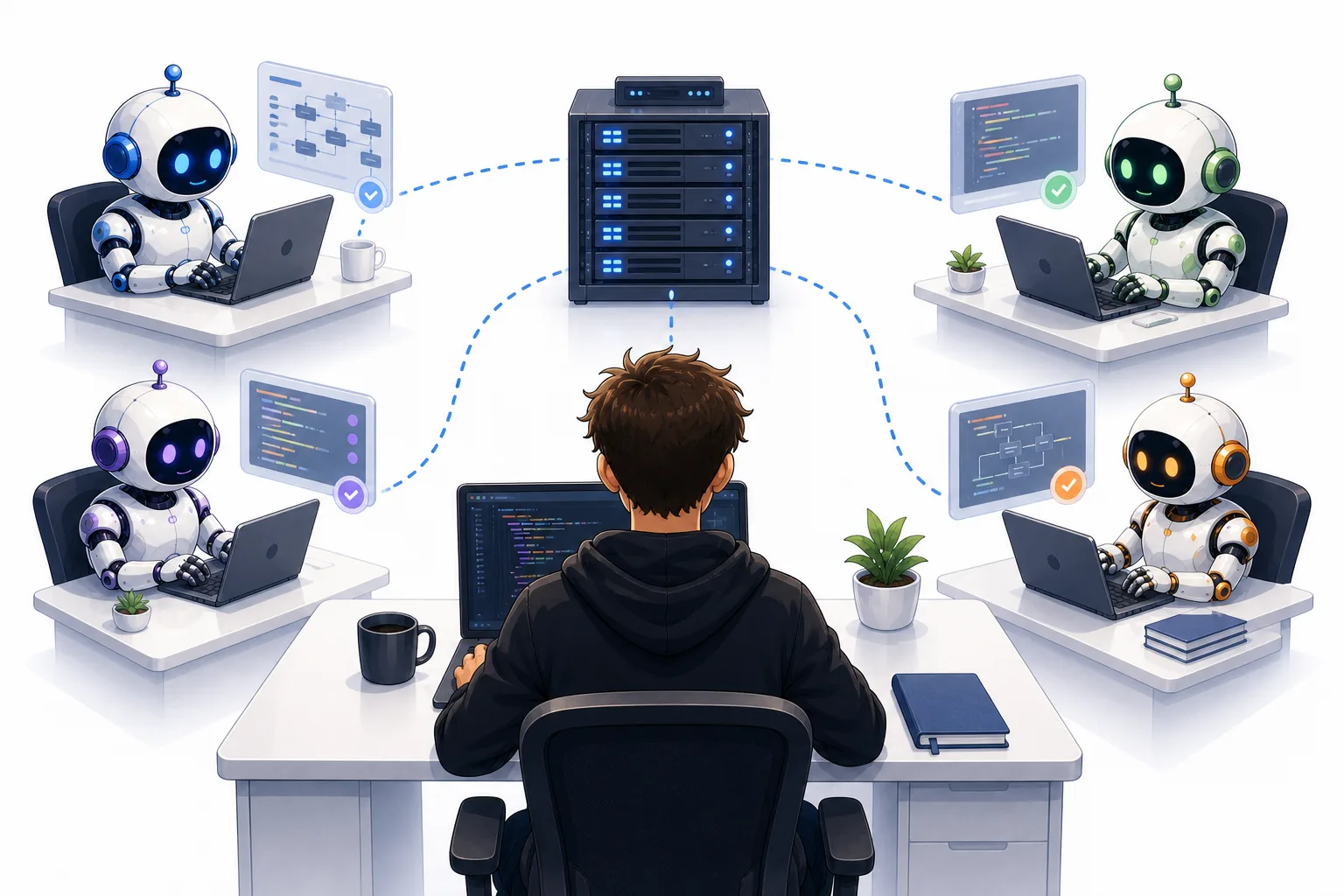
The promise of running a dozen coding agents on hardware you already own is the kind of quiet defiance that reshapes how we think about AI's real cost. Running parallel Claude Code sessions without a top-tier GPU or a cloud bill that spirals by lunch is not just a clever workaround. It is a direct challenge to the assumption that more power is the only path to more productivity. We have seen this pattern before, where a tool's perceived ceiling is really just a limitation of the default setup, not the underlying capability. The insight here is that orchestration, queuing, and smart resource allocation can often outpace brute force, a lesson that applies far beyond coding agents.
This matters because the barrier to entry for serious AI work has never been the model itself; it is the infrastructure story we tell ourselves. Many readers are likely stuck in a mindset where "scaling up" means buying more hardware or renting time on a remote cluster. That works, but it is expensive and often unnecessary. Focusing on running multiple sessions concurrently, likely through efficient batching or local model management, points to a more sustainable approach. It aligns with the broader exploration of how we structure data and tasks for AI, as seen in our piece on Exploring Paragraph Structure: How LLMs Navigate Token Space, which examines how the internal organization of information can be just as critical as the raw compute behind it. If you can manage the context and the flow, the hardware becomes secondary.
What we appreciate here is the demystification of a process that often feels reserved for those with deep pockets or specialized IT teams. This is not promising magic; it is showing a repeatable method. This is the kind of practical, human-centered advice that empowers users to experiment without fear of breaking the bank. It reminds us that the most innovative solutions are often the most accessible ones, a principle that should guide how we adopt new tools. We would tell a reader who is curious but hesitant to start with a single session, then gradually increase the load, observing how the system behaves. The goal is not to hit a specific number of agents, but to understand the trade-offs between concurrency and responsiveness.
The open question now is whether the broader ecosystem will take note. Will future tooling build in these optimizations by default, or will we continue to rely on community hacks to bridge the gap? We are watching to see if the default advice shifts from "buy more" to "use better." For now, the takeaway is simple: your current machine is likely more capable than you think, and the bottleneck is often your own assumptions. Start small, measure the results, and let the data guide your next step. The hardware is not the limit; your approach is.