Swiggy Uses 350+ Features and Multi-Task MLP to Predict Customer Lifetime Value
Our take
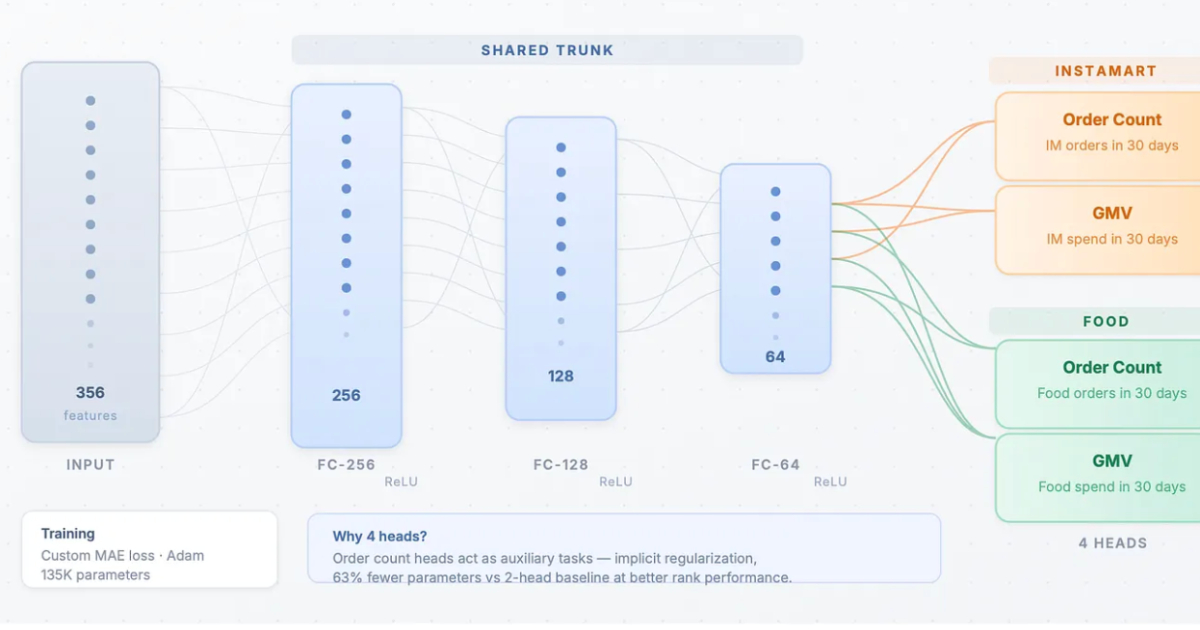
Swiggy's recent development of an in-house predicted lifetime value (pLTV) model, leveraging over 350 pre-order features and a multi-task MLP, represents a significant advancement in how large-scale online platforms approach customer acquisition and retention. The sheer scale of feature engineering—350+—highlights the richness of the data Swiggy collects and the potential for granular customer understanding. It’s fascinating to see this applied in a space so heavily reliant on rapid iteration and data-driven decision-making. This focus on predictive modeling echoes broader trends in the industry, as evidenced by discussions around leveraging techniques like Hidden Markov Models [Are HMMs still used for unsupervised tasks?] for dataset exploration, demonstrating a continued interest in sophisticated analytical approaches. Furthermore, the model’s integration with Google Target ROAS bidding underscores the practical application of pLTV, moving beyond theoretical value to directly impacting marketing spend efficiency. The ingenuity of adding order count as an auxiliary task, resulting in a 63% reduction in model parameters while *improving* predictive performance, is particularly noteworthy – a clear demonstration of efficient model design and a focus on practical resource utilization, something increasingly relevant as computational costs rise. It also speaks to the importance of thinking beyond solely optimizing for prediction accuracy; model size and efficiency are critical considerations for deployment and scalability.
The core innovation here isn’t just the pLTV model itself, but the way Swiggy is utilizing it. Connecting this predictive signal directly to advertising bidding strategies like Target ROAS is a powerful move, allowing for a more precise allocation of marketing resources. Traditional approaches often rely on broader segmentation or retrospective analysis, whereas Swiggy’s approach enables real-time optimization based on predicted future value. This shift towards a more proactive and individualized approach to customer acquisition is becoming increasingly important in a competitive landscape where customer attention is a scarce resource. The emphasis on a multi-task learning approach, where the model predicts both pLTV and order count, is a smart way to leverage shared information and improve overall performance. This echoes the broader exploration of PySpark Window Functions [A Practical Introduction to PySpark Window Functions] for efficient data aggregation and analysis, reflecting a general movement towards more sophisticated data processing pipelines. The ability to effectively manage and analyze such large datasets, and then translate those insights into actionable strategies, is what separates leading companies from the rest.
The implications of Swiggy's work extend beyond the food delivery sector. Any business operating with a recurring customer base and substantial data—e-commerce, subscription services, ride-sharing—can benefit from similar pLTV modeling techniques. The challenge lies in the complexity of feature engineering and model deployment, but the potential return on investment is significant. It’s also worth noting the resource commitment required to build and maintain such a system. Swiggy’s decision to build this in-house suggests a level of sophistication and a long-term commitment to data science capabilities. The accessibility of powerful GPU resources, as discussed in [Best place to rent an NVIDIA L40S GPU from India?] highlights an increasingly democratized environment for model training and deployment, potentially lowering the barrier to entry for smaller businesses wanting to explore similar strategies.
Ultimately, Swiggy's success underscores the growing importance of predictive analytics in driving business outcomes. The ability to accurately forecast customer lifetime value and translate that into optimized marketing spend represents a significant competitive advantage. As data volumes continue to grow and AI techniques become more sophisticated, we can expect to see even more innovative applications of pLTV modeling across various industries. The question now is: how will other companies adapt their acquisition strategies to compete in a world where customer value is increasingly being predicted with such precision, and will we see similar models emerge across adjacent industries like quick commerce and grocery delivery?
Swiggy developed an in house predicted lifetime value model using more than 350 pre order features and a multi task MLP for Food and Instamart. Adding order count as an auxiliary task reduced model parameters by 63% while improving predictive performance. The pLTV signal is used with Google Target ROAS bidding to optimize customer acquisition.
By Leela KumiliRead on the original site
Open the publisher's page for the full experience