'We have maybe 20 months' to rebuild for AI agents, Meta's infrastructure VP tells VB Transform 2026
Our take
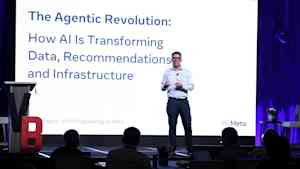
The accelerating shift towards agentic AI, as highlighted by Meta’s Barak Yagour at VB Transform 2026, isn’t merely a technological curiosity; it's a fundamental reshaping of how organizations interact with their data and infrastructure. Yagour’s observation that enterprise infrastructure was largely built for human users, not autonomous agents, is a stark realization for many. The 30x surge in agentic queries at Meta, echoing broader trends like the automation of internet traffic – now exceeding human traffic – underscores the urgency of this transformation. This isn’t a distant future scenario; it's a current inflection point demanding immediate attention, and as Stripe’s recent benchmark Stripe Benchmark Shows AI Agents Build Integrations but Struggle with Validation reveals, agentic AI, while capable of rapid integration building, still faces significant challenges with validation, highlighting the complexities inherent in this shift. The implications are profound, extending far beyond simply scaling existing systems and requiring a rethinking of core architectural principles.
The challenges Yagour outlines – capacity, identity, and velocity – represent breaking points in established engineering practices. The exponential growth in load generated by agents, coupled with the difficulty in applying traditional identity and access controls to non-human actors, creates a complex environment. Meta’s proposed solutions – agent-aware infrastructure, dynamic controls, and trusted data environments – offer a glimpse into a potential future but also raise questions about implementation complexity and potential security vulnerabilities. The need for schema-aware storage, as Meta is developing, is particularly noteworthy. It addresses the inefficiency of overfetching data for GPU processing, a significant bottleneck in AI workloads. The move towards real-time streaming, replacing batch ETL, further illustrates this shift towards accommodating the velocity demands of reasoning-based AI models. Furthermore, the exploration of alternative interfaces to data, questioning the continued dominance of SQL, as suggested by Yagour's comments during the Q&A, signals a willingness to fundamentally reconsider established paradigms – a willingness that is shown by Gwen Shapira’s exploration of how teams are scaling AI features using PostgreSQL Presentation: Postgres for Production Agents: Your Relational Foundation for Enterprise AI.
What’s truly compelling is the flywheel effect Yagour describes: agents driving data accessibility, better data enabling reasoning, and reasoning creating demands that push agents and infrastructure forward. This feedback loop suggests that the transformation isn't a one-time project but a continuous evolution. The focus on "fully conversational recommendations," where user intent drives results rather than keyword matching, showcases a more human-centric approach to AI, even within this agent-driven landscape. It acknowledges that while agents can automate tasks, understanding and responding to human needs remains critical. The governance question of balancing agent autonomy with human oversight, particularly within trusted data environments, is a crucial area of focus. The "explore broadly, release narrowly" principle demonstrates a pragmatic approach to mitigating risk while maximizing the potential of agentic access to data.
Ultimately, Yagour’s 20-month timeline is a sobering call to action. The rapid progress in AI, particularly in generative models, necessitates a proactive response from infrastructure teams. The challenge now lies not just in adapting existing systems but in designing new architectures that are inherently agent-aware, prioritizing data governance, and embracing continuous evolution. As Vint Cerf works toward standardizing AI agent identification on the open internet Vint Cerf is working on a plan to unleash AI agents on the open internet, one critical question remains: will organizations be able to rebuild their infrastructure quickly enough to harness the full potential of this new era, or will they be left struggling to contain the chaos of an increasingly agent-dominated digital world?
Organizations need to transform to meet the needs of agentic AI.
Meta VP of Engineering Barak Yagour opened his talk at VB Transform 2026 wearing a pair of Ray-Ban Meta AI glasses, a small sign of how far AI has already worked its way into physical life. His argument went further: enterprise infrastructure was built for humans, not for agents, and it's starting to show.
Yagour, who leads its data infrastructure organization, told the audience that agentic queries hitting Meta's data systems grew 30x in a single half, an inversion that he said is breaking assumptions the company spent two decades building around.
The shift is not confined to Meta. Automated traffic overtook human traffic on the internet last year, reaching 51% of the total, according to Imperva's 2025 Bad Bot Report. That traffic is also growing roughly eight times faster than human traffic, according to HUMAN Security's 2026 State of AI Traffic report. Yagour cited both figures to describe what he called an inflection point already underway inside his own organization.
Yagour framed the shift as an open question for infrastructure teams everywhere. "What happens to the infrastructure we've spent years building when agents and not humans become the main consumers of that," Yagour said. "That's the world we're stepping into."
Capacity, identity and velocity are breaking at once
Yagour said three assumptions are breaking simultaneously inside Meta's infrastructure: capacity, identity and velocity.
On capacity, the math no longer works the way engineering teams are used to. "One engineer used to mean one unit of load," he said. "Now one engineer spawns 10 agents, each spawning subagents. Your 1,000-person org can generate the load of 100,000 users practically overnight."
His answer is not to block agent traffic but to make infrastructure agent-aware, with dynamic controls that understand agent hierarchies, cost attribution that traces consumption back to the use case that spawned it, and throttling that adapts based on priority.
Identity is breaking, too. Yagour said an agent does not fit the categories infrastructure teams built access controls around. It is not a human user, it does not carry a badge and it is not a deployed service, yet it makes decisions on its own.
Velocity is the third assumption under strain. Yagour cited a company-reported figure that GitHub Copilot writes 46% of the average user's code, then noted that faster code generation does not make the rest of the pipeline faster.
"That code still needs to be built, tested, deployed, monitored," he said. "The agent writes the code in seconds, but your CI/CD pipeline doesn't get faster just because the machine is the author."
Trusted data environments keep agents inside guardrails
Data is where Yagour said the pressure from agents is most direct.
"Data sits at the center of everything," he said, pointing to the decisions, products, recommender systems and next generation models it drives.
Meta is also rethinking how much autonomy to grant agents inside its own data systems. In February, the company shipped what Yagour called agentic data apps. Within three months, 63% of dashboards published across Meta were built using the new tooling, part of the same 30x rise in agentic queries Yagour cited earlier.
That growth raises a governance question. Human analysts have traditionally sat between raw data and business decisions, curating it and serving as an informal check on quality. Yagour said Meta wants to grant agents more independence on harder problems, but was direct about the risk.
"Autonomy without governance is nothing but chaos," he said. That's why the company built what it calls trusted data environments, to preserve the human check as agents take on more of that work.
"Inside, the agent can explore data freely, but every output is traced back to its source and scrutinized. So you always know that the data shared back is trusted and governed," Yagour said.
Sensitive fields are masked before an agent can reach them, and every access request is evaluated in real time against what the agent is trying to reach, why and whether it is allowed. Yagour summarized the approach as exploring broadly while releasing narrowly.
Reasoning models are rewriting the data layer
Meta's models are also demanding more from data as they shift from correlation to reasoning.
"Reasoning is data hungry," Yagour said.
Pattern matching works on sparse, summarized signals. Reasoning demands the full behavioral history, every interaction across every surface over time. Yagour pointed to two shifts already underway inside Meta's infrastructure to keep up.
Real-time streaming is replacing batch ETL for ranking pipelines. A pipeline that takes 24 hours to run is not viable when a model is reasoning about a user's current intent. Yagour said real-time streaming, not batch extract-transform-load processing, is becoming the backbone of Meta's ranking and recommendation systems.
Storage is becoming schema-aware to stop GPU starvation. Meta previously stored user data as opaque blobs with no awareness of what the data contained, which Yagour said led to heavy overfetching and idle GPU capacity. The company is now building storage that understands what it holds, pulling only the columns and time ranges a given query needs. Yagour said Meta is building toward 500 million queries per second and a petabyte per second of throughput for training data reads.
That data feeds directly into how Meta's recommendation systems behave. Yagour said 42% of Instagram users have told the company they want to fundamentally change the algorithm, not adjust a single session or setting. Meta's response is what Yagour called fully conversational recommendations, where a user tells the system what they want more of and it reasons about intent rather than matching on keywords. Yagour said the same search term, soccer, would return different results for a casual fan looking for highlights than for a club athlete seeking training drills, because the system would reason about which one is asking.
Yagour described the three threads of his talk, agents, data and recommendations, as reinforcing each other rather than moving independently.
"Agents make data more accessible. Better data makes reasoning. Reasoning creates new demands that push agents and infrastructure forward," he said. "This isn't linear; it's a flywheel."
During the Q&A, an audience member asked whether Meta's push toward more intelligent infrastructure signals the end of traditional file systems in favor of newer neural storage approaches, and whether agents will keep using SQL as their interface to data the way humans do. Yagour said Meta is experimenting at every level, including questioning whether SQL is the right interface for agents at all, and that storage at Meta's scale already operates in the multi-digit exabyte range and needs to keep expanding.
Yagour closed his talk with the timeline he believes the industry is working against. "We spent 20 years building infrastructure for humans. We have maybe 20 months to rebuild the whole thing for a world where humans and agents co-create at scale," Yagour said. "The window is open, but it won't stay open for long."
Read on the original site
Open the publisher's page for the full experience