data visualization tools
144 stories filed under data visualization tools on Beyond Market Intelligence. The newest of them: “Smarter AI agents that cut confusion by loading only the tools they need”, “Trunk Tools cuts document review by 50 days with specialized AI architecture”, and “Design AI interfaces around user intent, not just chat”. As enterprise AI systems scale, efficiently routing tasks to the right tools becomes a significant challenge. Construction data presents a unique challenge: most general-purpose AI models struggle with the industry’s jargon-dense, abbreviation-heavy documents. Acme AI is the next-generation, AI-powered spreadsheet platform built to replace Excel and redefine how analysts, data scientists, and enterprise teams work… The list below is every data visualization tools story on Beyond Market Intelligence, newest first.

Smarter AI agents that cut confusion by loading only the tools they need
As enterprise AI systems scale, efficiently routing tasks to the right tools becomes a significant challenge. Alibaba researchers introduce SkillWeaver, a framework that creates execution graphs and employs Skill-Aware Decomposition (SAD) to iteratively refine tool selection. This innovative approach dramatically reduces token consumption—by over 99%—compared to traditional methods, while improving accuracy. SkillWeaver’s compositional approach highlights that task decomposition granularity is a key bottleneck, offering a future-focused solution for managing complex AI workflows, as demonstrated by Trunk Tools’ success in cutting document review times.

Trunk Tools cuts document review by 50 days with specialized AI architecture
Construction data presents a unique challenge: most general-purpose AI models struggle with the industry’s jargon-dense, abbreviation-heavy documents. Trunk Tools addresses this by building a specialized, three-layer architecture—perception, semantics, and agents—to transform data chaos into agent-ready workflows. This purpose-built stack has dramatically reduced document review cycles from months to days and prevents costly field errors.
Design AI interfaces around user intent, not just chat
The rush to integrate AI often defaults to chat interfaces, overlooking a fundamental principle of user experience: matching modality to intent. Simply because Large Language Models thrive on dialogue doesn’t mean every AI capability should be presented conversationally. Great UX prioritizes the user, adapting the interface to their context and cognitive load. Explore how shifting beyond conversational tunnel vision unlocks more intuitive and effective data interactions—as discussed further in "Users Don’t Need More Tools: They Need Seamless Integrations."

Google delivers faster, cost-effective image generation for enterprise teams
Google today introduces Nano Banana 2 Lite (NB2 Lite), designated Gemini 3.1 Flash-Lite Image, a significant advancement in AI image generation designed for enterprise efficiency. This model delivers images in a remarkably fast 4 seconds at a competitive $0.034 per 1,000 images. Optimized for high-throughput workflows, NB2 Lite outperforms its predecessor while offering cost savings compared to other Gemini models. Explore its capabilities now via Google AI Studio, the Gemini API, and GEAP—a practical solution for rapid prototyping and automated asset generation.

Choosing the Right Data Skills Platform for Your Growth in 2026
Navigating the world of data skills requires choosing the right learning platform. DataCamp and Coursera are both popular options, but cater to different needs. DataCamp focuses exclusively on data science and analytics, while Coursera offers a vast marketplace of courses across numerous disciplines. This comparison weighs pricing, course catalogs, and more to determine which platform delivers the most value in 2026. For deeper insights into related AI challenges, explore "Your RAG Pipeline Is Probably Useless. Here’s a Better Alternative."

Small model, big impact: Liquid AI redefines on-device data extraction.
Liquid AI has released LFM2.5-230M, its smallest AI language model yet, demonstrating that architectural efficiency can outperform brute-force scaling. This 230-million-parameter foundation model excels at data extraction and is designed for on-device agentic workflows, running seamlessly on smartphones, laptops, and robotics. Notably, LFM2.5-230M surpasses models four times its size on key benchmarks, signaling a pivotal shift toward optimized AI solutions for enterprises seeking cost-effective, local processing—a strategy mirroring recent price adjustments seen in the gaming console market, as discussed in our article on Xbox.
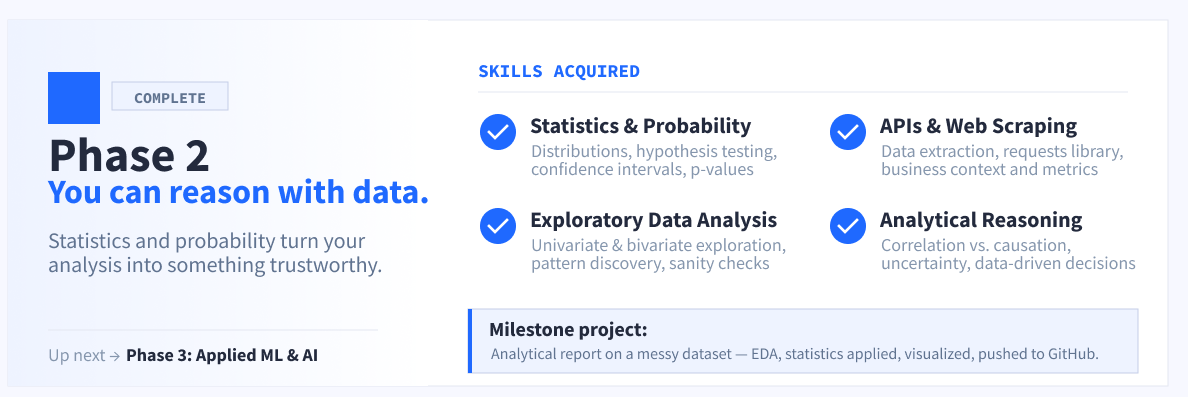
Your Practical Roadmap to Becoming a Data Scientist by 2027
## Data Scientist Roadmap for Beginners (2026–2027) Navigating the path to becoming a data scientist can feel overwhelming. This roadmap clarifies exactly what to learn, in what order, and how long it realistically takes to achieve job readiness by 2027 – whether you’re starting from zero or transitioning from data analysis, engineering, or research. We cut through the noise surrounding Python vs. R, degree requirements, and the rise of Generative AI to provide a focused, actionable plan.

Enterprise AI imagery finds its own voice with faster, open-weight generation
Enterprise-grade AI image generation in just 2 seconds is now a reality with Krea 2 Raw and Turbo, available as open weights under a custom license. Addressing concerns that AI imagery often lacks originality, Krea’s new models offer greater visual variety, prompt accuracy, and crucial customization capabilities for brands. Krea 2 Turbo’s remarkable 2-second generation speed surpasses competitors, while Krea 2 Raw provides a flexible foundation for training custom models.

Alibaba Cloud's HappyHorse 1.1 makes production-ready AI video accessible to enterprises
Alibaba's HappyHorse 1.1 AI video model has surged to the No. 2 spot in global rankings, capitalizing on a dramatic shift in the generative video landscape. Following OpenAI’s Sora discontinuation and ByteDance's Seedance freeze, enterprise buyers now face limited options. HappyHorse, built for integration into business workflows and backed by Alibaba's substantial $52.7 billion infrastructure investment, offers production-ready video synthesis with features like multi-image reference capabilities and improved motion quality.

AI agents that rewrite their own rules unlock smarter enterprise workflows
Researchers are introducing Self-Harness, a framework enabling AI agents to systematically refine their own operational rules, potentially boosting performance by up to 60%. While building frontier AI models remains complex, customizing the “harness”— the system governing agent behavior—is increasingly valuable for enterprises. Self-Harness addresses the challenge of manual harness tuning by leveraging the agent's own execution traces to identify and correct weaknesses, moving beyond intuition-based adjustments.

Turn your Claude Code session into a live, shareable interactive workspace
Anthropic’s Claude Code now delivers live, shared dashboards and interactive workspaces for enterprises through its new Artifacts feature. Transforming a Claude Code session into a custom, shareable HTML webpage, Artifacts allow users to connect live code and data sources, creating dynamic visualizations for teams. This eliminates the need for manual status updates and facilitates clearer communication between engineers and stakeholders. As highlighted by Claude Code lead Boris Cherny, Artifacts are "a game changer" for collaborative workflows, and closely mirror a recent feature release from OpenAI.

Adobe shifts Creative Cloud from media generation to intelligent production orchestration
Adobe is redefining creative workflows with the public beta release of its embedded "creative agent," now available across Creative Cloud applications like Premiere Pro and Photoshop. Moving beyond simple media generation, this agent orchestrates complex production tasks—from batch file management to brand asset updates—by directly accessing software APIs. Powered by new "Elements" and "Projects" technologies for visual consistency and contextual memory, Adobe empowers creatives to delegate tedious tasks, maintaining full aesthetic control.

Discover How Protein Structure Reveals a Deeper Chemical Order
For decades, the established understanding of protein structure centered on a hydrophobic core. Our research now proposes a significant expansion of this model, revealing distinct clustering of all amino acids—polar, acidic, basic, and special—in groups of approximately eight units. We’ve termed this the Mosaic Q model, providing tools for its quantification and visualization. Explore this transformative framework and discover a new perspective on protein architecture.
Embrace Uncertainty to Make Smarter Design Decisions with AI
In an increasingly AI-driven design landscape, it's crucial to move beyond treating predictions as definitive truths. Probabilistic Design is a future-focused mindset empowering UX and product teams to embrace uncertainty and intelligently interpret AI outputs. Learn how to make adaptive decisions, transforming potential pitfalls into opportunities. Discover a framework for navigating complexity and building more resilient solutions. For deeper insights into the evolving AI landscape, explore "Probably raises $9M to build a more reliable kind of AI."
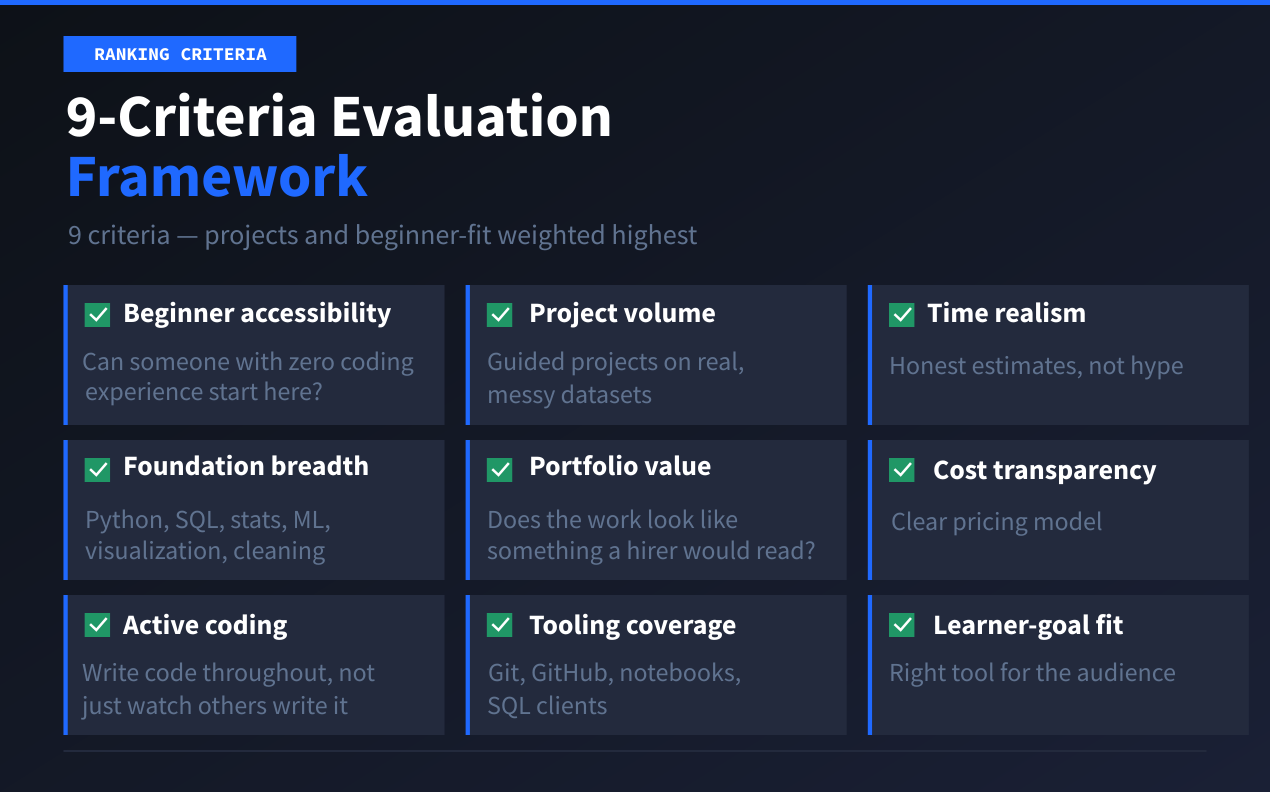
Find the Data Science Course That Fits Your Path, Not Just Your Budget
Choosing the right data science course can genuinely transform your career, but the sheer number of options can be overwhelming. We’ve analyzed dozens to identify the 10 Best Data Science Courses for Beginners in 2026, ranked by practical skill development and accessibility. Whether you’re seeking a free option or a more comprehensive program, this guide clarifies which paths align with your goals. Explore our findings and empower your data journey—and for a broader perspective on data agency, consider our recent discussion with Martin Kleppmann.
Explore the top data analytics courses shaping smarter skills in 2026
Finding the best data analytics course in 2026 requires navigating a diverse landscape of tools, roles, and learning objectives. This guide reviews ten leading courses, ranging from foundational certificates to immersive, project-based programs and even free official training for platforms like Tableau and Power BI. We’ve prioritized options that empower users to transform their data skills and achieve tangible results. For a broader perspective on incorporating user insights, explore our related article, "The Benefits Of Cognitive Inclusion In UX Research."
Designing for cognitive inclusion improves UX for everyone
Recent exploratory user research reveals the transformative power of cognitive inclusion in UX design. Our study, "The Benefits of Cognitive Inclusion in UX Research," highlights unique insights and actionable recommendations directly from participants with cognitive disabilities. These findings underscore the critical need for inclusive design practices, leading to more accessible and user-friendly experiences for everyone. Discover how prioritizing cognitive diversity can significantly improve usability and expand reach.

New benchmark reveals GPT-5.5 outperforms Claude on complex professional tasks
A significant shift has occurred in AI evaluation with the launch of Agents’ Last Exam (ALE), a rigorous new benchmark designed to assess AI’s ability to handle economically valuable, long-horizon professional workflows. OpenAI’s GPT-5.5, operating through the Codex harness, currently leads the ALE Leaderboard with a 24.0% pass rate, surpassing Anthropic’s Claude Fable 5.

Discover how Gemma 4 12B brings agentic AI capabilities to your laptop.
Gemma 4 12B brings agentic, multimodal intelligence straight to your laptop, letting you run sophisticated AI workflows without cloud latency. Its encoder‑free architecture enables on‑device processing of text, images, and code, so you can automate data analysis, generate visual insights, or build webpages locally with Google AI Edge. By eliminating the need for heavyweight servers, Gemma 4 12B transforms everyday machines into powerful, privacy‑first assistants. For a broader view of emerging AI‑enabled tools, see our recent “AWS Releases Next Generation of Amazon OpenSearch Serverless” coverage.
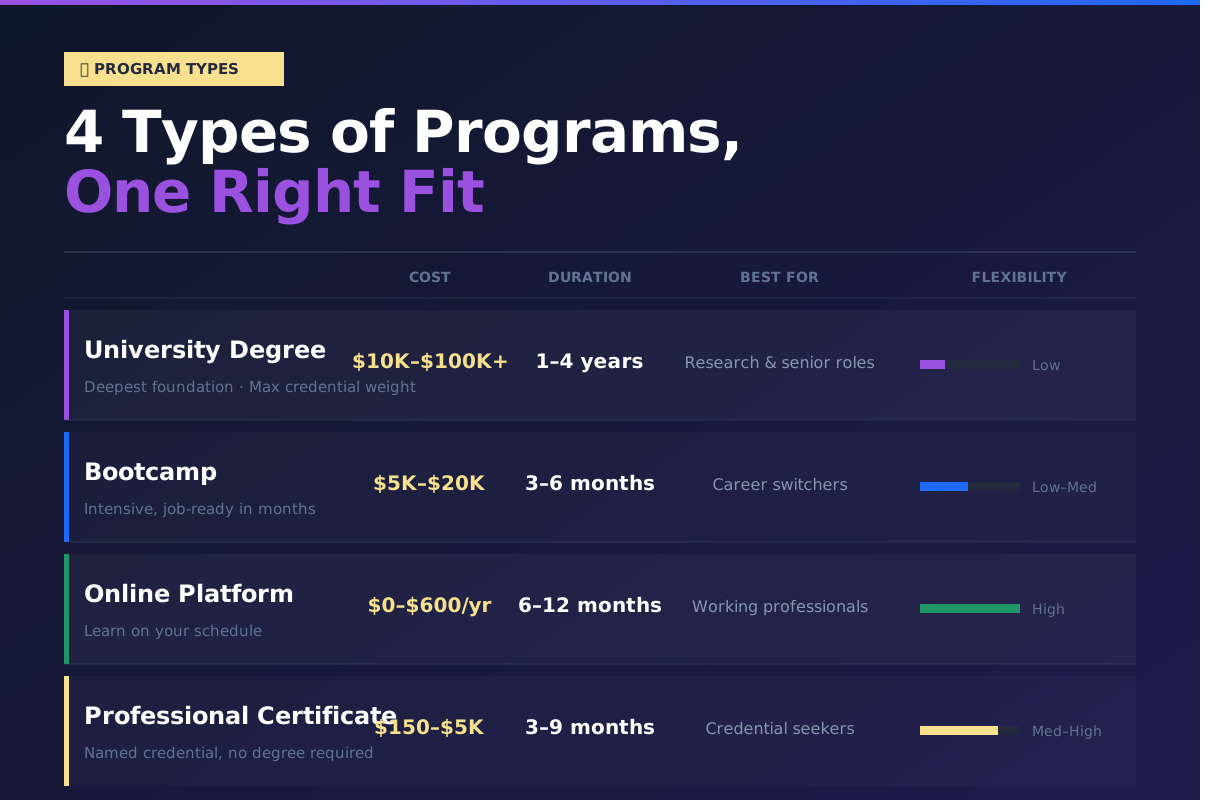
Navigating Data Science Education from Degrees to Self-Guided Paths
In 2026, navigating data science education feels like sprinting through a maze of degrees, bootcamps, and online courses, each claiming the quickest route to a career. The market ranges from free YouTube tutorials to multi‑hundred‑thousand‑dollar master’s programs, yet many comparison lists flatten these options without clarifying which path best fits your goals. This guide ranks programs by curriculum depth, industry relevance, and return on investment, helping you choose a course that truly transforms your data skills and accelerates your career.

Three Paths Through Machine Learning Based on Your Real Goal
In 2026, selecting the best machine learning course requires clarity on your goals—whether you aim to understand ML concepts, apply them practically, or engineer systems for production. Many lists fall short, offering either overly theoretical content or tool-centric bootcamps that miss critical math foundations. This guide breaks down the most effective courses tailored to your objectives, ensuring you find a path that empowers your learning journey.
Focus Your Deep Learning Search on Training, Not Just Using AI
Navigating the landscape of deep learning courses can be challenging, especially with the mix of AI literacy, pre-trained model usage, and hands-on neural network training. This guide focuses solely on the third category, offering you the best deep learning courses for 2026 that equip you with the skills to build and train your own models. If you're eager to deepen your understanding and practical expertise, this curated list is your gateway to transformative learning.
Explore how 104 million curated images can transform your data projects.
Introducing MONET, a groundbreaking dataset featuring over 104 million high-quality curated images, complete with captions and metadata. Built from an extensive collection of 2.9 billion images, MONET is open and Apache 2.0-licensed, making it a valuable resource for researchers and developers. Explore its capabilities through accompanying projects, including a visualization tool and a retrieval tool for text or image searches. For a deeper understanding of its creation, check out our newly published paper. Discover MONET on Hugging Face: [MONET Dataset](https://huggingface.co/datasets/jasperai/monet).
When Users Know It's a Test, Your Data Stops Telling the Truth
In usability testing, a common moment arises when participants hesitate at the login screen, sensing the prototype's artificiality. This pause signals their awareness that they are interacting with a simulation, which can skew subsequent feedback. To enhance user honesty and engagement, it’s crucial to create a more authentic experience during testing. By addressing these concerns, you can gather more accurate insights that drive meaningful improvements. For practical automation solutions to streamline processes, check out "10 Everyday Tasks You Can Automate with AI Today."