Presentation: Compiling Workflows into Databases: The Architecture That Shouldn't Work (But Does)
Our take
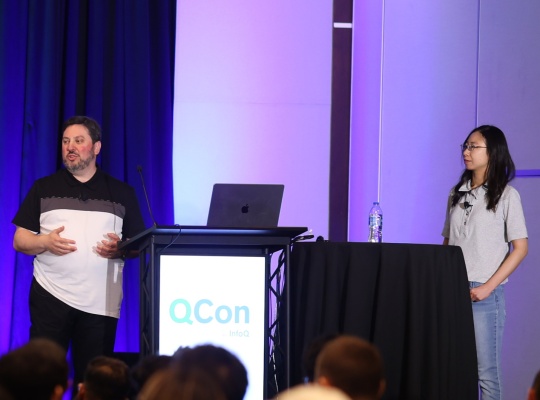
The relentless pursuit of efficiency and reliability in AI workflows has led to some fascinating architectural shifts, and the recent presentation by Jeremy Edberg and Qian Li on DBOS Transact offers a particularly compelling perspective. The core argument – that external orchestrators often introduce points of failure and unnecessary complexity – resonates deeply with anyone who’s wrestled with sprawling, distributed systems. It’s a validation of a trend toward simpler, more integrated solutions, echoing concerns explored in articles like Achieving Compliance as a Platform Engineering Team by Helping Developers, which highlights the pitfalls of forced, overly complex workflows. DBOS Transact’s approach, leveraging standard database tables, SKIP LOCKED queues, and unique primary keys to manage workflows, is a clever sidestep of the traditional distributed orchestration paradigm. This fundamentally challenges the assumption that robust, fault-tolerant AI execution *requires* a separate, dedicated orchestration layer.
The elegance of DBOS Transact lies in its ability to repurpose existing database infrastructure. Many organizations already have robust, scalable database systems in place; adding a layer of distributed orchestration on top introduces operational overhead, potential bottlenecks, and increased complexity in debugging and maintenance. The presentation suggests that by cleverly utilizing database features—specifically SKIP LOCKED queues for concurrency control—you can achieve durable execution and fault tolerance directly within the database itself. This aligns with the broader movement toward composable architectures, as seen in discussions about building agents like real software—Presentation: From Copy-Paste to Composition: Building Agents Like Real Software. The shift is away from monolithic, tightly coupled systems toward modular, interconnected components, and DBOS Transact embodies this principle by integrating workflow execution directly into the data layer. Even the emergence of platforms like OpenAI’s Presence—OpenAI unveils Presence, a new platform that lets enterprises launch and manage realtime voice agents and chatbots—underscores the growing interest in streamlined AI agent management and deployment, further highlighting the need for more efficient architectural solutions.
The implications of this approach are significant. Reduced operational overhead is a clear benefit, but the potential for lower latency is equally compelling. By eliminating the network hops and inter-process communication inherent in external orchestrators, DBOS Transact promises faster execution times, which is critical for many AI applications. Furthermore, the reliance on standard database features reduces the learning curve and simplifies integration. This accessibility empowers a wider range of developers to build and deploy complex AI workflows without needing specialized expertise in distributed systems orchestration—a challenge that has historically limited adoption. The use of unique primary keys for workflow state management is a particularly insightful detail, providing a clear and reliable mechanism for tracking progress and ensuring data consistency. It's a practical demonstration of how clever design choices can unlock unexpected capabilities within existing technologies.
Ultimately, the DBOS Transact approach represents a compelling alternative to the established norms of AI workflow orchestration. It demonstrates that achieving fault tolerance and scalability doesn't necessarily require complex, specialized infrastructure. The true test, of course, will be seeing how well this architecture scales with increasingly complex workflows and massive datasets. As AI continues to permeate every aspect of business, the question becomes: will we continue to build increasingly intricate layers of infrastructure, or will we discover more elegant, integrated solutions that leverage the power of our existing data foundations? The work presented by Edberg and Li suggests a promising path toward the latter, and it’s a development worth watching closely.
Jeremy Edberg & Qian Li discuss why external orchestrators decrease reliability and how to use your existing database for durable execution. They share how DBOS Transact uses standard tables, SKIP LOCKED queues, and unique primary keys to manage complex, fault-tolerant AI workflows with minimal latency, all without the operational overhead of separate distributed systems.
By Jeremy Edberg, Qian LiRead on the original site
Open the publisher's page for the full experience