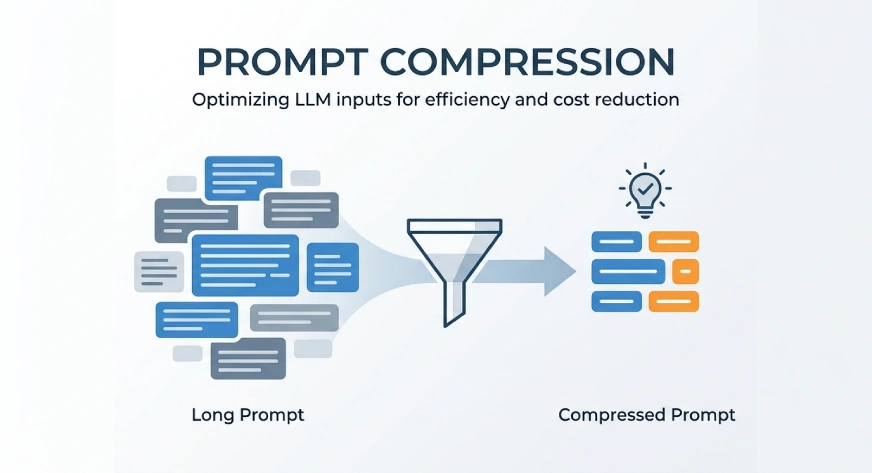
Large language models are often asked to carry far more than they need. A prompt stuffed with long instructions, retrieved documents, chat history, examples, and tool descriptions drives up token usage, inflates cost, and slows response time. Worse, it can bury the actual signal. Prompt compression tackles this directly: it trims the prompt while preserving the key meaning and instructions. That sounds simple, but it is the quiet workhorse of practical AI deployment. We are not talking about a flashy new model or a clever benchmark. We are talking about making the tools you already use more efficient, more focused, and more affordable. This is the kind of progress that matters.
Compression is framed as a cost-saving measure, and it is. But the real opportunity is about clarity. When a model has less noise to sift through, it can actually find the thread. This connects to a deeper idea we have been following: that context is not just storage, it is active material. In Explore how AI agents learn by editing context, not model weights, we saw how agents improve by editing what they see rather than retraining what they are. Compression is the same principle applied to cost and speed. It is not about dumbing down the input; it is about making sure the model is looking at the right thing. And when you consider how models navigate token space, as discussed in Exploring Paragraph Structure: How LLMs Navigate Token Space, the structure of that context matters as much as its size. Compression is not just a hack; it is a way of respecting the model's attention.
Our take is straightforward: if you are building on top of LLMs and not thinking about prompt compression, you are leaving efficiency on the table. The practical impact is immediate. Lower token usage means lower bills, but faster responses and better accuracy are the real wins. We would tell a reader who is just starting to explore this: do not wait for the perfect compression algorithm. Start with the simple rule of auditing your prompts. Remove redundant instructions. Summarize chat history. Cut examples that are not earning their place. The techniques described are a map, not a requirement to master overnight. The goal is to make compression a habit, not a feature you occasionally remember.
The open question we are watching is how far compression can go before it starts to lose nuance. There is a tradeoff between brevity and fidelity, and the best approaches will be the ones that let you measure that tradeoff in real time. That is the detail to watch: not how small you can make a prompt, but how small you can make it before the model starts to miss what matters. For now, the takeaway we would quote is this: prompt compression is not about squeezing tokens; it is about making every token count. That is a shift in mindset, not just a cost optimization. And it is one we hope more teams adopt as they build.