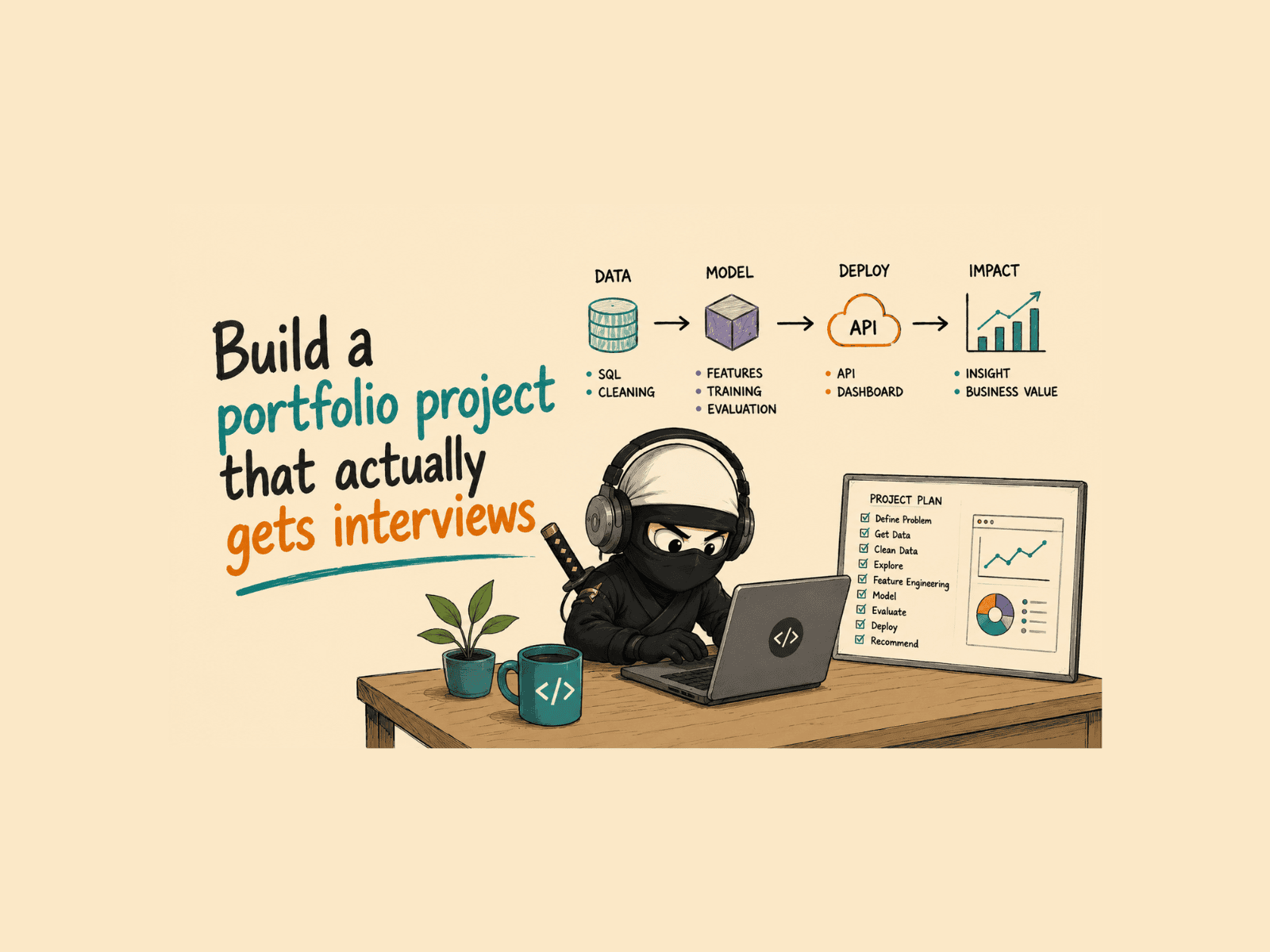
The notebook is dead. Not literally, of course, but as a final deliverable, it might as well be. We see it constantly: a data scientist spends weeks wrestling with a messy dataset, tuning a model, and validating results, only to present a static collection of cells that stops at the last output. The premise that most portfolios stop at a notebook cuts to the core of what we tell our readers every day. A notebook is a sketchpad, not a painting. It shows process, but it rarely demonstrates the disciplined thinking required to take a project from exploration to production. If you are serious about showing what you can do, you have to go further. This is why we've been exploring how Expanding Your Tech Fluency: Key Insights Beyond Artificial Intelligence matters, because the tools around the model are often more important than the model itself.
Taking a project end-to-end means making choices that a notebook never forces you to confront. It means packaging your code, writing tests, containerizing the environment, and thinking about how a user will actually interact with your work. It means moving from the comfortable linear narrative of a Jupyter file into the messy, iterative world of a real application. We recently touched on how Beyond MSE: Refining Forecasts with Autoregressive Rollout and Uncertainty pushes your thinking about evaluation, and the same logic applies here. A portfolio that includes a REST API, a simple front-end, or even a scheduled job that retrains the model shows a level of maturity that separates a hobbyist from a professional. You are not just proving you can fit a curve; you are proving you can deliver a solution.
Our honest take is that this is where the real learning happens, and it is also where most people get stuck. It is uncomfortable to expose your code to the scrutiny of a linter or to debug a race condition in a data pipeline. It is far easier to tweak a hyperparameter and call it a day. But that discomfort is the signal. It tells you where your gaps are. We would tell any reader who asks that if you have time to build one project this year, skip the extra model and spend that time on the engineering. Deploy something. Write a test that fails. Watch it break in the cloud. That experience is worth more than another accuracy point on a benchmark. It is also the difference between a portfolio that gets a polite nod and one that gets a follow-up call.
The specific consequence to watch for is how you frame the journey. The next time you finish a notebook, ask yourself one question: what would it take for a stranger to run this themselves? If you cannot answer that, you are not done. Build the wrapper, write the README, and make the setup painless. That is the standard we hold, and it is the one that will get you hired.