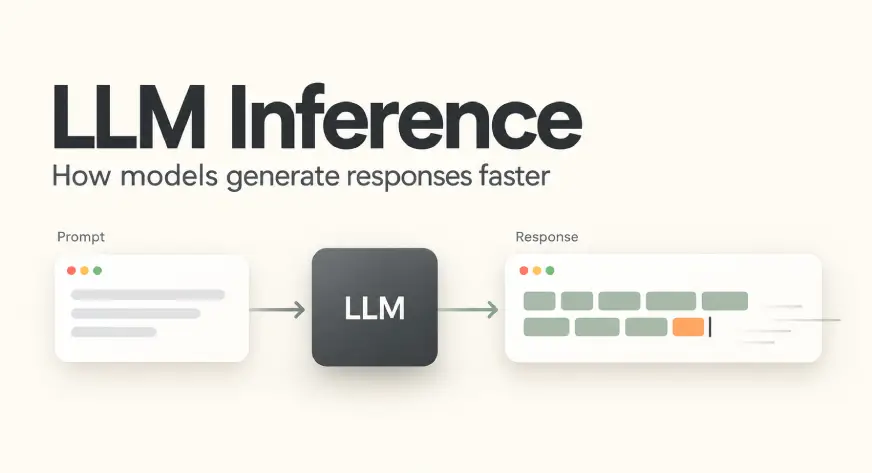
That split second you wait for an AI to start answering is not dead air. It is the most important moment in the entire exchange.
That brief pause, and the steady stream of words that follows, are two fundamentally different jobs happening in sequence on a GPU. Understanding this distinction is what separates an AI tool that feels sluggish from one that feels instant. And it is exactly the kind of invisible technical work that Your AI team works through the night so you wake to a finished newsletter relies on to deliver results by morning. In that silent half-second, the model is parsing your entire prompt, weighing probabilities across billions of parameters, and assembling the first token of its response. Only after that heavy lifting is done does the word-by-word generation begin.
We think this distinction matters more than most users realize. Too many people treat AI tools as a single, magical box. They type a question, see a flashing cursor, and assume the machine is simply typing slowly. But the difference between prompt processing and token generation is the difference between reading the question and writing the answer. They use the same hardware but in very different ways. Prompt processing is computationally dense, it works the GPU hard in a short burst. Token generation is memory-bound and sequential. Optimizing one without the other leaves you with a tool that either hesitates before starting or stalls in the middle.
For anyone building or choosing AI-powered productivity tools, this has a concrete consequence. The tools that feel fastest are not necessarily the ones with the fanciest models. They are the ones that have been engineered to shrink that initial pause through smarter batch processing and parallelization. This is the same kind of thinking that drives Explore free open-source tools that give you more control over your workflow, the principle that understanding how something works underneath gives you the power to make it work better. You do not need to know how to write a GPU kernel. But knowing that the pause is not random, that it is a measurable and optimizable phase, lets you ask better questions when evaluating a tool.
Here is the specific takeaway: the next time a spreadsheet or data app promises "AI-powered" speed, ask how it handles prompt processing versus generation. A tool that treats both the same way will feel inconsistent. A tool that optimizes that initial split-second will feel like it reads your mind. That is the difference between a feature and a workflow. And in a world where Keep your private chats secure when sharing your device with others has become a real concern, the same engineering discipline that makes AI fast can also make it reliable and predictable, because you know exactly what is happening under the hood.