Graph Engineering for AI Agents: Beyond the Single-Agent Loop
Our take
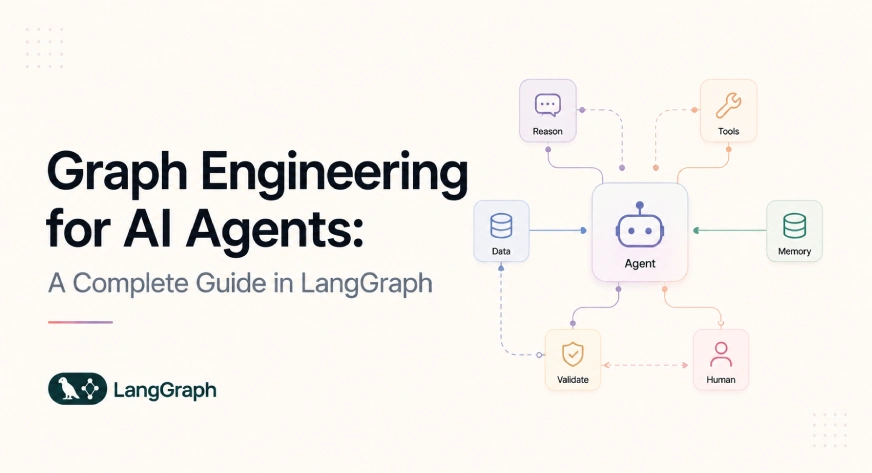
The rapid evolution of AI agents has been a fascinating journey, moving from the initial novelty of prompt engineering to increasingly sophisticated architectures. We’ve seen a progression through stages like context engineering, tool use, autonomous loops, and even memory systems, as highlighted in the Analytics Vidhya piece on graph engineering. The shift now towards graph engineering represents a particularly significant evolution, moving away from the idea of a single, self-contained agent and towards a more orchestrated system of interconnected components. It’s a move that acknowledges the inherent complexity of real-world applications and the limitations of relying on a single AI entity to handle everything. This aligns with recent explorations of Modern AI Agent connectivity, as discussed in MCP Explained: How Modern AI Agents Connect to the Real World, where the focus is on enabling agents to seamlessly interact with external tools and data sources. The potential for enhanced data-driven decision making also echoes recent reporting on the expansion of Grafana Assistant to more than 30 data sources Grafana Assistant Expands to More Than 30 Data Sources, suggesting a broader trend towards integrating AI agents with a wider array of operational systems.
What’s compelling about graph engineering is its explicit focus on workflow design. Rather than simply training an agent to perform a task, it involves defining *how* different agents, tools, functions, validators, and even humans will interact to achieve a desired outcome. This approach brings a welcome element of structure and predictability to AI agent development, addressing a crucial challenge that has plagued the field – the "black box" nature of many AI systems. By visualizing and managing these interactions as a graph, developers gain greater control and transparency, making it easier to debug, optimize, and maintain these increasingly complex systems. This methodical approach is particularly relevant as businesses look to integrate AI into core operations, as evidenced by PayPal's ongoing efforts to incorporate AI into its turnaround strategy PayPal leaves the door open to a higher takeover offer following earnings beat. It signals a move towards treating AI not as a standalone solution, but as a component within a larger, well-defined business process.
The shift to graph engineering also speaks to a growing recognition that many real-world problems are inherently multi-faceted and require the coordinated effort of multiple specialized components. A single AI agent, however sophisticated, is unlikely to excel at every aspect of such a problem. By breaking down the task into smaller, more manageable steps and assigning those steps to different agents or tools, graph engineering allows for a more modular and scalable approach to AI agent development. This modularity also facilitates reuse and collaboration, allowing developers to build upon existing components and create more complex systems more efficiently. The implications extend beyond purely technical considerations, influencing how organizations structure their teams and workflows to effectively leverage these new AI-powered systems.
Looking ahead, the adoption of graph engineering will likely fuel a period of increased specialization within the AI agent development space. We can anticipate the emergence of roles focused on graph design, agent orchestration, and workflow optimization. The challenge will be to develop tools and frameworks that make graph engineering accessible to a broader range of developers, not just AI specialists. As these systems become more prevalent, a critical question arises: how will we ensure the ethical and responsible design of these interconnected workflows, preventing unintended consequences and aligning AI-driven decision-making with human values? The power of orchestrated AI demands a parallel focus on responsible governance.
AI-agent development has progressed through overlapping phases: prompt engineering, context engineering, tool use, autonomous loops, memory systems, and multi-agent coordination. A newer focus is graph engineering, which treats AI applications as explicitly designed workflows rather than a single autonomous agent. Graph engineering defines how agents, tools, deterministic functions, validators, data sources, and humans coordinate to […]
The post Graph Engineering for AI Agents: Beyond the Single-Agent Loop appeared first on Analytics Vidhya.
Read on the original site
Open the publisher's page for the full experience