Microsoft Moves AI Governance From Policy to Runtime Enforcement
Our take
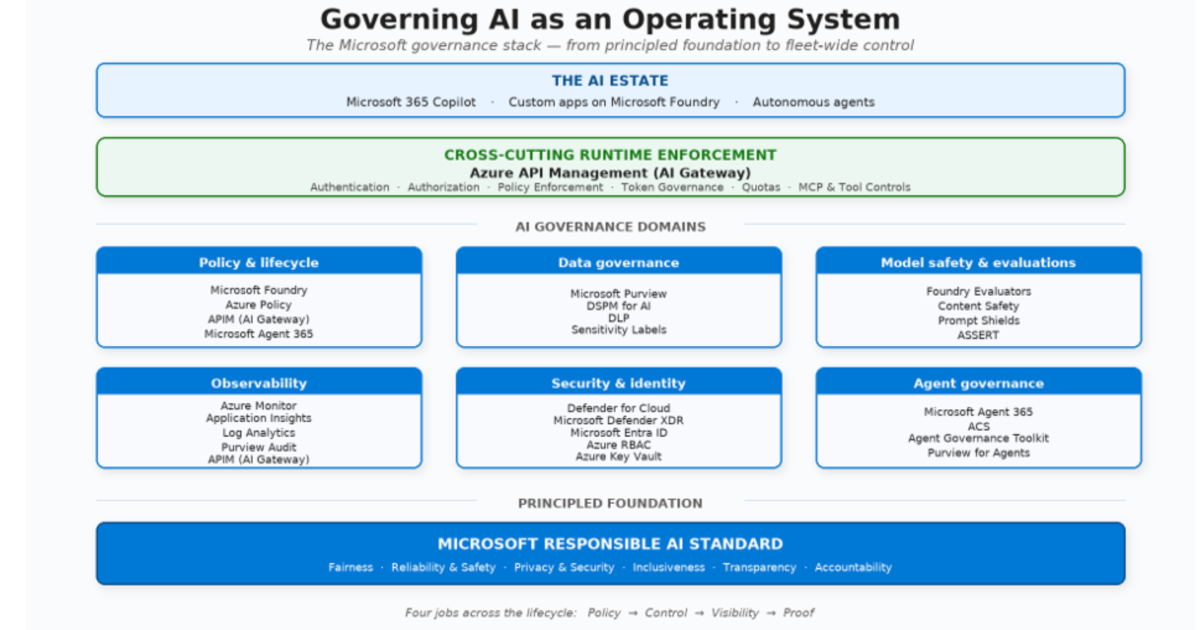
Microsoft's recent unveiling of its AI governance architecture, moving from policy declaration to runtime enforcement, represents a significant evolution in how organizations will manage the risks and ensure the responsible deployment of AI. It's a shift we've been anticipating, as the initial wave of AI enthusiasm often overlooked the crucial need for ongoing oversight. The reality is that AI models, particularly generative AI agents, are dynamic entities, their behavior evolving with data and usage patterns. Simply defining policies in a vacuum is insufficient; they need to be actively monitored and enforced in real-time. This framework, with its nine governance domains and four functions, acknowledges this inherent complexity and provides a roadmap for building genuinely trustworthy AI systems. The emphasis on continuous evaluation and observability is particularly important, aligning with the concerns raised in [Enterprise AI agents are only as reliable as the messiest documents behind them], where the quality of training data is rightly highlighted as a critical determinant of AI performance and reliability.
The move towards runtime enforcement is a practical response to the limitations of reactive governance models. Previously, many organizations relied on post-hoc audits and evaluations, which are inherently lagging indicators. By embedding governance controls directly into the AI application lifecycle, Microsoft is enabling proactive risk mitigation. This aligns with the broader trend of "shift-left" principles, as explored in [Rightsizing Platform Engineering: Building the Platform Your Organization Actually Needs], where integrating security and governance considerations earlier in the development process yields substantial benefits. The inclusion of identity, security, and audit evidence as core components underscores the importance of accountability and transparency – vital for building user trust and complying with emerging regulatory frameworks. The framework's focus on "proof" – verifiable evidence of adherence to governance requirements – will be essential for demonstrating compliance to stakeholders and regulators alike.
However, the practical implementation of such a framework presents its own challenges. While the architecture provides a solid foundation, the specific controls and policies will need to be tailored to each organization's unique context, risk appetite, and regulatory obligations. Furthermore, the integration of these governance mechanisms into existing AI development workflows will require significant investment in tooling and expertise. As noted in [Enterprises winning with AI agents are limiting how much the agents can do alone], a pragmatic approach to AI deployment – one that balances autonomy with human oversight – is often necessary to ensure responsible and reliable outcomes. Microsoft’s architecture seems to implicitly support this view, emphasizing continuous evaluation and providing mechanisms for human intervention when necessary. The success of this initiative will depend not only on the architecture itself but also on the ease with which organizations can adopt and adapt it to their specific needs.
Looking ahead, the convergence of AI governance architectures like Microsoft’s with emerging AI safety standards and regulatory frameworks will be a defining trend in the coming years. The ability to demonstrate verifiable compliance – the “proof” element of Microsoft’s framework – will become increasingly critical for organizations seeking to deploy AI responsibly and sustainably. A key question remains: how will these governance frameworks evolve to address the challenges posed by increasingly sophisticated AI models, particularly those exhibiting emergent behaviors that are difficult to predict or control? The industry's collective ability to answer this question will ultimately determine the long-term viability and societal impact of AI.
Microsoft has outlined an AI governance architecture spanning nine governance domains and four functions: policy, control, visibility, and proof. The approach connects policies with runtime enforcement, continuous evaluation, observability, identity, security, and audit evidence to help organizations verify governance requirements as AI applications and agents operate in production.
By Leela KumiliRead on the original site
Open the publisher's page for the full experience