Presentation: Producing the World's Cheapest Tokens: A How-to Guide
Our take
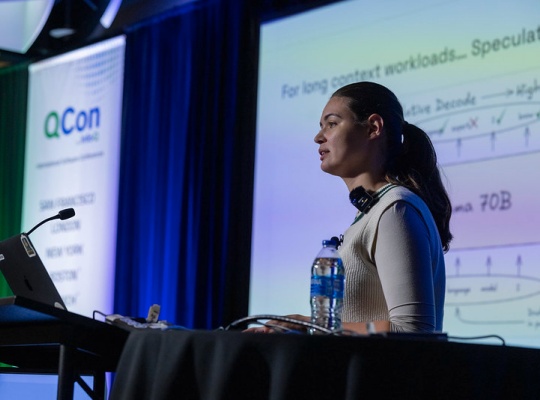
The recent presentation by Meryem Arik, detailed in "Presentation: Producing the World's Cheapest Tokens: A How-to Guide," strikes at a critical juncture in the rapidly evolving landscape of Large Language Models (LLMs). The sheer cost of running these models, particularly at scale, has become a significant barrier to wider adoption and innovation. Arik’s work highlights a pragmatic approach to this challenge, emphasizing that substantial cost reductions – order-of-magnitude, in fact – are achievable through thoughtful architectural trade-offs. This resonates particularly well given the growing concerns around responsible AI development and deployment, where resource efficiency is increasingly paramount. The conversation around AI governance, as highlighted in [IBM and Red Hat Expand Lightwell to Strengthen Trust and Governance for AI-Era Open Source], emphasizes the need for sustainable AI practices, and Arik's strategies directly contribute to that goal. Furthermore, the struggles users are experiencing with usage limits, as illustrated in [How to Install Claude Code: A Step-by-Step Guide], underscore the pressing need for more efficient inference architectures.
Arik’s focus on non-real-time workloads is key. While low-latency responses are crucial for applications like chatbots, many use cases – data analysis, content generation, code completion – can tolerate a degree of delay. This opens up a vast space for optimization, allowing architects to prioritize cost savings without sacrificing functionality. The strategies she outlines—careful hardware selection, optimized inference runtimes, speculative decoding, and smart queue reordering—are not radical departures, but rather a sophisticated orchestration of existing techniques. The real value lies in the systematic approach to evaluating and implementing these trade-offs, ensuring that cost reductions don't come at the expense of accuracy or usability. It’s a move away from simply throwing more compute power at the problem, a strategy that is proving increasingly unsustainable. The potential for broader accessibility, driven by lower costs, should not be underestimated – it’s a pathway to democratizing access to powerful AI tools.
The broader significance of this development extends beyond just individual organizations looking to reduce their cloud bills. It signals a shift in the industry's mindset, moving from a purely performance-centric view of LLMs to a more holistic consideration of efficiency and sustainability. This is particularly relevant as we see increasing exploration of new architectures and deployment models, such as edge computing and specialized hardware accelerators. Cloudflare’s efforts to simplify web application integration with AI models, as previewed in [CloudFlare Previews Automatic WebMCP Support for Web Pages], are another piece of this evolving puzzle – making AI accessible and cost-effective for a wider range of applications. Arik’s work provides a practical blueprint for engineering leaders to contribute to this shift, empowering them to build more responsible and economically viable AI solutions. It’s a valuable contribution to a field often dominated by hype and abstract concepts.
Looking ahead, the key question becomes: how can these optimization strategies be further automated and integrated into the LLM development lifecycle? As models continue to grow in size and complexity, manual tuning will become increasingly impractical. The future likely involves AI-powered tools that can automatically analyze workloads, identify cost-saving opportunities, and configure inference architectures accordingly. This represents a significant opportunity for innovation in the tooling space, and one that will be crucial for unlocking the full potential of LLMs while ensuring their long-term sustainability. Can we anticipate a future where cost optimization is as integral to LLM deployment as model accuracy?
Meryem Arik discusses strategies for designing low-cost LLM inference architectures for high-volume, non-real-time workloads. She explains how software architects and engineering leaders can achieve order-of-magnitude cost reductions by making critical trade-offs across hardware, inference runtimes, speculative decoding, and smart queue reordering.
By Meryem ArikRead on the original site
Open the publisher's page for the full experience