10 Essential Agentic AI Concepts Explained Simply
Our take
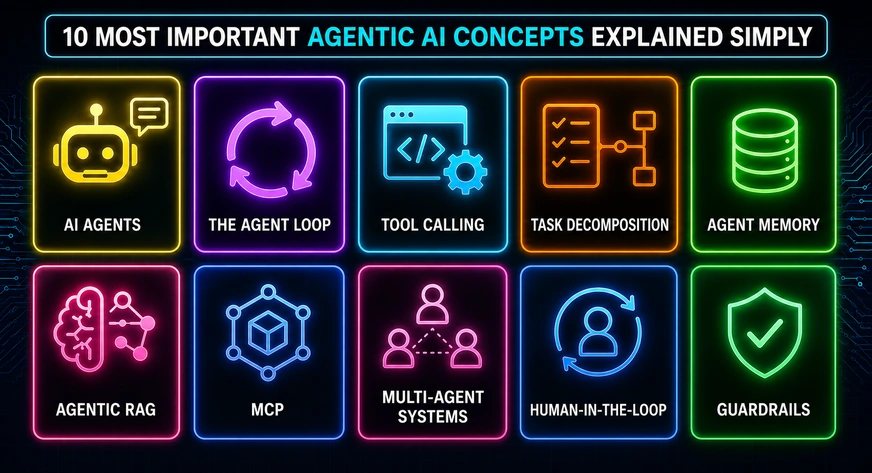
The recent surge in discussion around AI agents can feel overwhelming, a rapid influx of jargon threatening to obscure the underlying potential. The Analytics Vidhya piece, "10 Essential Agentic AI Concepts Explained Simply," arrives at a crucial moment, offering a much-needed demystification of this evolving landscape. It’s right to highlight that while the terminology – tool calling, agent loops, MCP, guardrails – is increasingly prevalent, a shared understanding remains elusive. This isn't a reflection of inherent complexity, but rather the speed at which the field is advancing. As OpenAI continues to explore new monetization strategies, as evidenced by [OpenAI to start showing ads on ChatGPT’s free and Go tiers in India], and as companies like Instinct rapidly gain traction with substantial funding rounds like [Viral AI startup Instinct has raised $350 million at a $2.5 billion valuation], the need to grasp these foundational concepts becomes paramount. The article’s focus on simplifying these core ideas is a valuable contribution, particularly for those seeking to move beyond the hype and engage with practical applications.
Agentic AI represents a significant shift from the passive, query-response models that have largely defined AI interaction thus far. Instead of simply providing answers, agents actively pursue goals, leveraging tools and iteratively refining their approach. This parallels the escalating demand for computational power, as demonstrated by [Amazon just tripled its order of Nvidia chips over ‘surging demand’], underscoring the infrastructure investments required to support these more complex AI systems. Understanding the components—the planning, the tool utilization, the memory, and the ability to self-correct—is essential to appreciating the transformative potential. The article’s breakdown of these elements empowers users to not just understand *what* agents are doing, but *how* they’re doing it, fostering a deeper engagement with the technology. The ability to define and constrain these agents – through guardrails and ethical considerations – becomes increasingly vital as they take on more complex tasks, impacting everything from customer service to data analysis.
The broader significance of this shift lies in the potential for AI to become a truly collaborative partner, augmenting human capabilities rather than simply replacing them. Agentic AI opens doors to automating intricate workflows, handling nuanced decision-making, and even proactively identifying opportunities that might otherwise be missed. While the current iteration of agentic AI is still in its nascent stages, the trajectory points towards a future where these systems become increasingly integrated into our daily lives, seamlessly handling tasks and freeing up human resources for more strategic endeavors. The key, however, will be ensuring accessibility and transparency, preventing these powerful tools from becoming opaque black boxes. Simplifying the core concepts, as Analytics Vidhya does, is a vital step in this process.
Looking ahead, the evolution of agentic AI hinges on the development of more robust and adaptable frameworks. The ability to create agents that can learn and adapt to new environments, handle unexpected situations, and collaborate effectively with humans will be critical for realizing the full potential of this technology. A compelling question to watch is how effectively we can establish clear ethical guidelines and safety protocols for these increasingly autonomous systems, ensuring they align with human values and contribute to a positive future. The move from understanding the individual components to designing and deploying truly reliable and responsible agentic AI systems represents the next frontier.
AI agents are everywhere right now. You hear terms like tool calling, agent loops, MCP, guardrails thrown around as if its common language… it isn’t! But that is about to change. Agentic AI isn’t nearly as complicated as it sounds once you understand the few core ideas that actually matter. Here are 10 agentic AI concepts […]
The post 10 Essential Agentic AI Concepts Explained Simply appeared first on Analytics Vidhya.
Read on the original site
Open the publisher's page for the full experience