Silent Broadcasting Can Ruin Your Model
Our take
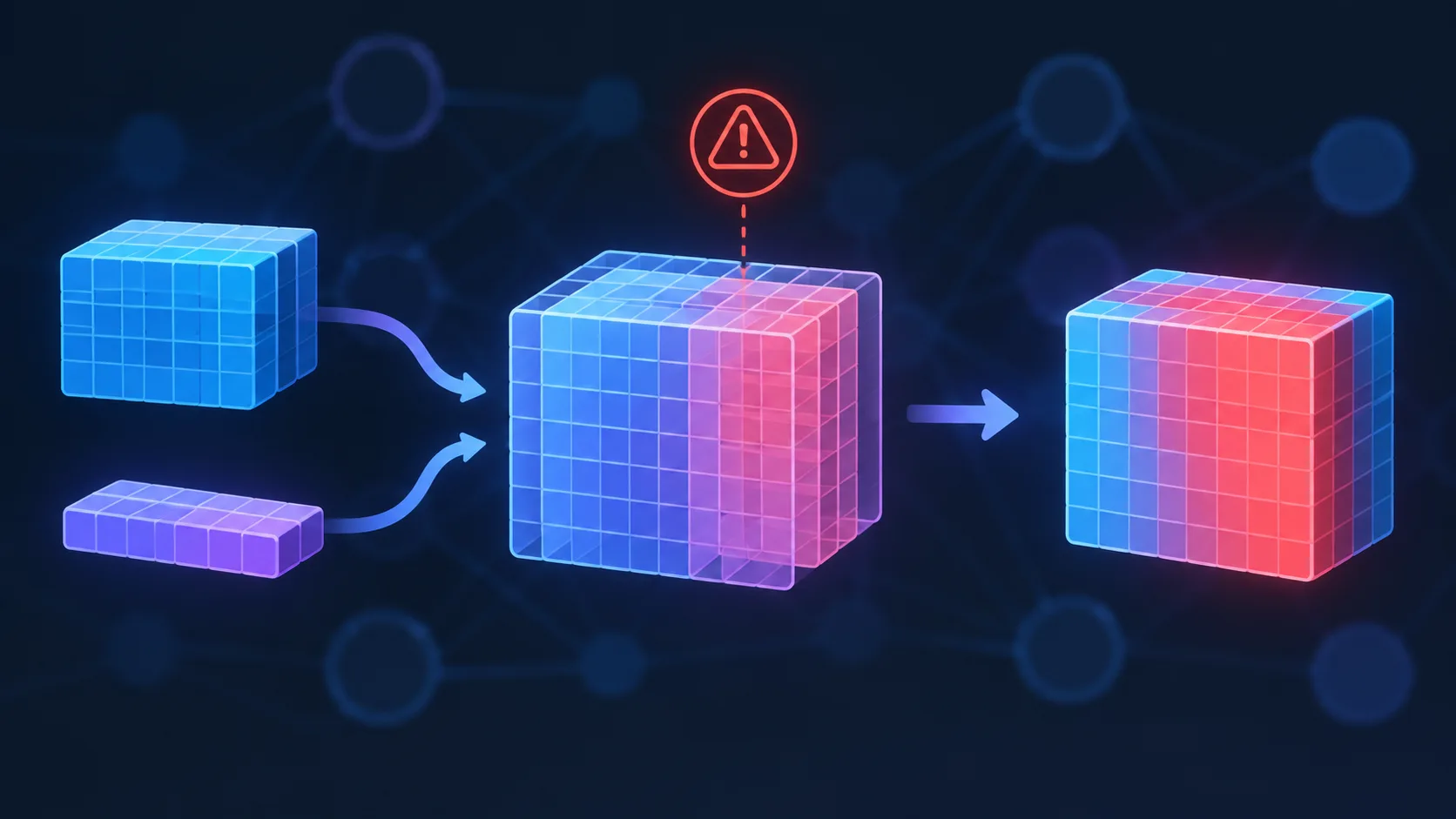
The recent Towards Data Science piece, "Silent Broadcasting Can Ruin Your Model," shines a much-needed light on a pervasive and often frustrating source of errors in machine learning development – the subtle pitfalls of tensor broadcasting in PyTorch and TensorFlow. It's a reminder that even seemingly straightforward operations can harbor insidious bugs, particularly when working with complex neural network architectures. The article’s core message resonates deeply with anyone who’s spent hours debugging unexpected behavior, only to discover the root cause was a silent shape mismatch during a tensor operation. We’ve all been there, wrestling with gradients that vanish or outputs that simply don't make sense, and this piece elegantly explains a common culprit. The challenge lies in the fact that these errors aren't always immediately apparent; the operations execute without raising exceptions, leading to incorrect results propagating through the model, making diagnosis exceptionally difficult. This is further complicated by the increasing complexity of models and the sheer volume of data they process, making manual inspection impractical. Related to this challenge of debugging complex systems, the article “The N Squared Pizza Problem” offers valuable insights into memory management in ML, highlighting the difficulties in scaling and optimizing resource usage, a concern often exacerbated by these subtle broadcasting errors.
The significance of this issue extends beyond just individual debugging headaches. It speaks to a broader need for improved tooling and developer practices within the machine learning ecosystem. While frameworks like PyTorch and TensorFlow provide powerful capabilities, they often abstract away low-level details, potentially masking underlying issues. This abstraction, while beneficial for productivity, can also create a false sense of security. The silent nature of these broadcasting errors underscores the importance of rigorous testing and validation, particularly with diverse input shapes. Furthermore, the article implicitly advocates for a more deliberate and mindful approach to tensor manipulation. Rather than relying solely on the framework’s broadcasting rules, developers should actively verify the shapes of tensors involved in operations to ensure compatibility. This proactive approach, while potentially adding a bit of upfront effort, can save significant time and frustration down the line. The exploration of modularity in adapting LLMs, as demonstrated in “[LARA: small, composable behaviours for frozen LLMs [P]]( /post/lara-small-composable-behaviours-for-frozen-llms-p-cmu4f3kaj00db5ngml71t7pv2)”, also highlights the importance of understanding the underlying components and their interactions to avoid unexpected outcomes, a principle that directly applies to understanding tensor broadcasting.
What’s particularly compelling is the article’s call for greater awareness and education around this topic. Many developers, especially those newer to the field, may not be fully cognizant of the intricacies of broadcasting and its potential pitfalls. The Towards Data Science post serves as a valuable resource for both novice and experienced practitioners alike, providing practical guidance and raising awareness of a common source of errors. It encourages a shift in mindset – from passively accepting framework behavior to actively scrutinizing tensor shapes and operations. This emphasis on understanding the fundamentals is crucial for building robust and reliable machine learning models. The ability to quickly and effectively diagnose these errors will become increasingly important as models grow in size and complexity, and as the demand for production-ready, error-free AI systems continues to rise. Addressing these issues is not just about fixing bugs; it's about building a more sustainable and trustworthy foundation for the future of AI.
Looking ahead, we can anticipate further developments in tooling and static analysis to help detect and prevent these silent broadcasting errors. Perhaps frameworks will incorporate more robust shape checking mechanisms or provide clearer error messages when mismatches occur. The community’s focus on reproducible research, as exemplified in discussions around “[NeurIPS Reference Check Response[D]]( /post/neurips-reference-check-response-d-cmu4f43rm00dl5ngmz3mq5acv)”, emphasizes the importance of meticulousness and attention to detail, a principle that directly applies to ensuring the correctness of tensor operations. The question becomes: how can we move beyond reactive debugging to proactive prevention, embedding checks and validations directly into our workflows and tooling to minimize the risk of these subtle yet impactful errors?
PyTorch and TensorFlow tensor broadcasting: how silent shape errors cause difficult-to-debug machine learning bugs
The post Silent Broadcasting Can Ruin Your Model appeared first on Towards Data Science.
Read on the original site
Open the publisher's page for the full experience