5 Best Local LLMs You Can Run on a Mac mini in 2026
Our take
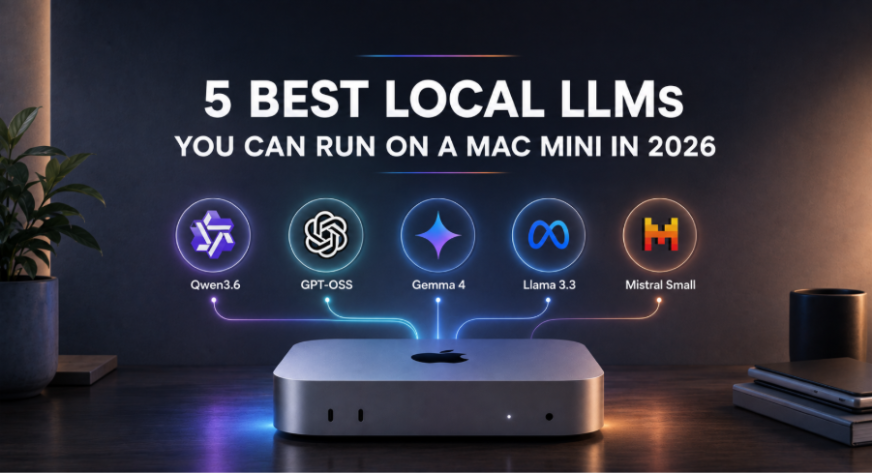
The rise of locally hosted Large Language Models (LLMs) represents a fascinating shift in the AI landscape, one that prioritizes control and customization over sheer scale. While proprietary models like those powering ChatGPT continue to impress with their raw capabilities, the desire for configurability – the ability to fine-tune and adapt models to specific needs – is driving a surge in interest in on-device solutions. The fact that the Mac mini, a relatively unassuming machine, is now capable of running these models is a testament to the rapid advancements in Apple Silicon and the ingenuity of tools like Ollama and LM Studio. This trend underscores a broader movement away from solely relying on centralized, cloud-based AI services, and towards a more distributed and user-centric approach. As we’ve seen with Apple's recent legal battles, [Apple shares ‘shocking evidence’ against former employee accused of stealing company data for OpenAI], data security and control are becoming increasingly paramount concerns, further fueling the demand for local processing.
The appeal of running LLMs locally extends beyond security. It empowers users, particularly those in specialized fields, to tailor models to their precise requirements without being constrained by the limitations of generic, pre-trained systems. Imagine researchers fine-tuning a model on a specific dataset for a niche scientific application, or businesses developing internal knowledge bases accessible entirely offline. This level of control unlocks possibilities unavailable with purely cloud-based solutions. This burgeoning ecosystem also reflects a broader debate about the concentration of AI power. The significant resources required to train and maintain massive proprietary models mean that only a handful of organizations currently have the capacity to do so. The development of accessible tools and optimized hardware, like the Mac mini, democratizes access to AI development and deployment, potentially fostering a more diverse and innovative AI landscape – a stark contrast to the situation detailed in [A group funded by Andreessen, Horowitz, and Brockman plans data center ads to sway midterms], where lobbying efforts highlight the high-stakes competition surrounding AI infrastructure.
The performance of these locally hosted models, even on devices like the Mac mini, is continually improving. While they may not match the absolute performance of the largest proprietary models, the trade-off in terms of privacy, control, and customization is often well worth it. Moreover, the ability to operate offline – a critical advantage for certain applications – is a significant differentiator. Consider the implications for industries like defense, where secure and reliable AI capabilities are essential, as evidenced by [The Pentagon now has its own version of ChatGPT and Grok]. The ongoing optimization of models for Apple Silicon, coupled with the continued development of user-friendly tools like Ollama and LM Studio, will only accelerate the adoption of local LLMs. This isn’t about replacing cloud-based AI entirely; rather, it’s about providing users with a viable and increasingly powerful alternative for specific use cases.
Looking ahead, the convergence of increasingly powerful and efficient hardware, optimized AI models, and intuitive user interfaces will likely solidify the position of local LLMs as a mainstream option. The question isn’t *if* local AI will become more prevalent, but rather *how* it will reshape the broader AI ecosystem. Will we see a proliferation of specialized, locally hosted models catering to niche industries and applications? Will the demand for on-device AI drive further innovation in hardware design and software optimization? The next few years promise to be a fascinating period of experimentation and growth, as users explore the transformative potential of AI, brought directly to their desktops.
Proprietary models are amazing! But sometimes what is of importance is configurability rather than raw power. This has led to the emergence of locally hosted models. The Mac mini has emerged as a surprisingly capable machine for running AI locally. With Apple Silicon, enough unified memory, and tools like Ollama and LM Studio, users can now run capable models entirely on-device. But […]
The post 5 Best Local LLMs You Can Run on a Mac mini in 2026 appeared first on Analytics Vidhya.
Read on the original site
Open the publisher's page for the full experience