How to Build a Career in AI: 3 Distinct Pathways
Our take
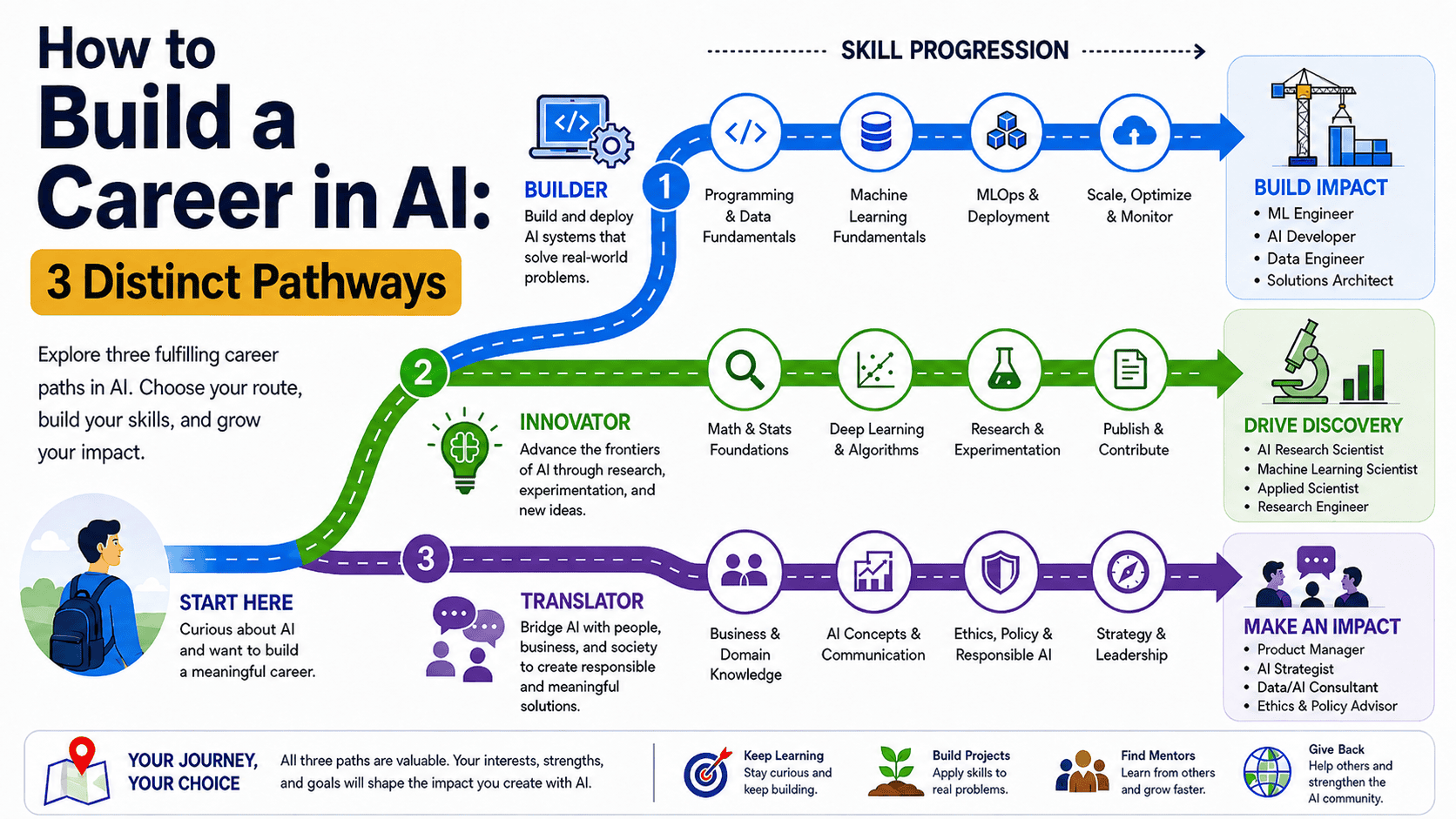
The recent piece outlining three distinct career pathways into AI – the Researcher, the Engineer, and the Product Specialist – strikes a vital chord in a field often perceived as a monolithic entity. It’s a welcome move away from the breathless hype surrounding AI, offering a grounded perspective on how individuals with varying skillsets and interests can find a meaningful role. The article rightly highlights that entry isn’t a singular, demanding climb; rather, it’s a landscape of opportunity adaptable to different backgrounds. We’ve seen this trend reflected in other conversations within our community, such as the discussion around evaluating AI coding agents, as detailed in Top 10 Open-Source Benchmarks for AI Coding Agents in 2026, demonstrating a growing focus on practical application and measurable outcomes, not just theoretical advancements. Furthermore, the emphasis on skill mapping resonates with the evolving needs we’re witnessing across the data management space; tools like Aspire are continually evolving to address these shifts, as evidenced by Microsoft Releases Aspire 13.5 With a Refreshed Dashboard and Workflow Improvements, illustrating a commitment to accessible and adaptable workflows. The breakdown of roles – Researcher focused on fundamental breakthroughs, Engineer building and deploying models, and Product Specialist bridging the gap between technology and user needs – provides a useful framework for aspiring AI professionals. It’s particularly encouraging to see the Product Specialist role gaining prominence. Historically, AI development has been heavily weighted towards research and engineering, often overlooking the crucial element of ensuring these innovations translate into tangible value for users. This article implicitly acknowledges that building successful AI solutions requires a blend of technical expertise and a deep understanding of human behavior and business objectives. The skill maps presented for each role are also insightful, underscoring the diverse skillsets – from advanced mathematics and statistical modeling for Researchers to software development and DevOps for Engineers, and market analysis and user experience design for Product Specialists. The clarity provided here empowers individuals to realistically assess their strengths and identify a pathway that aligns with their existing capabilities and aspirations. It's a shift from a "one-size-fits-all" approach to a more nuanced understanding of how different skillsets contribute to the broader AI ecosystem. The significance of this perspective extends beyond individual career planning. It speaks to a broader need within the AI industry to cultivate a more diverse and interdisciplinary workforce. For too long, the narrative has been dominated by the "AI genius," a figure often portrayed as possessing an almost superhuman ability to code and understand complex algorithms. This narrative can be intimidating and exclusionary, deterring individuals with valuable skills and perspectives from entering the field. By highlighting these distinct pathways, the article helps demystify AI and makes it feel more accessible to a wider range of talent. The focus on practical skills and real-world applications also addresses the growing concern about the "AI skills gap." As AI becomes increasingly integrated into various industries, there's a critical need for professionals who can not only build AI models but also deploy, maintain, and interpret them effectively. This requires a shift in education and training programs to emphasize practical skills and cross-functional collaboration. It’s a reminder that successful AI implementation isn’t just about the model itself; it’s about the entire ecosystem surrounding it, including data infrastructure, user interfaces, and business processes. Exploring the underlying mathematical and computational concepts, as detailed in [The spectral neuron - an ML primitive for scalable and interpretable models [R]](/post/the-spectral-neuron-an-ml-primitive-for-scalable-and-interpr-cmt1hb58o0ketmi9zubhifggx), is vital, but so is the ability to translate these concepts into actionable solutions. Looking ahead, the crucial question becomes: how do we effectively bridge the gap between these three pathways? The ideal scenario involves fostering greater collaboration and knowledge sharing between Researchers, Engineers, and Product Specialists. Siloed teams often lead to suboptimal outcomes, with brilliant research failing to translate into practical applications or innovative products failing to meet user needs. Encouraging cross-functional training and mentorship programs can help break down these silos and cultivate a more holistic understanding of the AI development lifecycle. Furthermore, we need to develop better tools and platforms that empower these different roles to work together more effectively.
Read on the original site
Open the publisher's page for the full experience