Reparameterization Tricks: Variance Reduction by Smarter Gradients
Our take
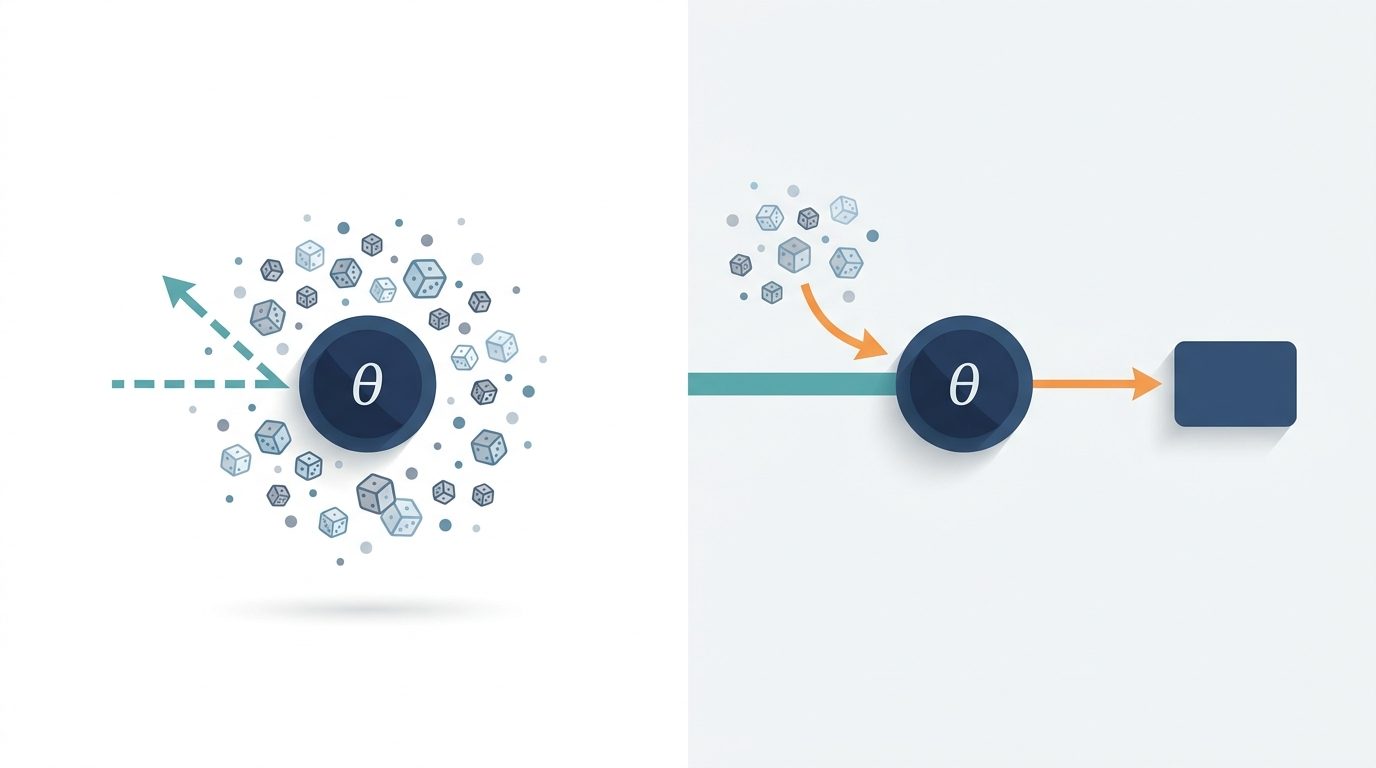
The recent Towards Data Science piece, "Reparameterization Tricks: Variance Reduction by Smarter Gradients," highlights a crucial advancement in training deep learning models, particularly those relying on stochastic gradient descent. The core idea—moving randomness outside the computation graph—is elegantly simple yet profoundly impactful. It addresses a persistent challenge in machine learning: the high variance often associated with gradient estimates derived from noisy data. This noise can significantly slow down convergence and, in some cases, prevent models from reaching optimal performance. As researchers increasingly explore complex architectures and datasets, techniques to stabilize training become paramount, and this reparameterization approach offers a compelling solution. It's a refinement that builds upon the foundational work of variational inference and allows for more efficient and reliable optimization. The challenge of replicating research findings, as demonstrated in [How do you get preprocessed dataset of a paper [D]], often hinges on understanding and reproducing the intricacies of the training process, and techniques like these directly impact that reproducibility.
The beauty of this method lies in its differentiability. By decoupling the random sampling from the gradient calculation, we retain the ability to backpropagate through the entire network, enabling end-to-end learning. This is a significant departure from older methods that might require approximations or workarounds to handle randomness. This also ties into broader discussions around improving the efficiency of AI development, similar to the exploration of tools like Superpose, [Former TikTok execs built an app that uses AI to teach you how to pose for a photo], which seeks to streamline a creative process using AI. Both represent efforts to make AI more accessible and useful by tackling specific challenges – Superpose focusing on creative output and this reparameterization technique concentrating on model training stability. The ability to reliably train complex models opens doors for advancements across numerous fields, from natural language processing to computer vision and beyond. Furthermore, the concept’s applicability extends beyond just reducing variance; it can also enable more efficient exploration of the parameter space, a consideration often brought up in discussions around submitting work in progress, like [How much work in progress can a workshop submission be [R]].
The implications of this work are far-reaching. While the concept itself isn't entirely new—reparameterization techniques have been around for a while—this article provides a clear and concise explanation of the underlying principles and its practical benefits. It underscores the ongoing evolution of optimization algorithms, moving beyond brute-force approaches towards more intelligent and adaptive strategies. This focus on smarter gradients directly addresses the computational demands of increasingly large models, allowing researchers and practitioners to train more effectively with limited resources. The move towards more efficient training processes is not merely a technical optimization; it represents a shift towards democratizing AI, making it accessible to a wider range of researchers and organizations who may not have access to massive computational infrastructure. It's a step towards a future where sophisticated AI models can be developed and deployed more sustainably.
Ultimately, the ability to reduce variance in gradient estimates represents a fundamental improvement in our ability to train deep learning models. This "smarter gradients" approach is a testament to the ongoing ingenuity within the AI research community. As models continue to grow in complexity and data volumes explode, techniques like reparameterization will become increasingly critical for achieving robust and efficient training. A key question to watch is how these advancements will integrate with emerging hardware architectures designed specifically for AI workloads – will we see specialized hardware optimized for these low-variance gradient calculations, further accelerating the pace of innovation?
How moving randomness outside the computation graph turns noisy gradient estimators into low-variance, differentiable ones
The post Reparameterization Tricks: Variance Reduction by Smarter Gradients appeared first on Towards Data Science.
Read on the original site
Open the publisher's page for the full experience