When Does Graph RAG Actually Add Value? A Hands-On Experiment
Our take
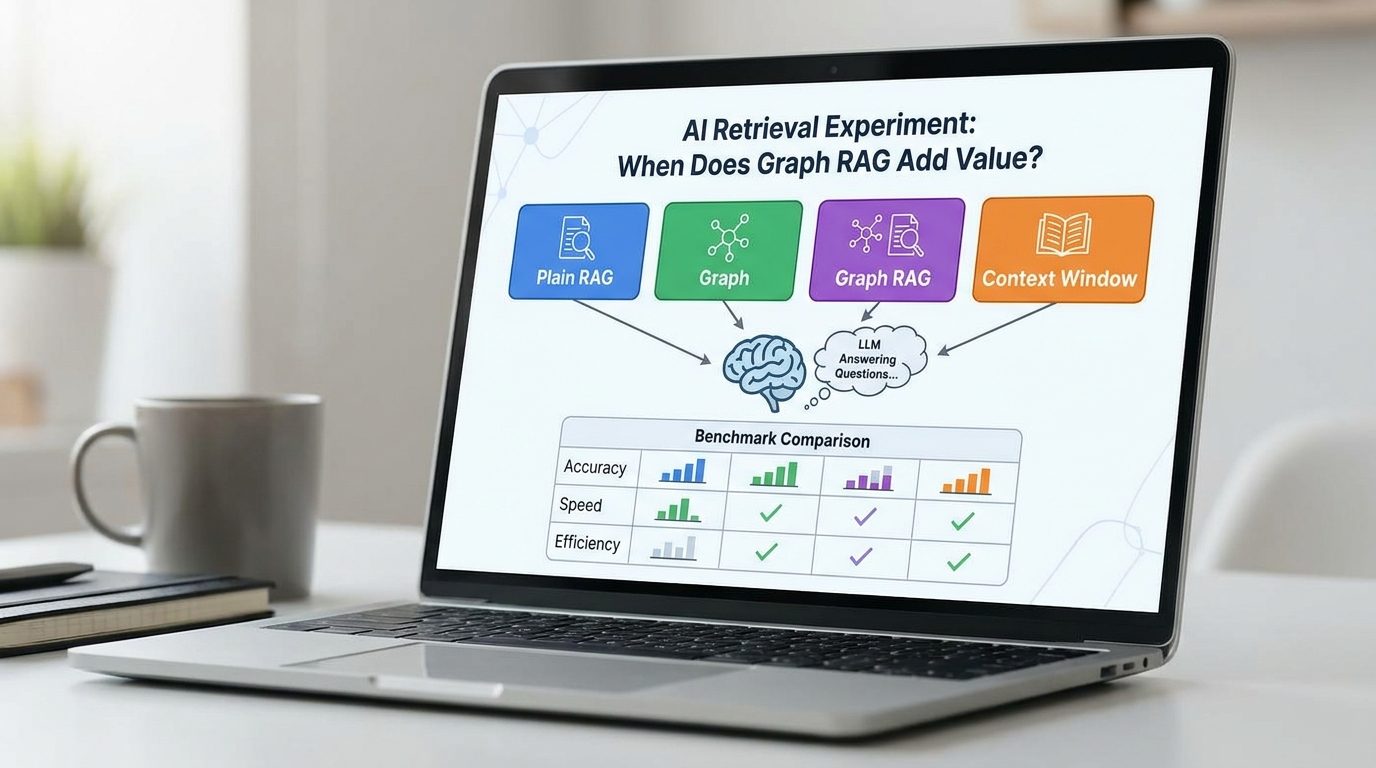
The recent exploration of Graph RAG’s efficacy, as detailed in "When Does Graph RAG Actually Add Value? A Hands-On Experiment," arrives at a crucial juncture in the evolution of AI-powered knowledge retrieval. The author's pragmatic benchmarking approach – building and testing architectures on readily available hardware – is particularly valuable in a field often dominated by theoretical discussions and impressive, but inaccessible, demonstrations. We’ve seen similar momentum building around the concept of AI-driven developer platforms, as explored in "Building an Internal Developer Platform with Artificial Intelligence," where leveraging semantic search across various tools promises to streamline workflows. This experiment reinforces the notion that the core value proposition of any AI solution, including RAG, isn't inherent in the technology itself, but rather in its demonstrable impact on practical outcomes. It’s a timely reminder that the complexity of a solution should be directly proportional to the problem it solves, and that sometimes, simpler approaches can be surprisingly effective. The ongoing efforts to utilize surplus AI compute for scientific endeavors, such as the project highlighted in "If you have leftover AI tokens/compute, there’s an open project working on the Twin Prime Conjecture [P]," further underscores the importance of resource optimization and finding practical applications for emerging technologies.
The author’s findings – that the trade-offs between plain RAG, graph RAG, and maximizing context window size are nuanced and context-dependent – are particularly insightful. The temptation to immediately embrace the seemingly more sophisticated graph RAG architecture, with its promise of richer relationships and contextual understanding, is tempered by the reality of increased computational cost and potential marginal returns. This challenges the prevailing narrative that equates complexity with superiority. The experiment’s focus on practical performance, measured against a consistent set of documents and questions, provides a valuable data point for those considering implementing RAG solutions. It highlights a crucial consideration: the performance gains of graph RAG are not universal and depend heavily on the nature of the data and the types of queries being posed. Over-engineering a solution without a clear understanding of the specific requirements can lead to unnecessary complexity and increased operational overhead.
The broader significance of this work extends beyond the specific comparison of RAG architectures. It speaks to a wider trend in AI – the increasing emphasis on pragmatic evaluation and the need to move beyond hype cycles. We’re entering an era where demonstrable value and efficiency are paramount, and where the focus is shifting from simply building sophisticated models to effectively deploying them to solve real-world problems. The ability to accurately assess the trade-offs between different approaches, as exemplified by this hands-on experiment, is becoming a critical skill for data scientists and AI engineers. Furthermore, the author's approach of conducting the experiment on standard hardware makes the findings accessible and reproducible, fostering a culture of open experimentation and collaborative learning within the AI community. This contrasts sharply with the often opaque and resource-intensive research conducted in specialized environments.
Looking ahead, the key question will be how these insights translate into more practical and accessible AI solutions. As context windows continue to expand and computational resources become more readily available, the balance between complexity and performance will continue to evolve. However, the fundamental principle remains the same: AI should empower users and simplify workflows, not add unnecessary layers of complexity. It will be interesting to observe how developers incorporate these findings into their RAG implementations and whether we see a shift towards more tailored and efficient architectures that prioritize demonstrable value over sheer technological sophistication. The future of knowledge retrieval will likely involve a more nuanced understanding of when and where graph RAG – and other advanced techniques – truly deliver on their promise.
I built four AI retrieval architectures on a laptop and benchmarked them against the same set of documents and questions. Here’s what the results taught me about the trade-offs between plain RAG, graph RAG, and simply putting everything into a frontier model’s context window.
The post When Does Graph RAG Actually Add Value? A Hands-On Experiment appeared first on Towards Data Science.
Read on the original site
Open the publisher's page for the full experience