Why You Shouldn’t Always Trust LLMs as Judges: Understanding Bias in Automated Evaluation
Our take
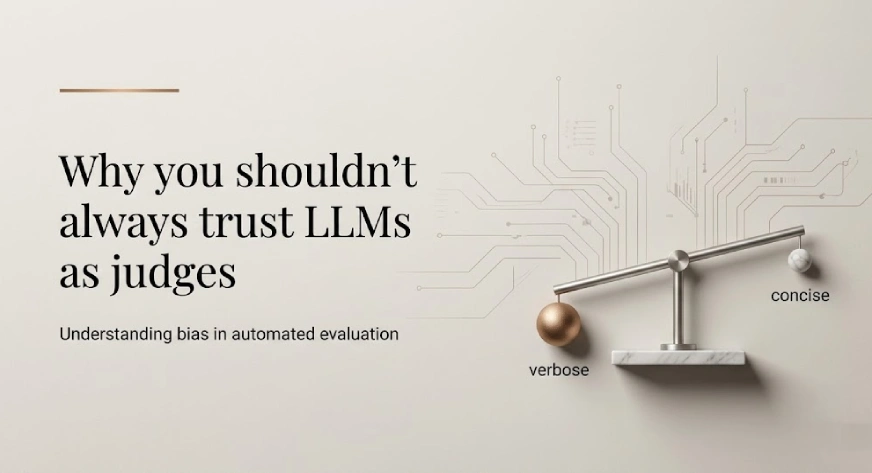
The allure of automation is strong, particularly when it promises speed, cost savings, and scalability. The recent embrace of Large Language Models (LLMs) as evaluators – assessing everything from student code to research papers – exemplifies this drive. As highlighted in Can a Local LLM Run My AI Assistant?, the practicalities of deploying and managing these models are already complex, and the Analytics Vidhya piece rightly cautions against a blind trust in their judgment. The core point, echoed by Bhaskarjit Sarmah, is a crucial one: these models, however efficient, are not objective arbiters. They reflect the biases inherent in the data they were trained on, and applying that reflection to evaluative tasks introduces a potentially significant and often invisible skew. The rapid advancements in AI agents, like those detailed in SpaceXAI's Grok Bot turns agents into persistent digital coworkers that can operate your apps for $120-per-month, further underscore the need to critically examine the underlying assumptions and potential pitfalls of automated systems.
The inherent challenge lies in the fact that LLMs learn patterns, not principles. They are remarkably adept at identifying correlations within vast datasets, but they lack genuine understanding. This means that biases present in the training data – whether reflecting societal stereotypes, historical inequalities, or simply the preferences of the data's creators – will be amplified and perpetuated in their evaluations. Imagine, for example, an LLM trained primarily on scientific papers authored by researchers from a specific geographic region or institutional background. It might inadvertently favor research that aligns with the methodologies or perspectives prevalent in that group, disadvantaging work from other sources. The implications for fairness and equity in academic assessment, or even in hiring processes, are substantial. While Claude's implementation of watermarking all generated content Claude Now Watermarks Everything It Makes is a positive step towards transparency, it doesn't address the underlying bias problem. It simply flags the *source* of the content, not its inherent quality or fairness.
This isn't to suggest that automated evaluation is inherently flawed or should be abandoned entirely. Instead, it necessitates a far more nuanced and rigorous approach. We need to move beyond simply accepting LLM outputs as definitive judgments and embrace a framework that incorporates human oversight and bias detection mechanisms. This might involve carefully curating training datasets to mitigate bias, developing methods for auditing LLM evaluations, and implementing hybrid models that combine AI-driven assessments with human review. The future of evaluation likely resides in a collaborative model – one where AI assists human evaluators, freeing them from tedious tasks while ensuring that critical judgments are grounded in human understanding and ethical considerations. The focus should shift from purely automating the process to augmenting human capabilities, leveraging AI's strengths while mitigating its weaknesses.
Ultimately, the cautionary tale of trusting LLMs as judges underscores a broader truth about AI: its power demands responsibility. The drive for efficiency and scalability shouldn't eclipse the need for fairness, transparency, and accountability. As we increasingly integrate AI into decision-making processes across various domains, it is imperative that we develop robust safeguards to prevent the perpetuation of bias and ensure that these technologies serve to enhance, rather than undermine, human values. What mechanisms will prove most effective in continuously monitoring and correcting for bias in AI-driven evaluations, and how can we build systems that are not only efficient but also demonstrably equitable?
In the rush to automate evaluation, from grading student code to ranking research papers, we have embraced Large Language Models as judges. They are fast. These units are cheap. They scale. However, at a workshop at DHS 2026, Bhaskarjit Sarmah made a point that stuck with me: “you can’t trust LLM as a judge. I […]
The post Why You Shouldn’t Always Trust LLMs as Judges: Understanding Bias in Automated Evaluation appeared first on Analytics Vidhya.
Read on the original site
Open the publisher's page for the full experience